Cyprus Through Syrian Eyes: Reflections on Hanna Diyab’s 1707 Travels
october 2026 | Vol. 14.10
By Nassos Papalexandrou
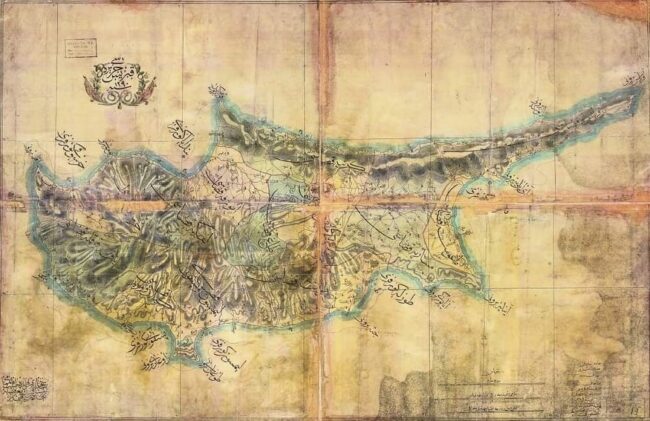
The recent English translation of Hanna Diyab’s Book of Travels has made accessible to a wide audience his adventures in Cyprus during a short stay in May 1707. The nature of this historical source may seem to lie outside the range of concerns normally covered by the writers and readers of The Ancient Near East Today. However, Diyab’s vivid account sheds a rare spotlight on Cyprus even as it may help to illuminate enduring patterns of mobility, economy, trade, everyday life, and intercultural communication. As we will see below, his text offers food for reflection on archaeological or historical matters of earlier, less well-documented periods in the life of this important eastern Mediterranean island. This short essay aims at highlighting the importance of this source. While the Book of Travels is a delectable piece of travel-literature, it also complements traditional textual sources of the 18th century — a period of increased and systematic interconnections between western Europe and the Ottoman Empire, of which Cyprus was a vital, yet wretched, part since 1571.
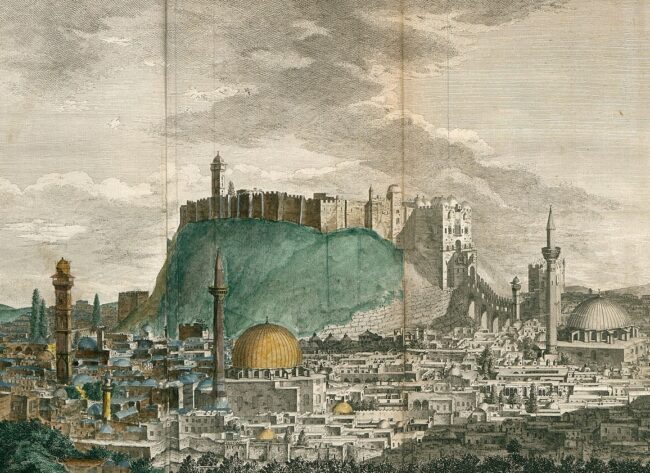
Born ca. 1687, Diyab was a polyglot Maronite Christian from Aleppo, Syria, who between 1707 and 1709 worked as personal assistant and translator for Paul Lucas, a French royal collector traveling in the eastern Mediterranean in search of treasures (coins, medallions, gems, inscriptions, rarities), often acquired with illicit or questionable methods, for the court of Louis XIV. Lucas lured Diyab to work for him with the promise of permanent employment in France. In Diyab’s travelogue, the extensive travels of these two men cover a long distance and after several beautifully narrated adventures they culminate in Paris. While waiting for employment, Diyab became a valuable source of tales for Antoine Galland, the compiler and editor of the famous Thousand and One Nights. He also had an audience with Louis XIV himself and functioned as a living Wunderperson, or living exotic curiosity, during his visit to Versailles.
It makes sense that Diyab’s account — compiled decades after his return to Aleppo in 1709 — has attracted more interest recently from historians of Arabic literature and specialists in the prehistory of orientalism in western Europe. The manuscript, written in a lucid idiom of Middle Arabic, was discovered in the Vatican by the Arabist Jérôme Lentin in 1993. In 2015, a French edition and translation came out, followed by a facing-page translation and commentary in English in 2021 (paperback in 2022), my source for the following commentary.
Diyab’s narrative about his visit to Cyprus is contained in the third chapter of his manuscript, titled “My first time at sea with Paul Lucas, in the month of May 1707.” Diyab and his employer arrived at Larnaca on May 5, 1707. This was the first time he had traveled so far away from his homeland in Syria. In this active cosmopolitan port of many languages and ethnicities, he immediately experienced a culture shock of sorts.
Not long after their arrival on Cyprus, the two travelers visit Nicosia, traveling through a landscape Diyab describes as lush with vegetation, well-watered (“as though we were strolling in a garden”), and replete with vineyards, wheat fields, and noisy herds of swine.
At Nicosia, the two travelers lodge at a Franciscan monastery, hosted by the monastery’s priest, who immediately departs on urgent business to Larnaca. When left alone at the monastery, Diyab takes care of the only inhabitant left at the monastery, a very old man who introduces himself as a Maronite, “one of the last remaining descendants of the Maronites who lived in this island when it was under Venetian rule.” He also experiences the hostility between Greek Orthodox and Catholic populations of Nicosia and gives vivid testimony to the Greeks’ hatred and suspicion of the Catholics and vice-versa.
It is a Greek Catholic who takes Diyab around Nicosia: “I could see that Nicosia was a grand city but that most of its buildings were in ruins.” Even in this state, Nicosia is an impressive, bustling city. They visit and marvel at the Ottoman Selimiye Mosque (Hagia Sophia before 1571), one of the most voluminous and imposing buildings Diyab had ever encountered. As they wander around Nicosia, Diyab gives a detailed account of the city and its commercial activities while commenting on the obvious inequalities of its population. Though not unparalleled, Diyab’s testimony vividly describes the wretchedness of the grassroots Cypriot populations under Ottoman control in the early 1700s. The contrast with his perception that the natural and productive landscape of the island justifies its reputation as the “Green Island” could not be sharper. It seems that this impression left an indelible aftertaste in his memory when several decades later he composed his manuscript from the spatial, temporal, and psychological distance of half a century.
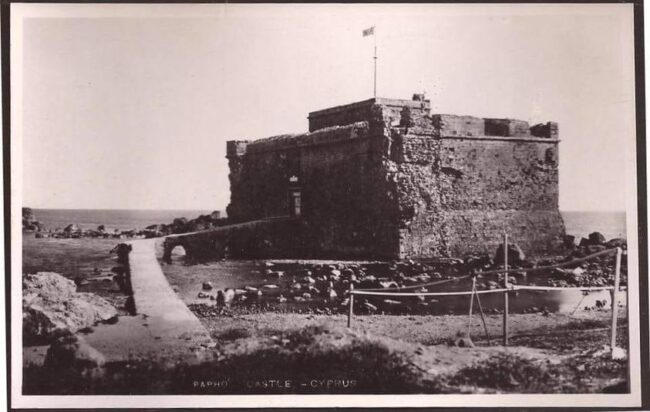
The chapter concludes with Diyab and Paul Lucas boarding a French commercial ship bound for Egypt. In the beginning of chapter four, titled “Our Voyage to Egypt and What Happened to Us in the Month of June 1707,” the French ship first calls at Paphos on the west coast of Cyprus, then at Limassol. Diyab writes that the port at Paphos was in a ruinous state, which can be taken as an indirect yet poignant comment about the neglect of the island’s productive infrastructure under the Ottomans. The reason for calling at Paphos was that “the captain aimed to load the ship with bitumen and tar from the port. There was a bitumen deposit in the mountains, which the mountain folk would gather and sell, using the revenue to pay the miri tax.” The port was empty, except for “the tax official and his men, and a few peasants harvesting the bitumen and tar.”
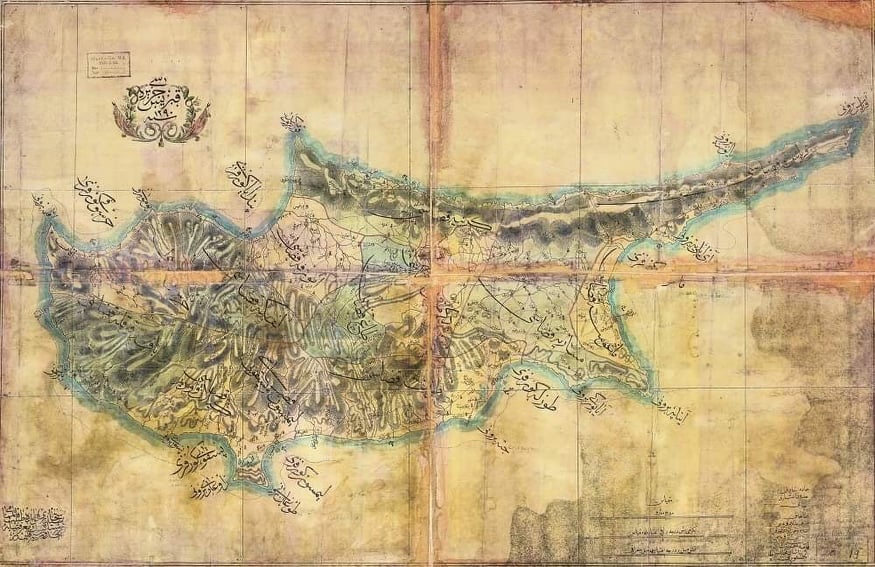
The mention of “bitumen and tar” for the cargo of the Egypt-bound ship raises several questions. The collocation “bitumen and tar” in the English translation leaves no doubt that in the original Arabic manuscript the translator understood the well-known mineral that abounds in several locations around the Middle East. Its usage there is archaeologically attested since the Neolithic period, when this asphalt-like mineral was used in art and architecture. However, it is a fact that Cyprus nowhere possesses deposits of bitumen and tar. Neither has this been the case in the long history of the island’s habitation. If the translation is correct, its testimony about a valuable mineral source in the beginning of the 18th century would be invaluable. But I do not think this is the case. The Egypt-bound cargo ship sought to load another material, which at the time may have been even more valuable than bitumen and tar.
Given that Hanna Diyab is usually a reliable witness about his travels and his experiences around the Mediterranean, I suspect that he used an Arabic term that could have been used for the usual meaning of “bitumen and tar.” But what? Frustratingly enough, I am not a speaker of Arabic; I therefore asked the expert opinion of a specialist, Dr. Phillip Westo Stokes, at the University of Tennessee at Knoxville, whom I thank for his eagerness to answer my question. Here is his kind response to my query, from August 2024:
Dr. Philip Weston Stokes, personal communication
Dr. Stokes’ kind commentary corroborated a hypothesis I had already formulated in May 2024, when I was conducting research on things BCE at Polis tis Chrysochou, north of Paphos (ancient Marion/Arsinoe). One fine morning at breakfast, Mrs. Despoina Nikolaidi, the very hospitable mother of my equally hospitable landlady, urged me to try her cookies flavored with terebinth gum (μαστίχα τριμιθιάς). The cookies were indeed mostly delicious in the unusual way one encounters in Cyprus, when flavors take their time to introduce themselves to you and to your palate, and when they are done, you sense the intensely delicious freshness of the never-before-experienced.
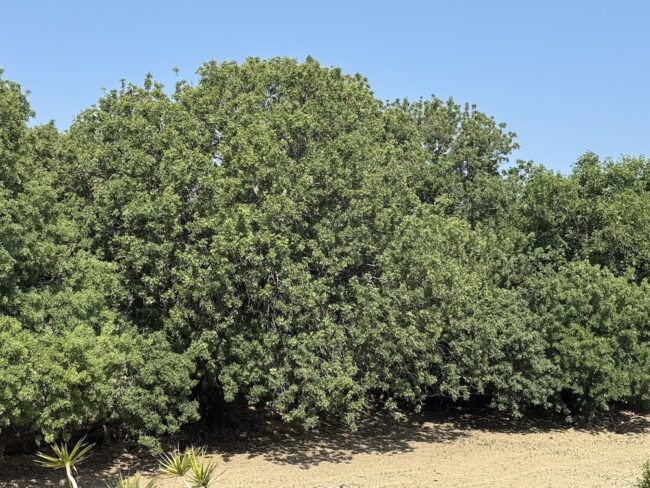
“I had no idea that trimithia produces a resin that flavors cookies or other baked products,” I said, pleasantly surprised. I was of course familiar with the term “trimithia” because in Cyprus it is a very common place name. I also knew that the trimithia (terebinth) is a tree species (Pistacia terebinthus); actually, the conversation with Mrs. Despoina took place against the lush backdrop of a field of trimithia trees adjacent to the veranda. They were ancient and robust, profusely foliated and sprinkled with minuscule blooms that kept changing shades as the sun moved higher in its celestial course.
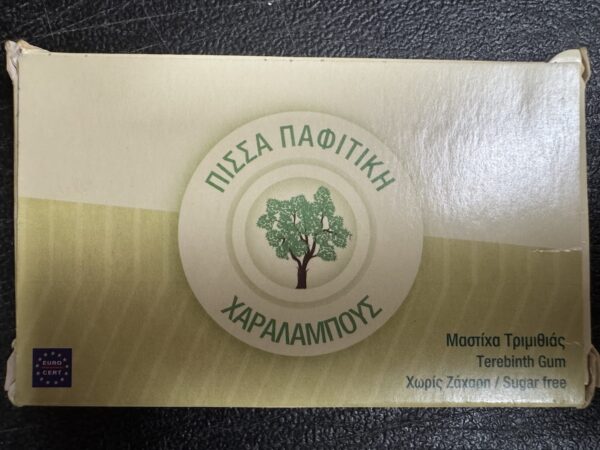
“What does it look like?” I continued my query about the flavoring. “It is like masticha,” she said, “you know, the masticha of Chios,” somewhat puzzled by my ignorance, given that she knew that I had been returning to Cyprus since the late 1980s and I should have known better than to be ignorant of terebinth gum. “Haven’t you ever heard of pissa paphitiki?” she asked. “Tomorrow, I will bring for you a box to see what it looks like and how it is packaged and sold in the grocery store.”
Mrs. Despoina’s mention of pissa paphitiki (πίσσα παφίτικη) made me experience an “aha!” moment, one still flavored by the lingering taste of her cookies in my mouth. Is it possible that what the French ship loaded at Paphos more than three hundred years ago was terebinth resin instead of bitumen and tar? Isn’t it much more plausible that this is what the poor peasants freely harvested in the wild countryside of Paphos area in the hopes of raising some revenue to pay the oppressive miri tax? Apparently, in local parlance the product known as terebinth resin or gum or mastic (μαστίχα τριμιθιάς) is referred to widely as pissa, a term used in colloquial Greek to refer to tar or asphalt, especially the material used either as a binder in paving roads with asphalt or for repairs. It is pitch-black and miserably sticky and always evokes unpleasant childhood memories when in the 1970s one would frequently encounter it in beaches as a tremendously annoying byproduct of shipwrecks or leaks from ships deposited by the waves. A lump of pissa could ruin a day’s fun on the beach and the only way to remove it from your skin was to rub the smearing with nefti, incidentally a byproduct of terebinth oil. The term pissa always refers to dark things or states (e.g. σκοτάδι πίσσα: pitch-black darkness) but I suspect the Cypriot idiom has adopted it because of its gooey (soft and wet and sticky) nature.
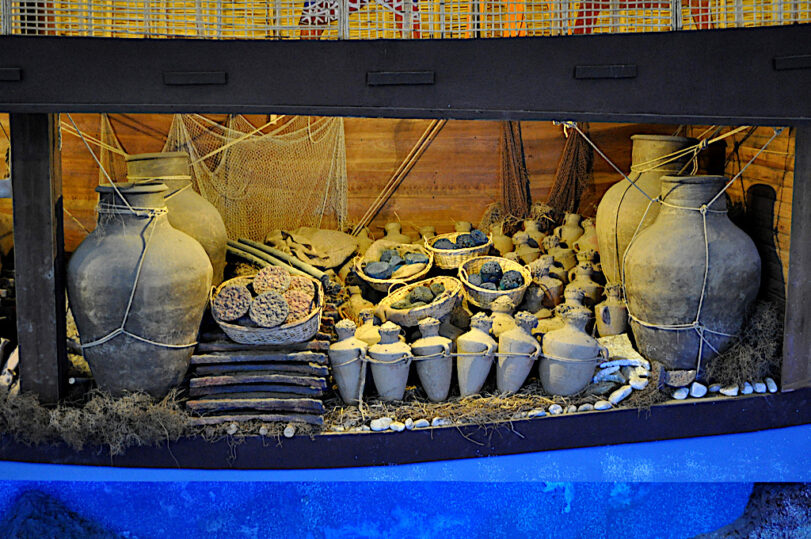
After this conversation, I set out to learn about the beautiful tree and its products, and discovered that its harvesting in the Mediterranean goes back to at least the Bronze Age. In fact, the major bulk of the cargo on board the famous Uluburun shipwreck was terebinth gum (one ton across approximately 130 Canaanite amphoras). This has been dealt with in wondrous detail in a doctoral dissertation by Claire Patricia Peachey supervised by the legendary George Bass, a pioneer of underwater archaeology in the Mediterranean — unfortunately this thesis has never been published, but it is a treasure trove of information. Besides carefully assessing the numerous amount of terebinth resin in the famous shipwreck, which scholars are still trying to understand, Claire Peachey collects all the ancient references to terebinth and its resin and addresses in detail its valuable uses — medicinal, aromatic, and culinary, among others. (This note, unfortunately, cannot go into more details about the marvelous byproduct of an equally marvelous tree that thrives in Cyprus and elsewhere around the Mediterranean.)
If indeed the Egypt-bound cargo ship was loaded with terebinth resin, it could have conformed to a very ancient trade pattern between Cyprus and Egypt or other destinations around the Mediterranean. But I leave it to experts to assess the quantitative nature of this trade and its economic and social consequences throughout the ages. Returning to the translation, it is very possible that Hanna Diyab, propelled by curiosity and his innate drive to learn as much as possible about the world, asked locals about the cargo (he was fluent in Ottoman Turkish) and the response he got registered perhaps a paraphrase or even a literal translation of the local word pissa, which ended up in his manuscript as qaṭirān (tar) and zift (bitumen). I have no doubt that Diyab knew exactly what this cargo was — he would have had a chance to look at the harvested product as it was loaded onto the French ship. It is probable that he was not familiar with terebinth resin or, at the moment of writing down his manuscript, had only a vague recollection of the ship’s cargo. He was not really interested in it. He was interested, rather, in the wretchedness of the local population which had to resort to the exploitation of a generous yet deserted countryside, to survive the extortionary conditions of the Ottoman regime.
His narrative may not be as enchanting as the material which ended up in the Thousand and One Nights, for which Hanna Diyab is now celebrated as a major contributor, if not inventor of major stories. But Diyab’s travelogue provides a vivid eyewitness account of life and society in Cyprus in the early 18th century even as it illuminates the diachronic character of trade, mobility, and society in the eastern Mediterranean. His text calls for attention and scrutiny, a detailed commentary, and critical appraisal for the light it sheds on Cyprus during a difficult moment of its long history.
Nassos Papalexandrou is the David Bruton, Jr. Centennial Professor in Art History at The University of Texas at Austin.
Further Reading:
Creswell, Robyn, “On the Road,” The New York Review of Books, October 7, 2021, 35-37.
Diyab, Antun Yusuf Hanna, The Book of Travels, edited by Johannes Stephan, translated from the Arabic by Elias Muhanna. New York University Press, 2021 (hardcover in 2 vols) and 2022 (paperback).
Diyab, Antun Yusuf Hanna, D’ Alep à Paris: Les pérégrinations d’un jeune Syrien au temps de Louis XIV, translated and edited by Paul Fahmé. Actes Sud, 2015.
Papalexandrou, Nassos, “Hala Sultan Tekke, Cyprus: An Elusive Landscape of Sacredness in a Liminal Context.” Journal of Modern Greek Studies 26.2 (2008) 251-281.
Peachey, Claire Patricia, “Terebinth resin in Antiquity: Possible uses in the Late Bronze Age Aegean Region.” Dissertation, Texas A&M University, 1995.
How to cite this article:
Papalexandrou, N. 2026. “Cyprus Through Syrian Eyes: Reflections on Hanna Diyab’s 1707 Travels“, The Ancient Near East Today 14.10. Accessed at: https://anetoday.org/hanna-diyab-cyprus-travels/.
Want to learn more?

Who Were the Sea Peoples? And Did They Bring About the End of the Bronze Age?


Post a comment