Treasures in Tunis: An Archaeologist’s Guide to the Bardo National Museum
november 2026 | Vol. 14.11
By Helen Dixon
The Bardo National Museum in Tunis is the largest museum in Africa outside of Egypt. Holding key patrimonial collections in Tunisian archaeology and history, the museum was established in 1888 and occupies a former royal estate founded in the 15th century by the Hafsid dynasty. The museum complex is a stunning work of art in its own right—a pastiche of different chapters of Tunisian history. It has been gradually reopening since September 2023, after being closed for two years in the wake of Covid-19 and following several reinstallations in key gallery spaces. I recently had the pleasure of revisiting the museum, in the process of writing a review on the museum’s reopening for the American Journal of Archaeology. From the perspective of a Phoenicianist, the Bardo Museum is a key stop on a Punic pilgrimage that includes Carthage, Kerkouane, Sousse, and other sites. But the Bardo has much to offer beyond Punic artifacts; it is a veritable treasure house of material culture spanning Tunisia’s history from the prehistoric to the Ottoman periods. Many visitors only have a couple of hours to spend before they are whisked away to Tunisia’s other heritage attractions as part of structured tours, but the collection deserves a full day for the dedicated visitor (with an enjoyable break for lunch in the museum courtyard’s Café Andalusia). Below, I offer a list of 12 objects, exhibits, and experiences that I think deserve extra lingering.
1. Winged Priestess of Carthage Sarcophagus (4th or 3rd centuries BCE)
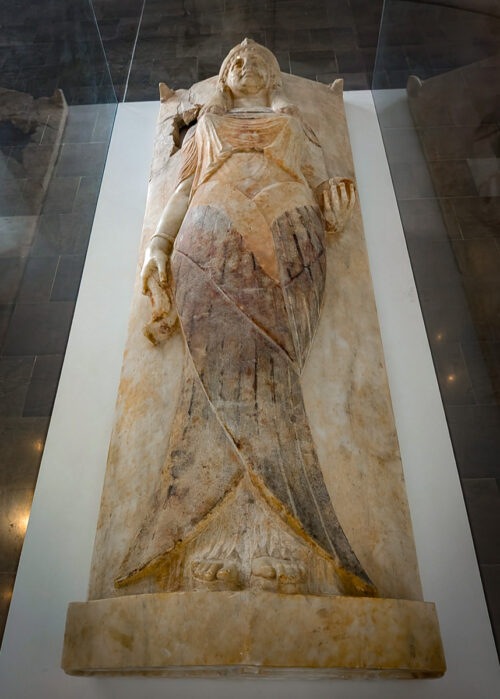
Painted stone (marble) Punic sarcophagus with a relief on the lid depicting a woman (priestess?) whose lower body is wrapped in wings. From the “Necropolis of the Rabs”, Carthage, 4th or 3rd century BCE. Photo by Helen Dixon.
This incredible stone sarcophagus with traces of colorful paint was made for a Carthaginian, long assumed to have been a Punic priestess of the 4th – 3rd centuries BCE. It was found by Alfred-Louis Delattre while excavating the “Necropolis of the Rabs,” a Punic-era cemetery in Carthage discovered in 1897. Four stone sarcophagi depicting two male and two female figures were found at the site, but the winged lady is the most famous and the only one held by the national Bardo Museum. The wings across her hips and legs are likely meant to evoke a divine attribute, possibly the wings of Isis, and she holds two items, perhaps sacred tools of the priesthood.
2. Depiction of the Libyan / Numidian Pantheon (2nd or 1st centuries BCE)
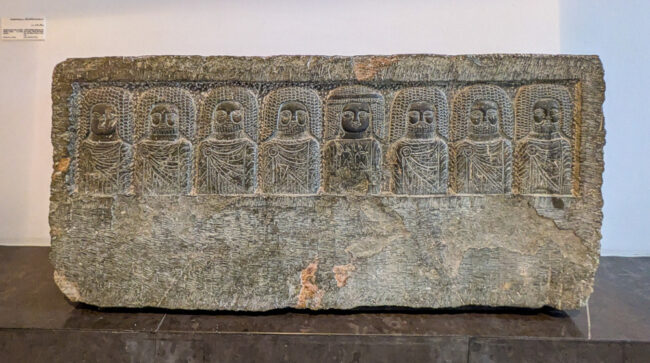
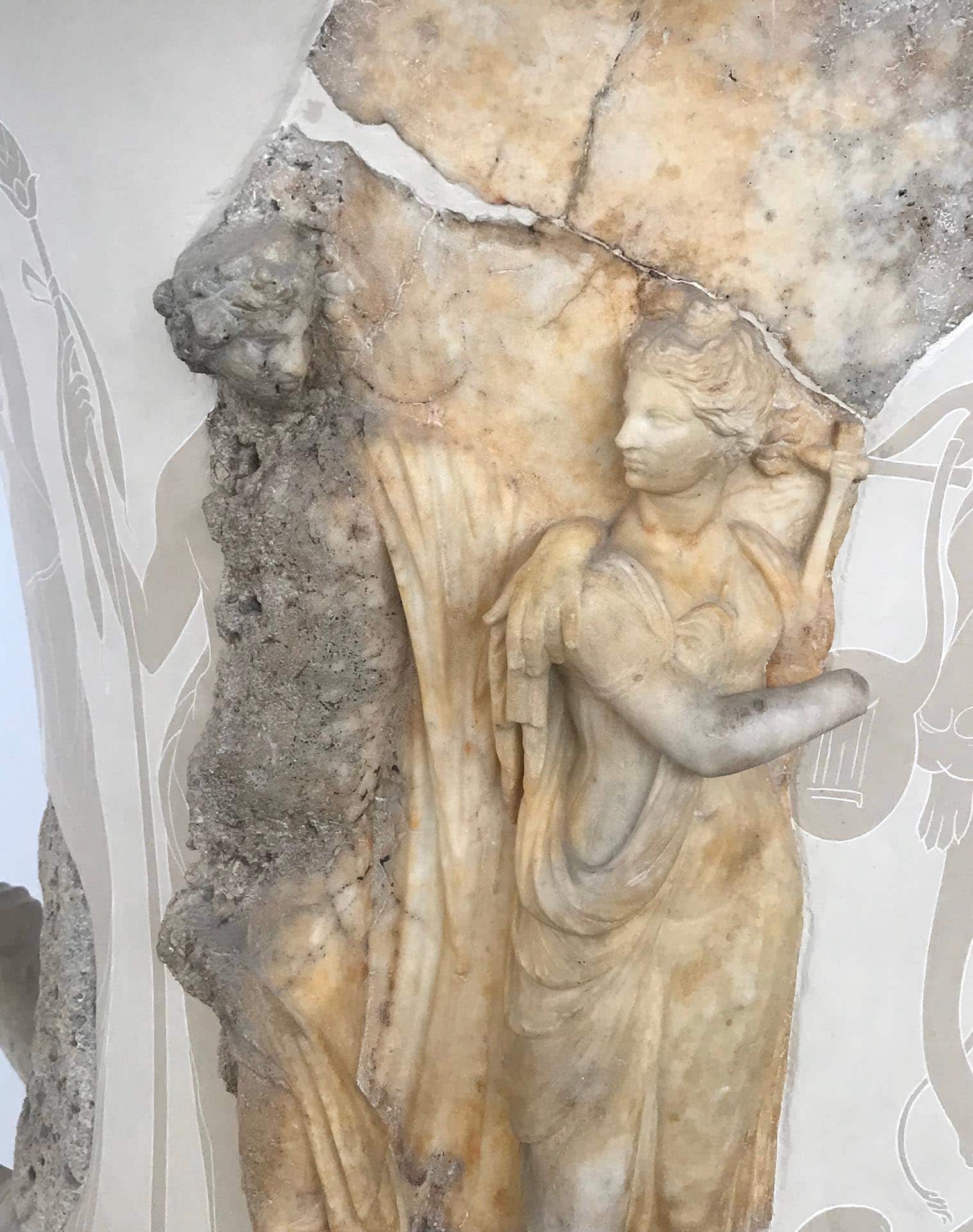
Relief stele depicting a Numidian goddess in the center flanked by a group of seven male gods. From Chemtou, Tunisia, ca. 2nd or 1st century BCE. Photo by Helen Dixon.
Scholarship on the ancient Libyan or Numidian world (in today’s northern Algeria, Tunisia, and Libya) is developing rapidly but is not yet widely known outside of the subfield. This arresting pantheon relief from Chemtou, Tunisia, has been dated to the 2nd or 1st century BCE. A goddess with a diadem stands at the center, flanked by a group of seven male gods. More than 50 deity names are attested in inscriptions in Numidian (represented with the Numidian / Libyco-Berber script), Punic, and Greek, including names like Fudina, Macurgum, Vihina, and Vacurtum. Most depictions of the pantheon feature between three and eight divine figures, with a lot of localized variety.
3. A Feast for the Eyes: Salle des Trésors
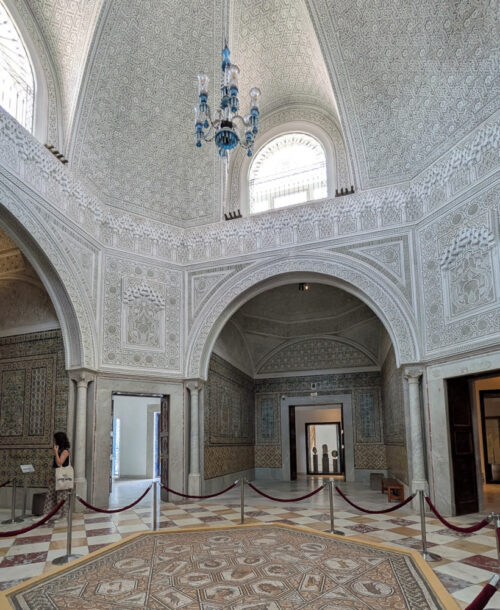
The center of the Salle des Trésors with its plaster dome carved with ornate patters; on the floor in the center is a 3rd century CE mosaic from Bir Chana (near Zaghouan, Tunisia). Photo by Helen Dixon.
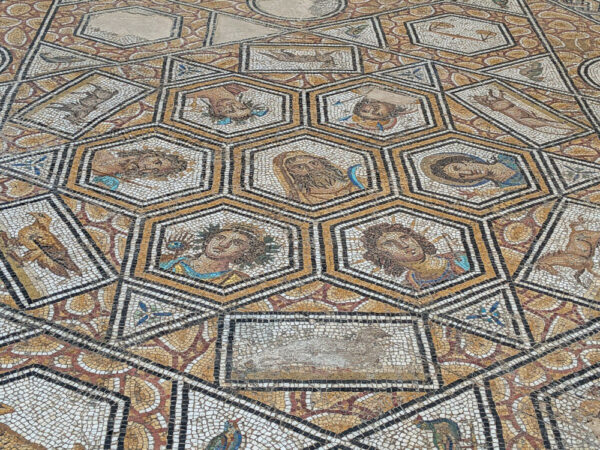
Detail of a mosaic depicting gods representing the days of the week and signs of zodiac. From Bir Chana, ca. 3rd century CE. Photo by Helen Dixon.
The Bardo is filled with spaces where ancient artifacts are framed by and juxtaposed with more recent architectural marvels, such as this one. An intricate mosaic, depicting symbols of the zodiac and gods representing the seven days of the week, sits under a soaring 19th-century vaulted dome made of plaster and carved with intricate patterns. Each alcove off the room holds another treasure to explore (giving the space its name), and the tiles on the floor are of many different marbles from around the Mediterranean world. Overhead a blue and clear glass chandelier hangs, emphasizing blue details in the 3rd-century CE mosaic from Bir Chana (near Zaghouan, Tunisia) below. Walking through the Bardo goes slowly since the space is as interesting as the objects!
The exterior portion of Punic gold textual amulets: gold tubular cases capped with god’s heads. Excavated from tombs in Carthage. Photo by Helen Dixon.
Tucked away in the corner gallery of the Salle des Trésors is a display case holding seven small gold cases and four tiny gold scrolls (lamellae) that represent the largest collection of Phoenician textual amulets in the world (only about 20 complete examples have survived across Spain, Malta, Lebanon, and Tunisia). The inner lamellae are typically covered in minuscule images of gods (usually 36 “decans,” representing deities associated with the small constellations used to track time across the night sky in Egypt and in the Phoenician world), and/or a Phoenician inscription calling on the gods to protect its wearer. The lamella would be tightly rolled up and inserted into the tubular case, capped with a god’s head (typically Sekhmet or Horus) and then worn around the neck.
5. Le Petit Palais (constructed 1831 – 1832)
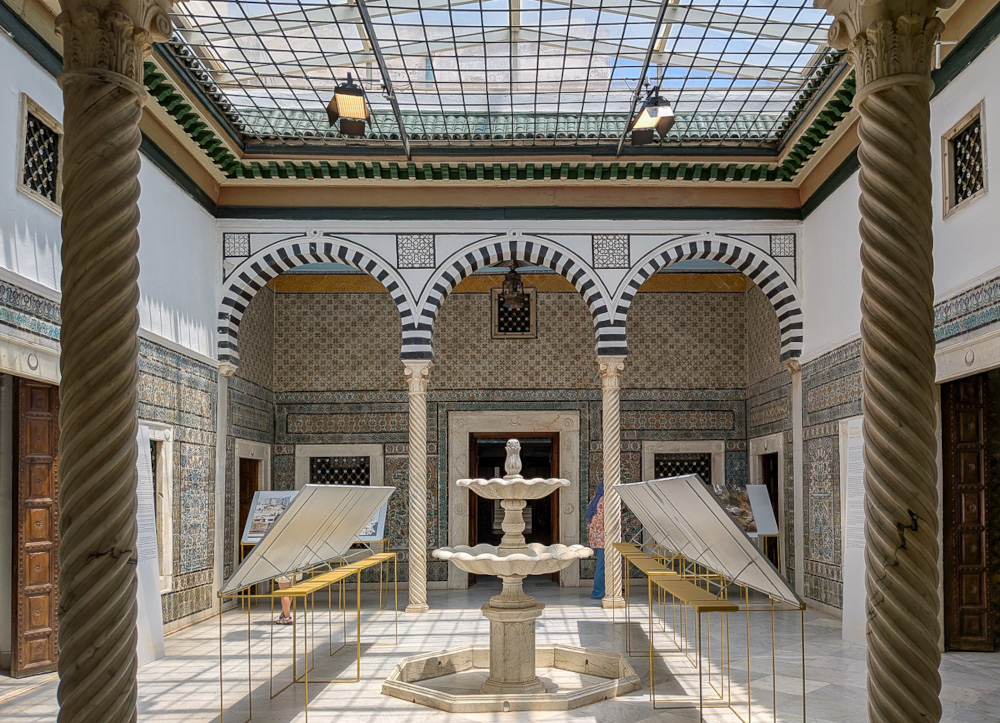
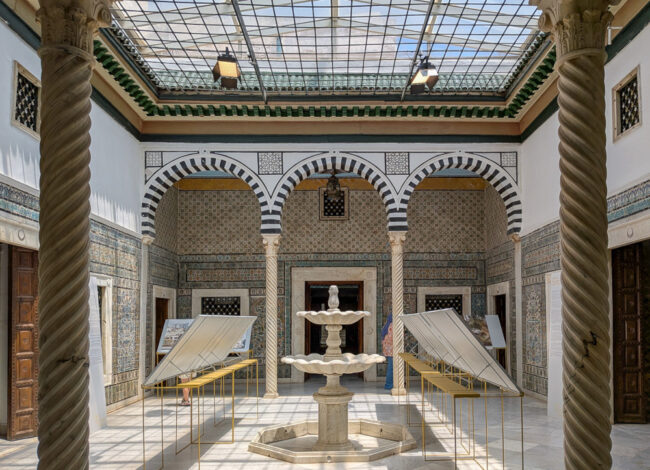
Courtyard of “Le Petit Palais”, constructed 1831-1832. Photo by Helen Dixon.
At the center of the Bardo Museum building is a beautifully preserved 19th-century royal suite, a series of rooms built by Hussein II Bey (in power from 1824 to 1835) to serve as the secure private quarters for his family. This “little palace” is used as a temporary exhibit space, but the hand-painted tiles, lattice window coverings, stone courtyard fountain, upholstered couches, painted ceilings, and other embellishments make it an artistic and architectural highlight.
6. Funerary Mosaic for a Little Girl (ca. 5th century CE)
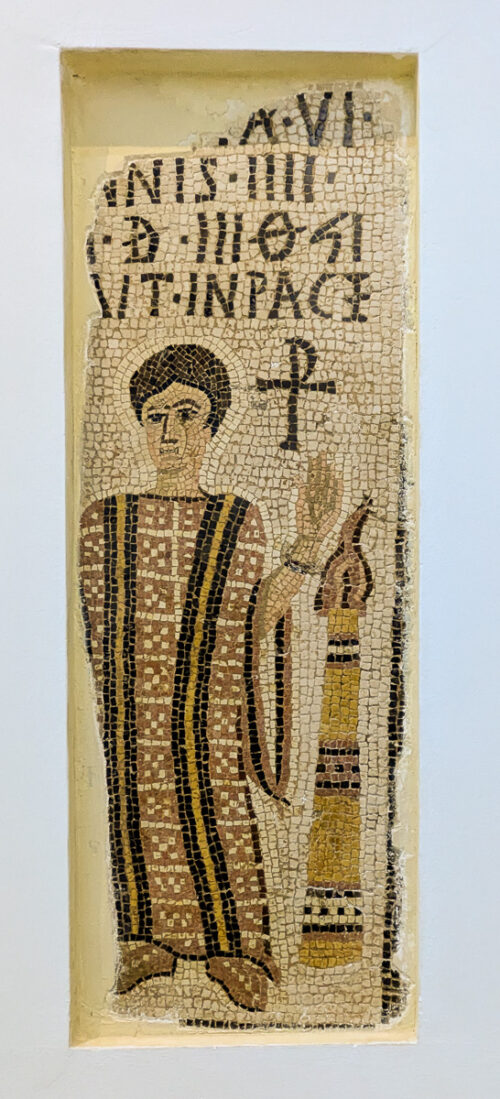
Mosaic panel depicting a young girl, which marked her tomb in a Christian necropolis at Merghani (near Sfax, Tunisia), ca. 5th century CE. The inscription indicates she died just shy of 5 years old. Photo by Helen Dixon.
The Bardo is the home of perhaps the world’s largest collection of mosaics, which are installed salon-style up the entire height of the walls and even under guests’ feet across the floors. In all these mosaics, it is easy to focus only on the biggest and most impressive — but what stuck with me were the small and personal mosaics. This Late Antique example from a Christian necropolis at Merghani (near Sfax, Tunisia) was made to mark the sarcophagus or tomb cover of a little girl whose short life is measured down to the hour: 4 years, 11 months, 3 days, and 7 hours. Despite her young age, she is depicted solemnly standing in a pious pose with a Chi-Rho cross and lit candle.
7. Funerary Statue of a Man Dressed as Hercules (2nd – 4th centuries CE)
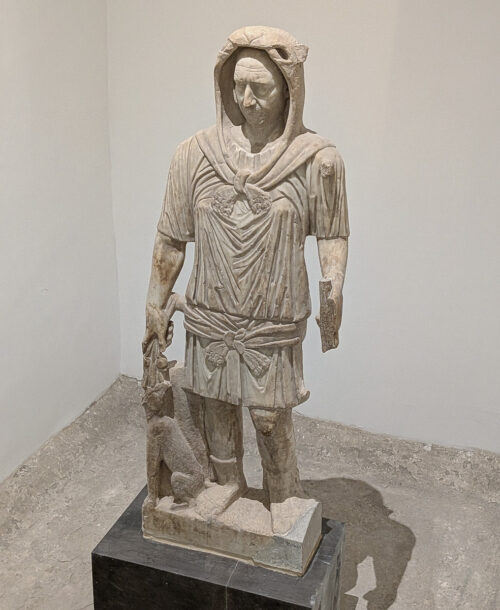
Statue of a man dressed as Hercules in a lion skin, likely meant to adorn a mausoleum. From Borj El Amari, 3rd century CE. Photo by Helen Dixon.
On the ground floor of the museum, the old Hafsid-dynasty cisterns have been repurposed into a unique gallery for displaying funerary monuments and sculpture. Walking along a glass catwalk, one is surrounded by 2nd – 4th century CE sarcophagi and funerary art, some on elevated platforms. The effect is a little surreal, but not unlike walking through a Roman necropolis where various expensive monuments vie for the viewer’s attention. My favorite is this Roman-period funerary statue of an older deceased man from Borj El Amari. Dressed as Hercules in a lion skin with paws tied at the neck and belt, he holds a drooping bouquet of poppies, which a small dog seems to sniff sadly.
8. Pages from the Blue Quran (9th – 10th centuries CE)
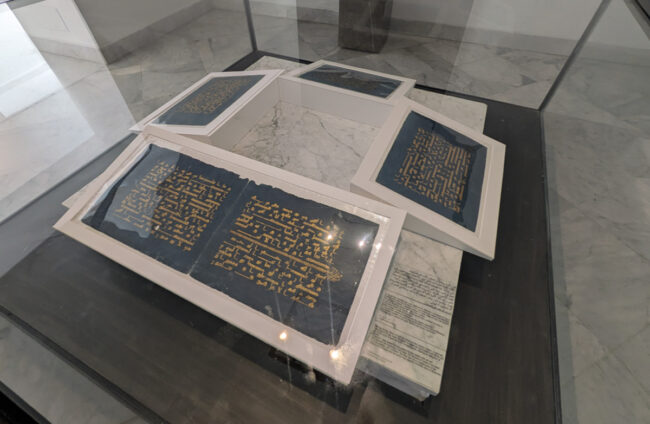
Pages from the Blue Quran, 9th–10th centuries CE. Photo by Helen Dixon.
Another star of the Bardo is the set of folios from the world-famous “Blue Quran” manuscript, written on breathtaking blue indigo-dyed parchment with gold ink in Kufic script (a bold, angular style of Arabic calligraphy named for the city of Kufa, Iraq) in the 9th or 10th century CE. The ink was fixed with egg white and outlined in brown ink to ensure perfection. Each surah is punctuated with red and blue ink on golden leafy scroll decoration, and silver rosettes were used as verse dividers. This Quran was used in the Great Mosque at Kairouan, Tunisia, where it appeared in an inventory of manuscripts as early as 1300 CE. More than 100 of its 600 or so folios remain in Tunisia today, although the manuscript’s origins are debated.
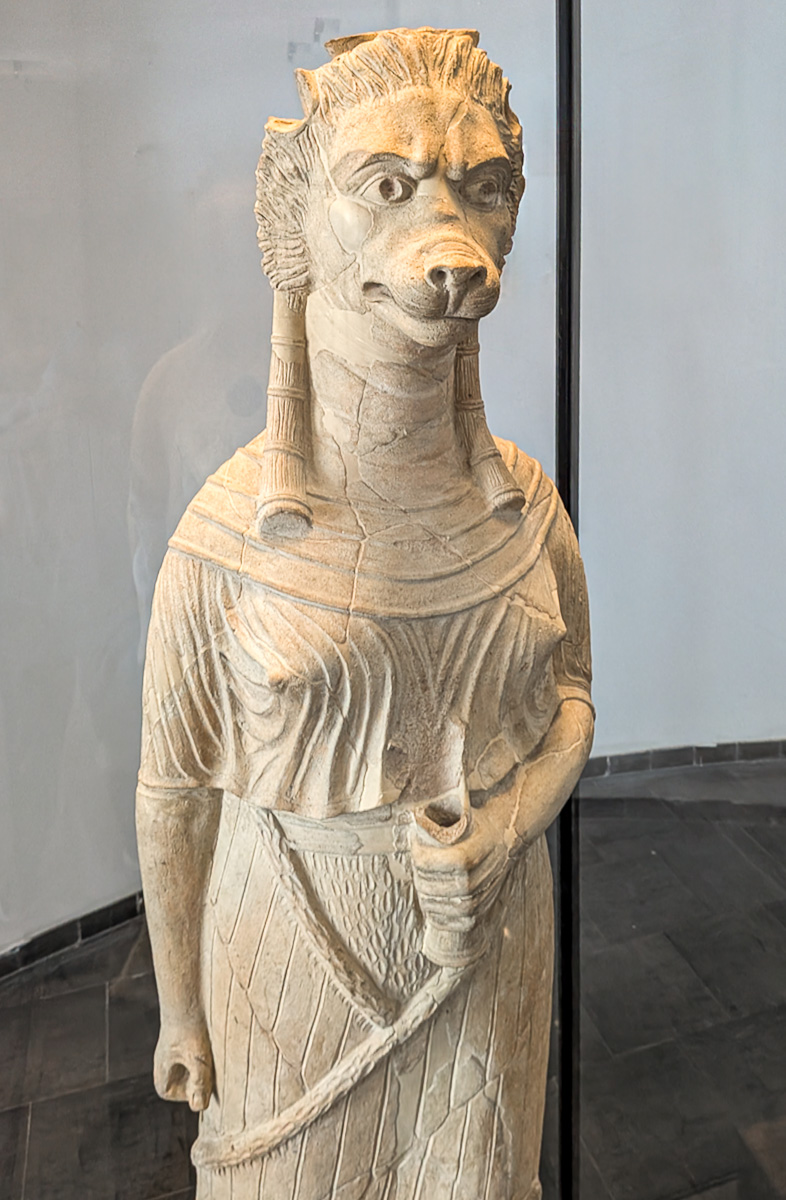
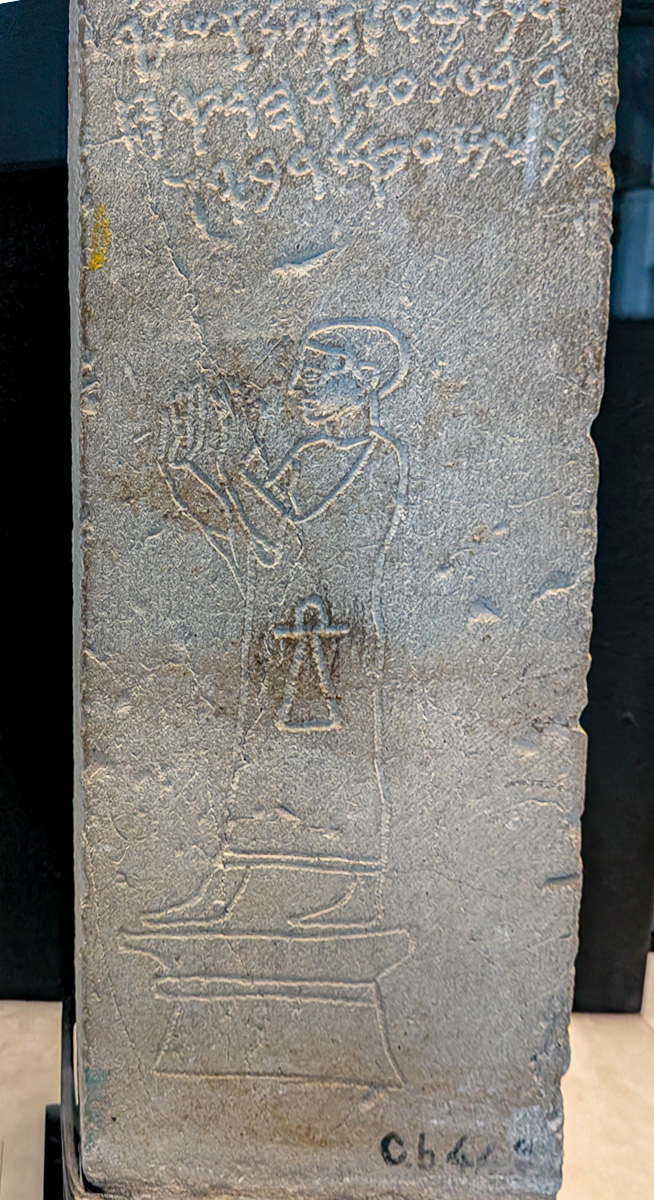
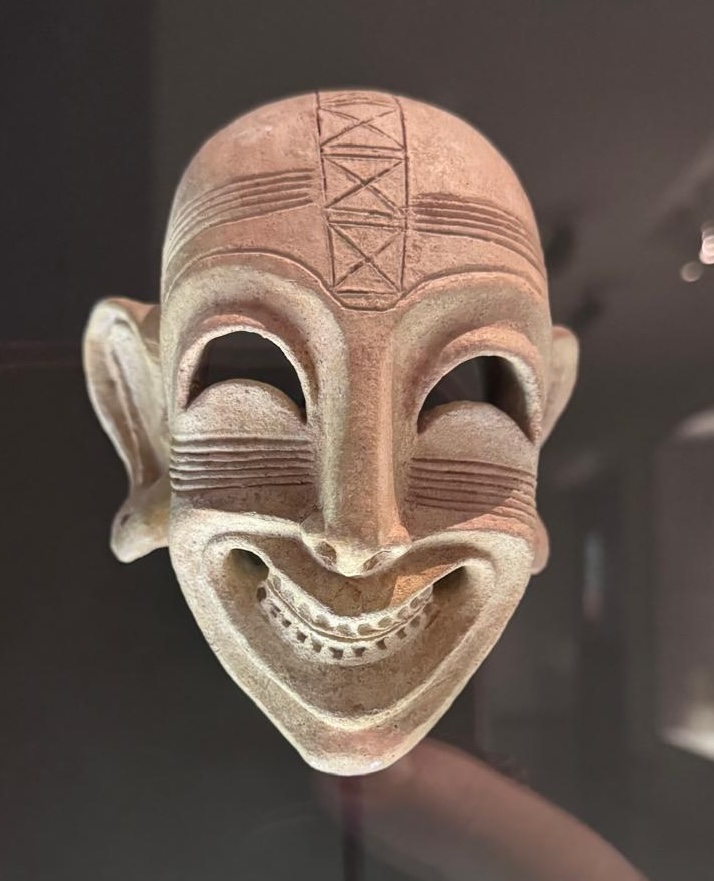
I already mentioned the winged-woman sarcophagus, but the Punic galleries have so much fascinating Punic material from Carthage and other coastal sites, that it is hard to choose. Other highlights include a terracotta statue of what must be a goddess with the head of a lion (perhaps depicting the goddess Tanit as Sekhmet); stelai from the so-called Tophet, marking the dedication of the cremated remains of human and goat infants to the deities Tanit and Ba‘al Hammon; and the grinning masks from the adult necropolis — all of it invites curiosity and contemplation. Most of the archaeological material from the Punic site of Carthage is held by the Carthage National Museum, founded in 1875 on Carthage’s Byrsa Hill just outside of Tunis, but this museum is currently closed for a complete inventory and reinstallation. The show-stopping examples of Punic art at the Bardo are also accompanied by many smaller objects, like votive ostrich eggs, ceramic vessels and incense burners, and glass pendants, which fill out the story of life and death in the heart of the Punic world.
10. Qallalin Tiles (17th – 18th centuries CE)
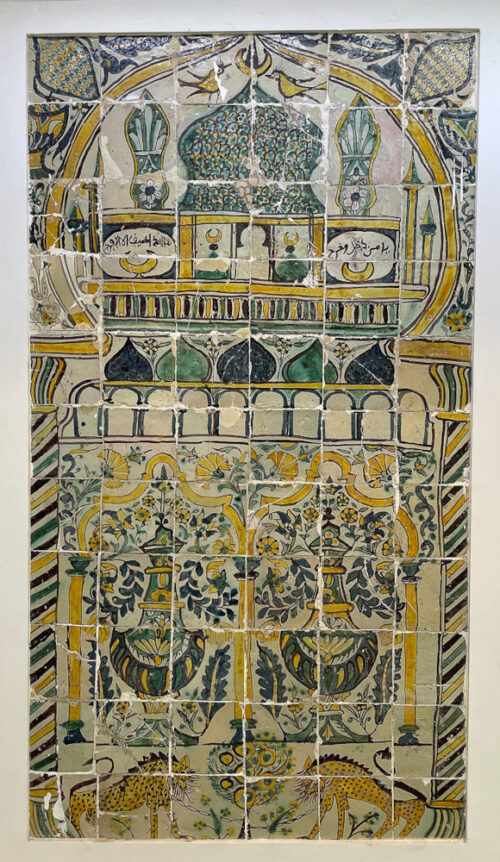
Hand-painted Qallalin tile panel, characteristic of Tunisian architecture of the 17th -18th centuries. Photo by Khalil Mokaddem, CC By-SA 4.0.
This beautiful hand-painted tile panel is called the “Cheetahs Panel” after the predators on either side of the lowest register, and is an example of Qallalin decorative tile, characteristic of Tunisian architecture in the 16th – 18th centuries. But the mosque building at the top illustrates the ways that these colorful works of art also served as expressions of piety. Colorful tile panels like this one were used in the interiors and courtyards of homes and public buildings, as well as in mosques throughout North Africa, with compositional panels linked by simpler patterned tiles. The story of Islamic history told at the Bardo naturally focuses on the significance of the Maghreb in early Islam, highlighting the three Tunisian centers of Kairouan, Mahdia, and Tunis, while text panels talk about the intersection of political, religious, and trade history (including the problem of pirates at the port of Tunis in the 11th – 13th centuries).
11. Odysseus Passing the Sirens (ca. 260–280 CE)
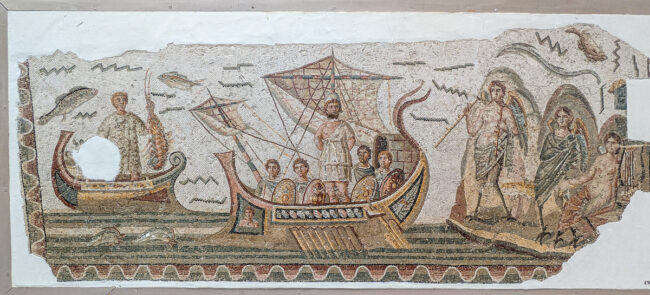
Mosaic depicting Odysseus and the Sirens. From Dougga, Tunisia, ca. 260-280 CE. Photo by Helen Dixon.
I would perhaps be remiss if I did not mention at least one of the Bardo’s more famous mosaics. This evocative depiction of Odysseus (or Ulysses in Latin) tied to the mast of his ship in order to pass safely by the sirens (Odyssey 12.151–200) comes from the House of Dionysus and Ulysses at Dougga, Tunisia, and has been dated to ca. 260 – 280 CE. Images of this mosaic are frequently reproduced in cropped form, only showing Odysseus and his men aboard the ship. However, looking at the whole scene in person allows the viewer to appreciate and puzzle over some other details, like the spindly bird legs of the alluring sirens playing a double flute and lyre (on the right) and the seeming non sequitur of the fisherman presenting his lobster catch (on the left).
12. Cargo from the Mahdia Shipwreck (4th – 1st centuries BCE)
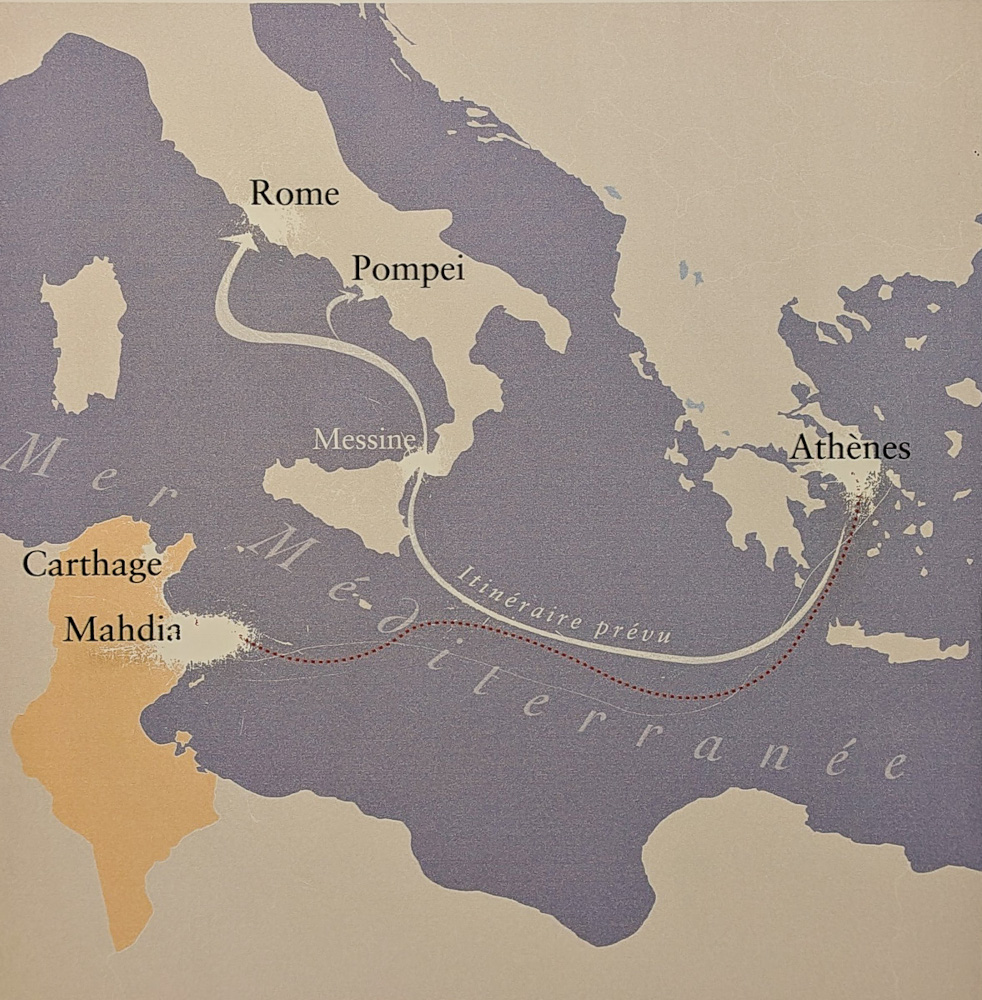
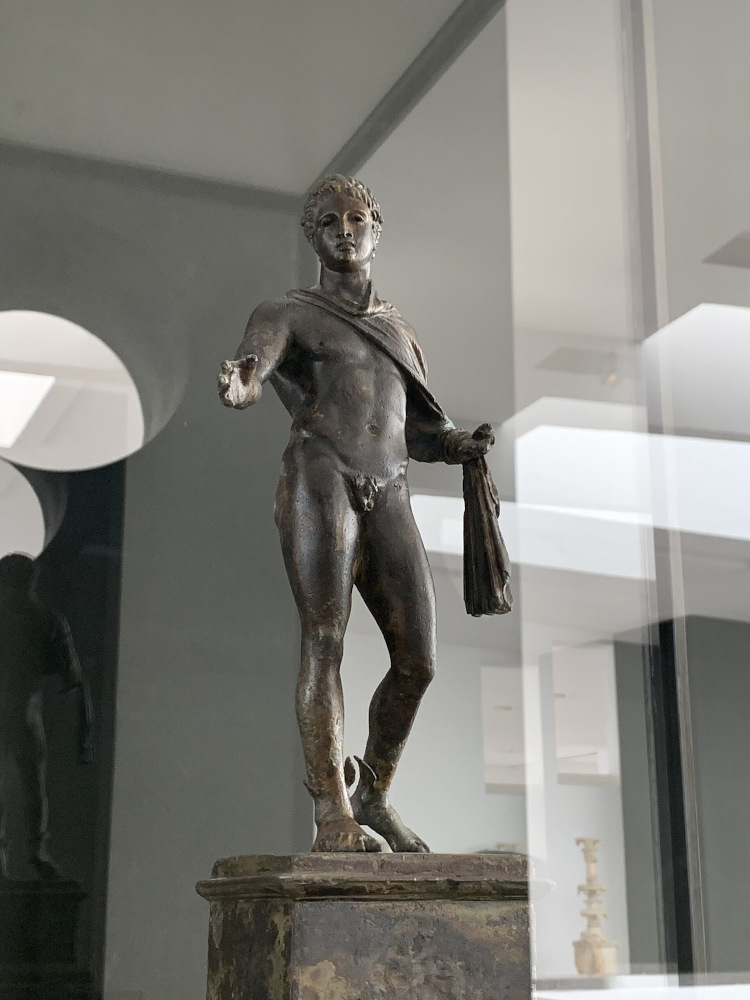
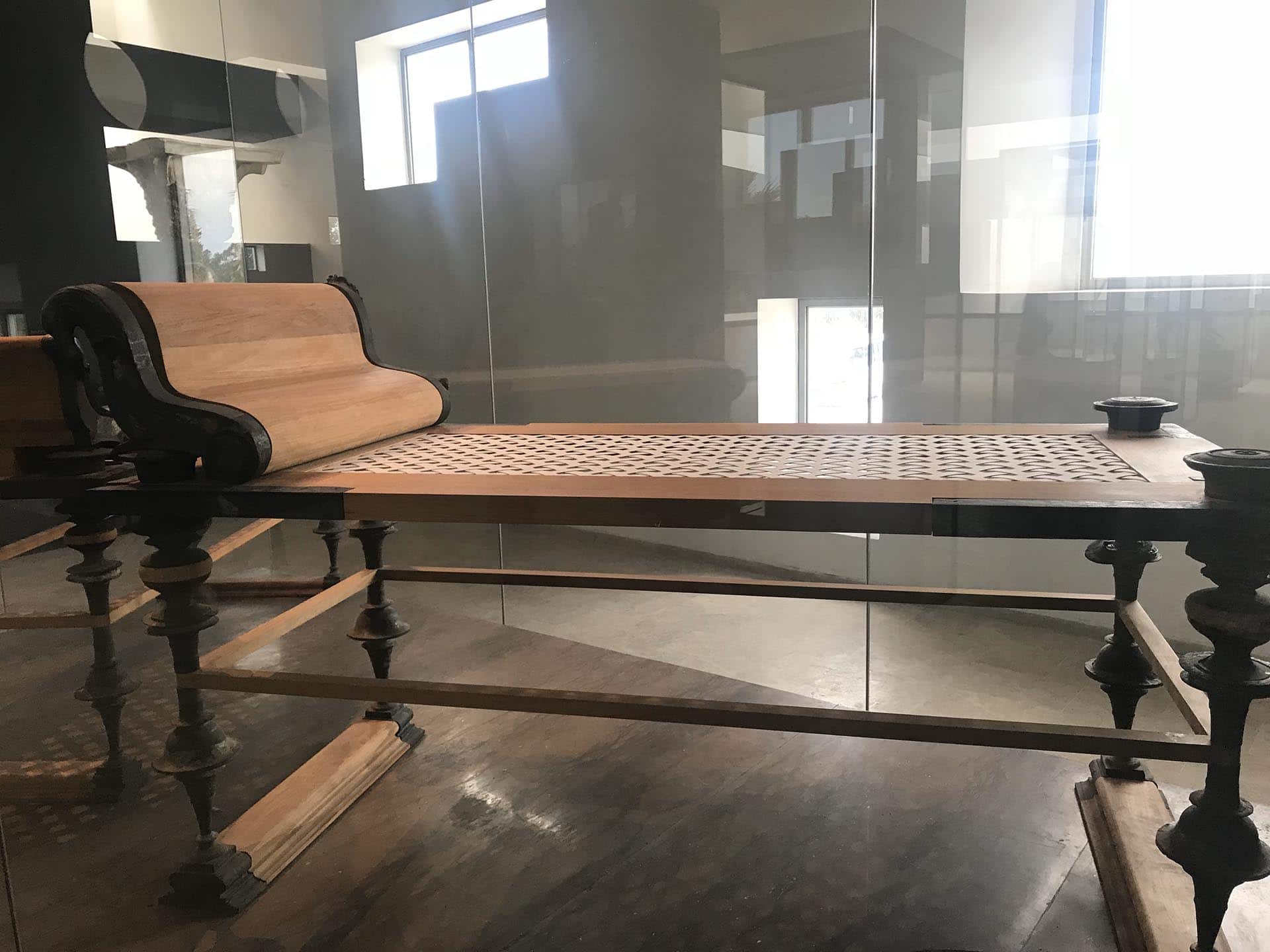
Finally, while not strictly Tunisian material culture, among the unexpected highlights for me was the impressive set of ancient Greek luxury items recovered from a Roman shipwreck discovered in 1907 by sponge divers off the Tunisian coast. Bronze statues, furniture made of wood and bronze, column capitals, and exquisitely carved stone sculpture, dating variously to the 4th – 1st centuries BCE — all seem to have been the cargo belonging to the ancient equivalent of an antiques dealer. The ship is thought to have left Athens between about 90 and 70 BCE transporting contemporary and antique Greek-made art and furnishings, probably intended to decorate a villa in Rome or Pompeii. Rather than heading through the Strait of Messina (the narrow waterway between eastern Sicily and southwest Italy), the ship seems to have been hit by a storm, blown off course, and eventually foundered off the Sahel coast, near Mahdia, Tunisia. I later learned from archival research that Francis Kelsey (the University of Michigan professor who excavated at Carthage in 1925–26) had tried to recruit the U.S. Navy to raise the ship in its entirety, but this plan never came to fruition; to this day the ship remains at the bottom of the Mediterranean Sea. The gallery’s black accent walls with high portal-shaped cutouts evoke the cargo hold of the ship, an immersive way to think about how high-end museum objects sometimes reach modern visitors by a series of accidents.
While these were my favorite moments in the Bardo National Museum, many others come close on their heels: the recreated Roman coin workshop and the hundreds of gold coins found in a hoard at Chemtou, the Campanian breastplate armor, or the 3rd-century CE portrait of Virgil from the so-called House of Virgil at Hadrumetum/Sousse, to name only a few. I fell in love with this collection, the museum itself, and its history, and hope all who are interested have the chance to visit in person.
Helen Dixon is Assistant Professor of History at East Carolina University.
Editor’s Note: Do you have a favorite object or room at the Bardo? Think we missed something? Let us know in the comments!
Learn more about the Bardo Collections:
Aounallah, S. (ed.). 2016. Un Monument, Un Musée: Je Suis Bardo. Tunis: Agence de Mise en Valeur du Patrimoine et de Promotion Culturelle.
Dixon, H. 2026. “The Reopened Bardo National Museum in Tunis, Tunisia.” Commissioned museum review. American Journal of Archaeology 130 (3: July): 467–477. https://www.journals.uchicago.edu/doi/10.1086/742141
Yacoub, M. 1993. Le Musée du Bardo, Départements antiques. Tunis: Editions de l’Agence Nationale du Patrimoine.
How to cite this article:
Dixon, H. 2026. “Treasures in Tunis: An Archaeologist’s Guide to the Bardo National Museum“, The Ancient Near East Today 14.11. Accessed at: https://anetoday.org/archaeologist-guide-bardo-museum/.


Post a comment