What’s in a Style? Minoanizing Paintings in the Eastern Mediterranean
September 2019 | Vol. 7.9
By Constance von Rüden
What does it mean when a particular Aegean style of wall paintings are discovered far from home, from central Anatolia in the north to the Nile delta in the south? Mostly decorating palatial buildings of local “elites,” do these paintings represent similar tastes or do they express a desire to belong to a transregional network? Or do small details suggest the reality is more complicated still?
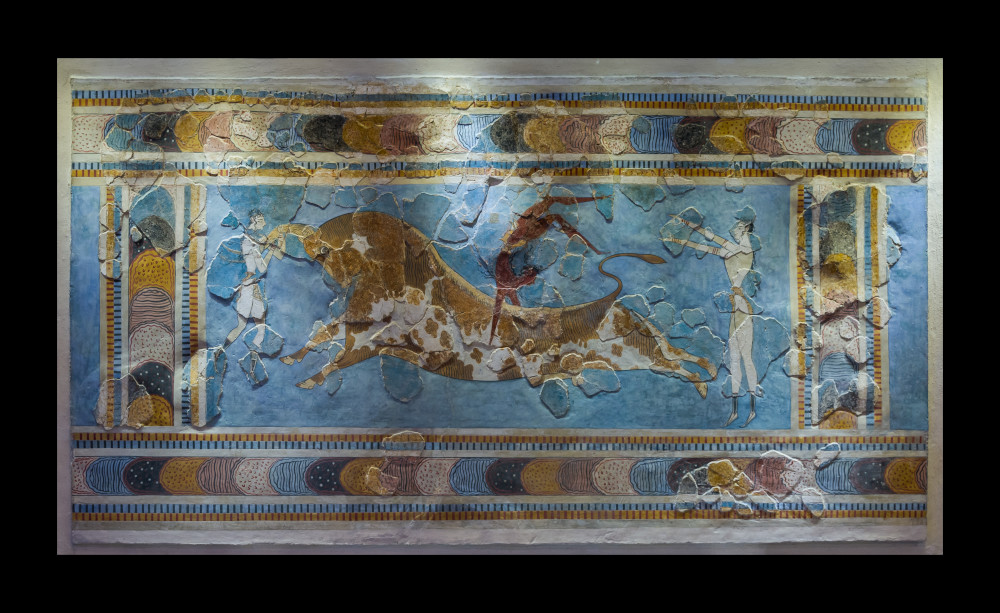
The Minoan culture of Crete became famous with the discovery of wall murals by Arthur Evans at the beginning of the 20th century. Dating to the Late Bronze Age in the mid second millennium BCE, these fantastic paintings decorating the interior of an immense palace and depicted what were assumed to be characteristic Minoan scenes, such as mythological creatures, plants and animals, and the famous and still mysterious sport of ‘bull leaping.’
‘Bull-leaping’ fresco from Knossos, ca. 1450, BCE
https://commons.wikimedia.org/wiki/File:Bull_leaping_minoan_fresco_archmus_Heraklion.jpg
Famed British archaeologist Leonard Woolley found the first very fragmented murals in the palace of Alalakh Level VII in the northern Levant just after World War II. The discovery marked the beginning of what has been a long controversy. Woolley identified different floral motifs, a bull’s horn, architectural imitations and string impressions and immediately related them to examples long known from the Minoan world.
Grass depicted on paintings from Alalakh palace VII. Photo by the author.
But rather than see the murals as being of Aegean origin, Woolley argued for traveling “Asian” craftspeople as the creators of the Aegean murals. His perspective was a classic example of the then current notion of ex oriente lux, the idea that ‘light from the orient’ diffused from east to west.
It was not until the late 1980s that the discovery of wall and floor paintings in the Middle Bronze Age palace at Tel Kabri at the southern Levant led to a renewal of the discussion. Tiny fragments of a miniature landscape scene with obvious Aegean parallels were discovered under a threshold. Unluckily, their fragmentation does not allow anything to be said about the painting’s composition.
Nonetheless, its reconstruction, based on the Miniature Fresco from Thera shifted the origin of the murals into the Aegean as they were finally considered as the product of Minoan craftspeople. This interpretation was perfectly suited to the new dominant narrative about the Minoans, who were portrayed as successful traders and agents for progress.
Reconstruction of a miniature landscape on base of the fragments found at the palace of Tell Kabri. Image courtesy of Wolf-Dietrich Niemeir.
But shortly afterwards, thousands of painted lime plaster fragments were discovered at Tell el-Dabca/Avaris in the eastern Nile delta. The murals were dumped in large secondary deposits in front of a palatial district. Despite the poor preservation of the mural fragments, a broad range of subjects was identified.
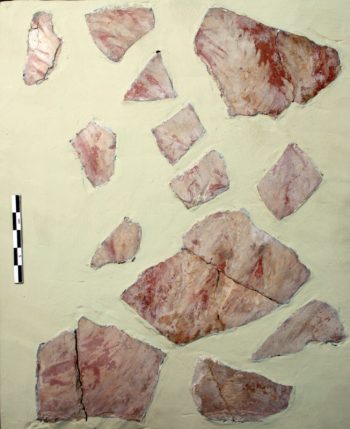
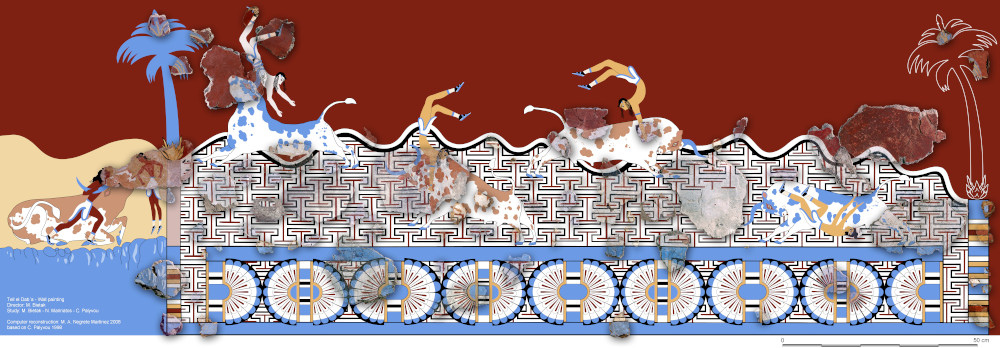
In addition to the now famous bull-leaping scenes, small-and large-scale murals depict leopards, lions, griffins and hunters accompanied by dogs. It was particularly surprising that no Egyptian religious and political power symbols were included in the murals.The site’s excavator, Manfred Bietak, suggested that an official meeting or even a political marriage could be a possible cause for the unique style.
Bull leaping scenes from Tell el-Dab'a. Image courtesy of Manfred Bietak
Tell el-Dabca also stands out for a stucco relief technique that was until then primarily known from Crete. These murals do not only share decorative motifs with the Aegean paintings, but also complex technical knowledge. They are largely executed on wet lime with the help of string impressions, display similar surface treatments and thus mirror a very tight relationship to the Aegean craft traditions.
These new discoveries have raised the question of itinerant craftspeople and their possible Aegean ethnicity. In support of such a hypothesis many studies have referred to isolated technical details or iconographic characteristics. The focus on the Aegean impact has led to an artificial separation of these ‘Minoanizing’ paintings from other murals common in these regions. However, to adequately comprehend the murals, we need to contextualize the entire workflow of stylistic and technical decisions.
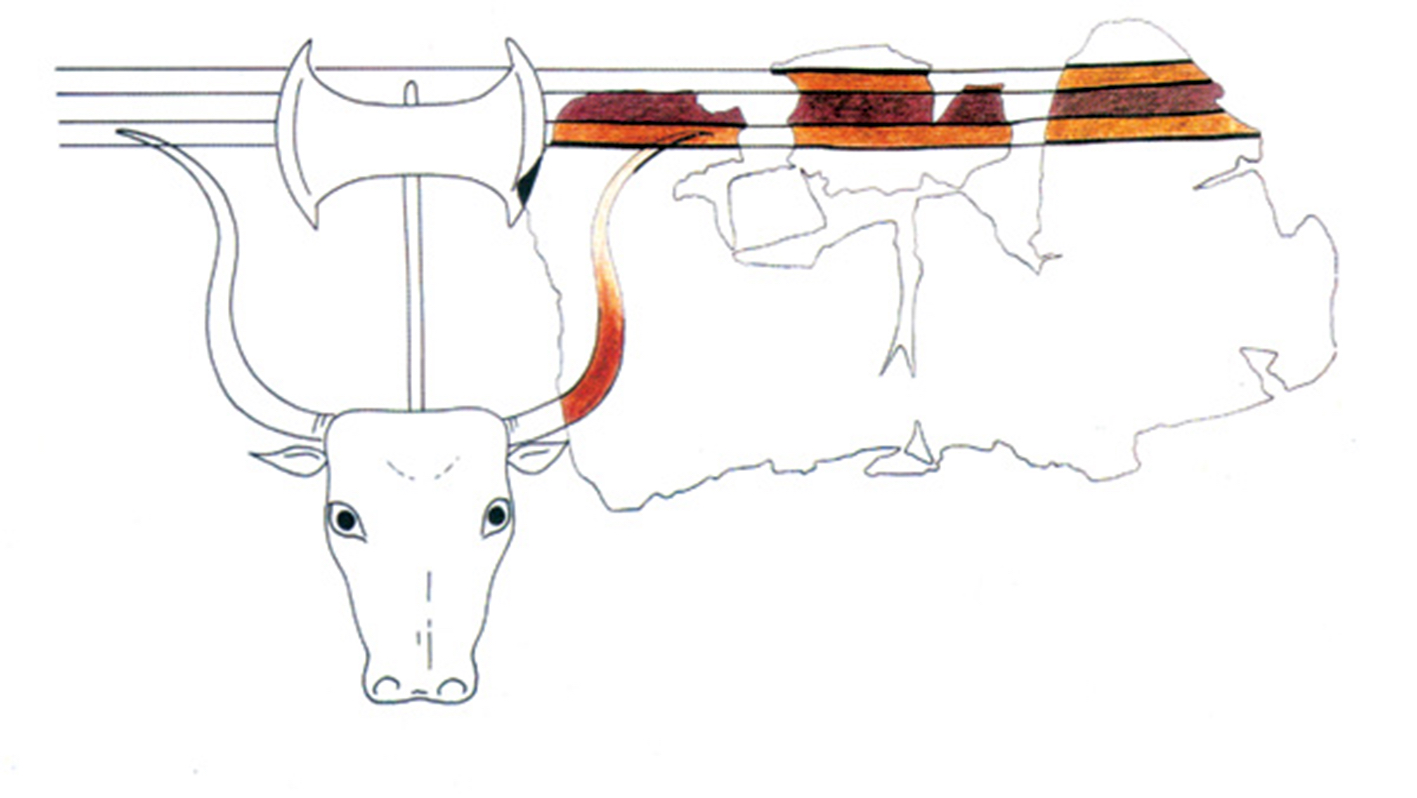
The new findings have led to a reconsideration of Woolley’s Alalakh fragments. Remarkably, Barbara and Wolf-Dietrich Niemeier’s recognized a notched-plume-motif, typical for Aegean wing depictions, which gave reason to assume the representation was of a griffin or sphinx. Again this resulted in the reconstruction of unmistakably “Minoan griffin” and the same tendency holds true for the completion of the horn fragment as a bucranion with a highly hypothetical double axe.
Reconstruction of the horn fragment as a bucranion with a double axe. Image courtesy of Wolf-Dietrich Niemeir.
Both reconstruction shave visually brought the paintings closer to the Aegean while any ambiguity or possibility of a hybrid combination of motifs has been erased. But other, local aspects of the Alalakh VII murals have until now been completely ignored, for instance the depictions of basalt orthostats, typical element of the local architecture, and the motif of a bicolored sequence of three horizontal ribbons, well-known from the palace of Mari at the Euphrates.
Both iconographic aspects clearly anchor the Alalakh paintings within a local, western Asian tradition. That the “Minoanized” paintings are not completely separated from the inner-Syrian paintings becomes also evident by another unexpected insight from Mari. A recently discovered string impression framing a spiral motifs raises the question if this technique can be indeed considered as exclusively Aegean.
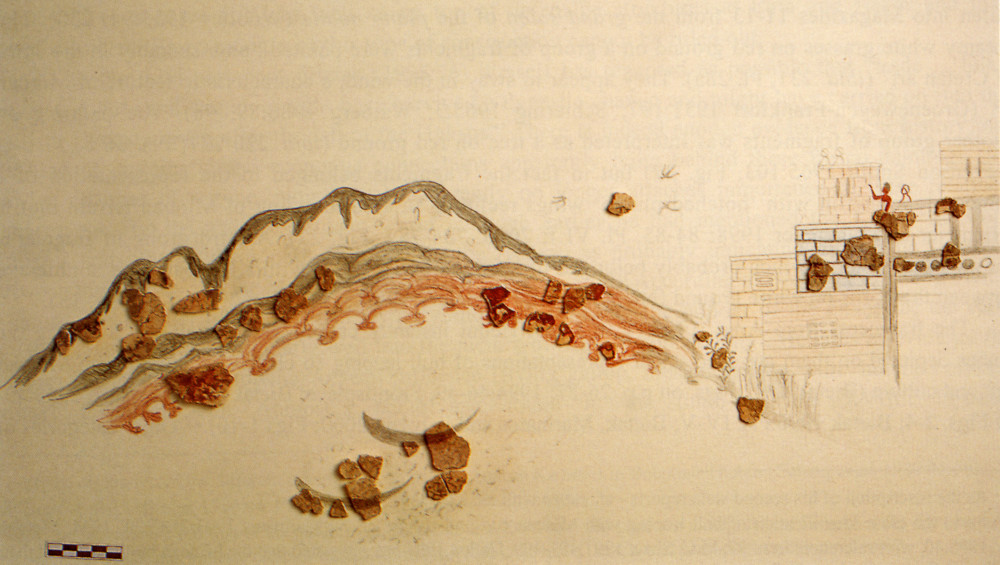
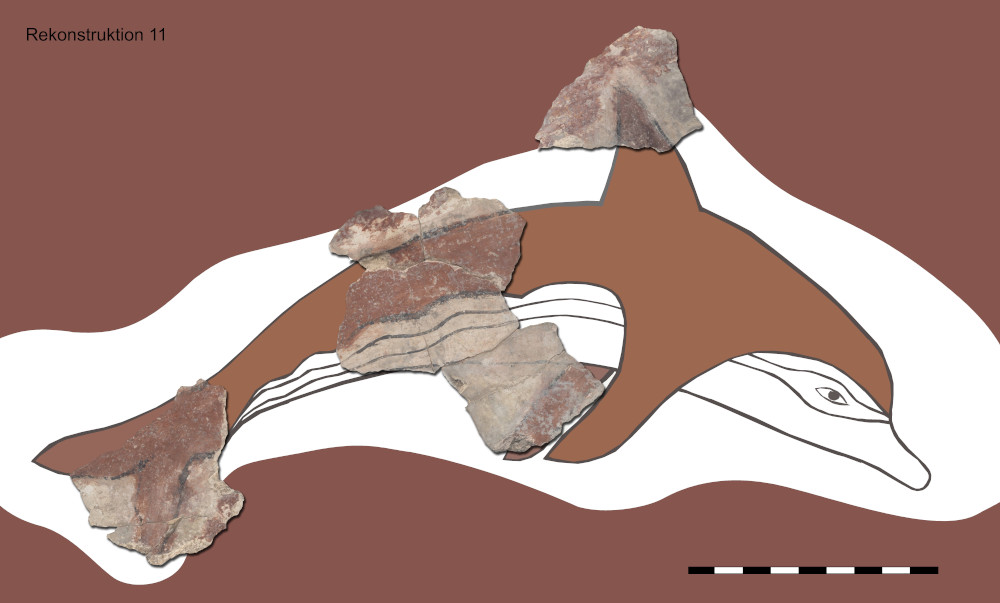
Finds from Late Bronze Age II Qatnain Syria have added to the evidence for murals still further. Many ofthe identified motifs, such as undulating landscapes, palm trees, or dolphins have their best parallels in Aegean images. But Qatna also demonstrates the methodological traps that await interpretations of these similarities. The hundreds small mural fragments indeed join together but the results include a quite unexpected visual syntax for previously well-understood single motifs.
For example, the restriction of spirals into trapezoid panels instead of a running frieze, or the arrangement of a miniature landscape above a small frieze of two counterrotating spirals are unusual from an Aegean viewer. Similar “deviations” can be observed in the less well-preserved seascape of the south wall. Furthermore, the black dado zone with irregular white dots below the panels appears to imitate basalt orthostats, as at Alalakh.The similarities between the corpora of Alalakh and Qatna across about 300 years hint indeed to the existence of a local tradition originally derived from Aegean and local elements; another hybrid visual language that joins other well-known aspects of Levantine imagery.
Reconstruction of Qatna scene. Image by the author.
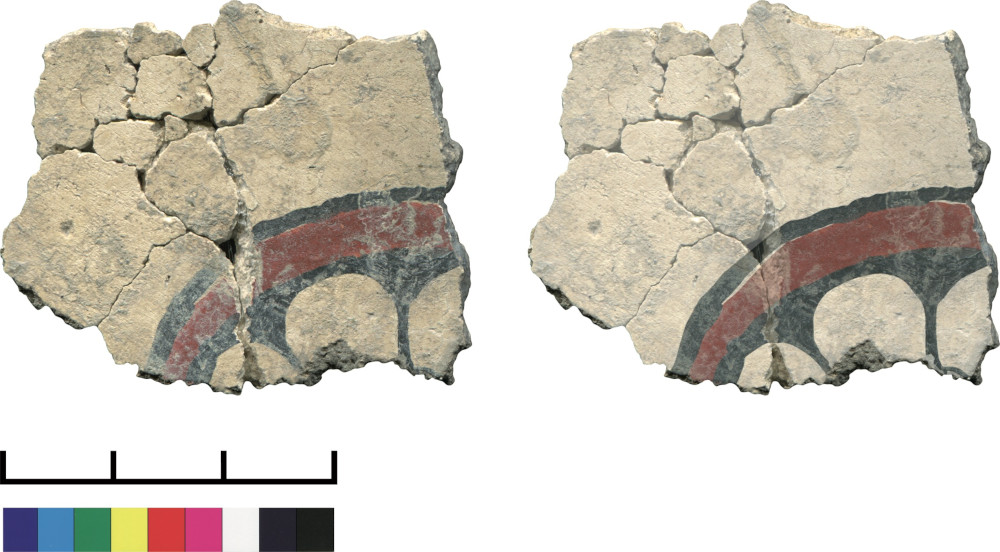
While such an explanation cannot be easily transferred to the Tell el-Dabca paintings, some characteristics of the few and mostly very small fragments from the upper city of Hittite Hattusha in central Anatolia might be explained in a similar way. Their fragmented state hardly allows a full understanding of the iconography, but it is clear that the rosette is a prominent motif. The rosette is very common in Hittite as well as Aegean iconography and it can be argued that this motif formed part of the headdresses of the local sphinx as well as an Aegean element.
Rosette from Hattusha. Image courtesy of Johannes Jungfleisch.
All these new results reveal a far more complex web of interactions than previously thought. There is indeed a shared craft tradition, but there are also variations in their local execution. Craft specialists may have moved in all directions, mixing and matching ‘Aegean’ motifs and local details. Scholars have until now homogenized various cases with a model of single visits by itinerant craftspeople -irrespective of the diverse chronological, architectural, and social contexts of the paintings.
Only the painstaking and time-consuming reconstruction of the histories of individual paintings will allow us to shed light on the entanglement of the different craft traditions oft he eastern Mediterranean. This emerging picture might be more difficult to define in a single marketable sentence, but it will help us grasp a unique period at the end of the second millennium when craftsmen, images, and technologies circulated around the Mediterranean as never before.
Constance von Rüden is a faculty member at the Ruhr-University Bochum.
How to cite this article:
von Ruden, c. 2019. “What’s in a Style? Minoanizing Paintings in the Eastern Mediterranean”, The Ancient Near East Today 7.9. Accessed at: https://anetoday.org/minoan-paintings-mediterranean/.

Post a comment