Smells are everywhere and humans have always been conscious of them, but ancient Egyptians were among the first to document and judge smells.
What are smellscapes?
The word smellscape refers to all the smells found in a given area. Many smellscapes together form a smellmap. The modern method of smellmapping startswith smellwalking– walking around in the city and recording the smells one encounters. Since odors cannot be recorded digitally, the notes can be either in writing or by recording one’s voice.
Smells are perceived on a scale of good-bad with nothing in between. In fact, psychological experiments have shown that assigning adjectives to odors or creating clusters of smells are universally unsuccessful. Thus, during smellwalking, odors can be described with adjectives, by comparisons, with colors or forms. The description will depend on the individual’s preferences, language and culture.
Why are smellscapes important in ancient Egypt and how can we study them?
The olfactory world of a city reveals many aspects of a culture: urban planning, social hierarchy, professional and culinary activities, customs and values, sexual behavior, hygiene, treatment of the sick, religious beliefs, differences between mundane and holy days, plant cultivation, and animal husbandry.
One way to discover the smellscapes of an ancient Egyptian city is by examining the written sources that elaborate on the smells of various urban areas. Since odors are left mostly undetected in the archaeological record, the texts the ancient Egyptians recorded themselves about the smell of their urban environment are all the more important. Let us take a smellwalk in an ancient Egyptian city!
Smell of the palace
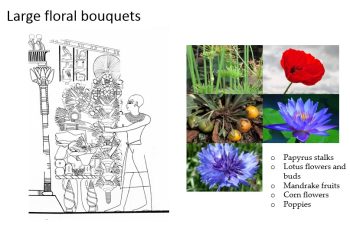
An official arrives in the palace to pay his respect to the king. He brings a large floral bouquet as a gift. The strong floral scent fills the halls of the palace and makes the pharaoh content.
Smell of the palace.
“Presenting all manner of fresh plants that are native to this land, the pick ofthe pools of the king, namely lotuses, lotus buds, reeds, mandrake, freshmyrrh from Punt, the scent of marsh-plants, all manner of pure flowersnative to the land of god, in which there is joy and health, all that has beenoffered to the king of god[s], to the nose of his beloved daughter,Hatshepsut-Khenemet-Amun, who lives forever.”
(Theban Tomb 110 of Tehuti)
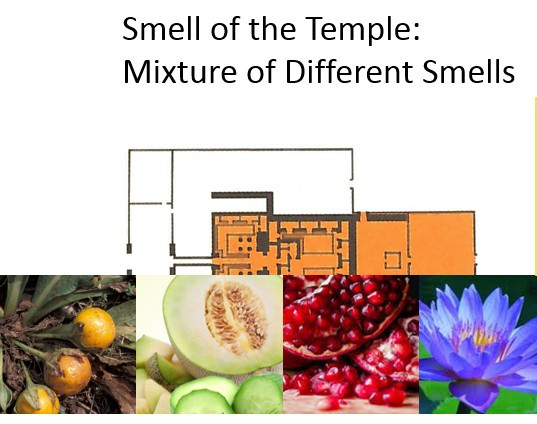
Smell of the temple
It is time for the daily temple ritual. The statue of the deity partakes in an offering consisting of roast meat, incense, honey, scented unguents, and flowers, redolent ofplants, herbs, vegetables, fruit, bread, beer and milk.
Smell of the temple
“Presenting white bread. Words to be spoken: Perfect white bread.Provisions of bread in the following way (?): I am presenting (them) to yourka on my hands. Its hot smell is for your nose. (My) Majesty, while you areeating, your heart is (filled with) love.”
(Dendera III, 111, 1 – 112, 4)
“Offering choice cut of meat and reciting: I am extending my arms to the choice cut of meat of oxen, birds, gazelles, oryx antelopes and ibexes. Yourbraziers are on fire. May you smell its fragrance! Its scent of fat rises up to the sky!”
(Philae III, 25)
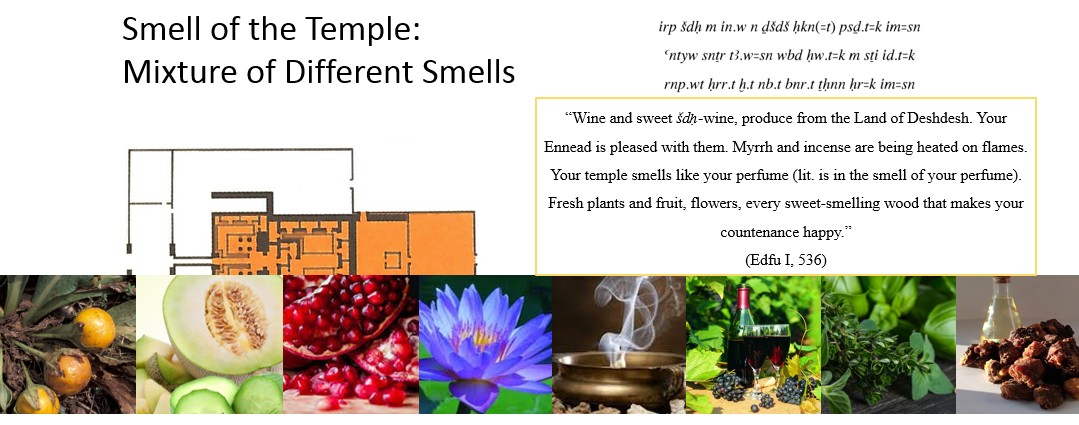
The mixture of all these scents result in a strong and peculiar smell pervading the inner halls of the temple.
“Wine and sweet SdH -wine, produce from the Land of Deshdesh. Your Ennead is pleased with them. Myrrh and incense are being heated on flames.Your temple smells like your perfume (lit. is in the smell of your perfume). Fresh plants and fruit, flowers, every sweet-smelling wood that makes your countenance happy.”
(Edfu I, 536)
Smell of a garden
After attending to his religious and administrative duties, the king takes a walk in the garden he had proudly built for the gods. Filled with fragrant trees, flowers and herbs, the garden’s purpose is to satisfy the gods and to contribute to the pleasant olfactory landscape of the city.
“I made a garden for him with offerings opposite the royal harem, planted with all manner of sweet-smelling plants and all manner of pleasant, fresh herbs from the field.”
(Inscription of Amenhotep III, south wing of the 3rd pylon, Karnak)
Smell of the House of Life
The scribal students enter the scriptorium called House of Life to dedicate their day to learning the Egyptian script. They need to make sure not to be anointed with unguent, especially myrrh, as their life must be simple, devoid of any olfactory pleasure.
“So he said, namely, The-one-who praises-knowledge, he said: Do you smell of myrrh? Do not enter the House of Life. Stinking bulls are the ones whoare in [it (?)].”
(The Book of Thoth, 25)
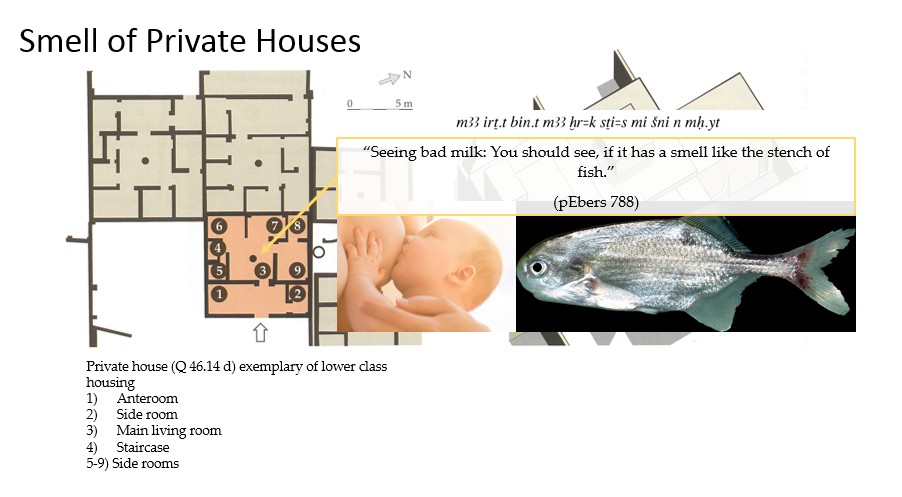
Smell of a lower-class house
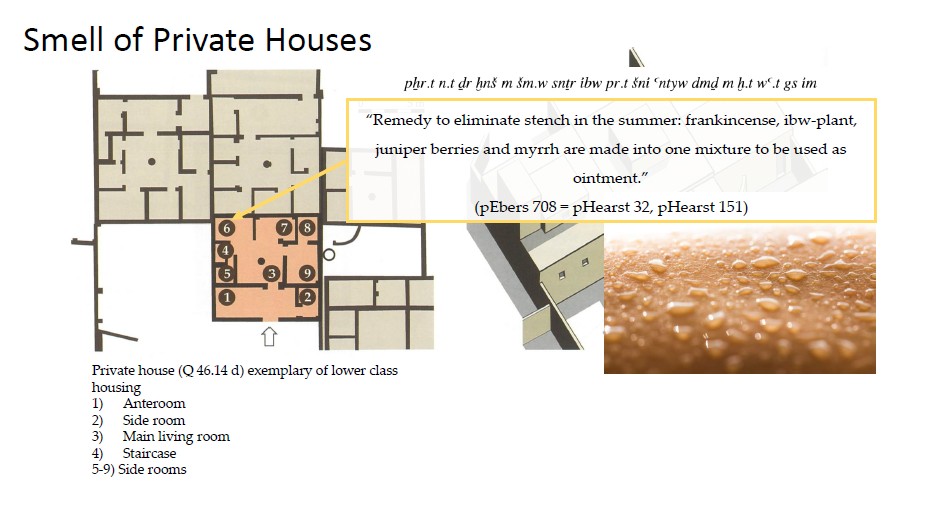
It is a hot summer day and a peasant arrives home sweating after working hard in the field. He does not have a bath in his house, thus he needs a remedy for stench.
Smell of lower-class private house
“Remedy to eliminate stench in the summer: frankincense, ibw–plant, juniper berries and myrrh are made into one mixture to be used as ointment.”
While the peasant is preparing the remedy, his wife is trying to breastfeed their newborn. However, her milk has gone bad and it stinks like fish.
Smell of lower-class private house
“Seeing bad milk: You should see, if it has a smell like the stench of fish.”
(Papyrus Ebers 788)
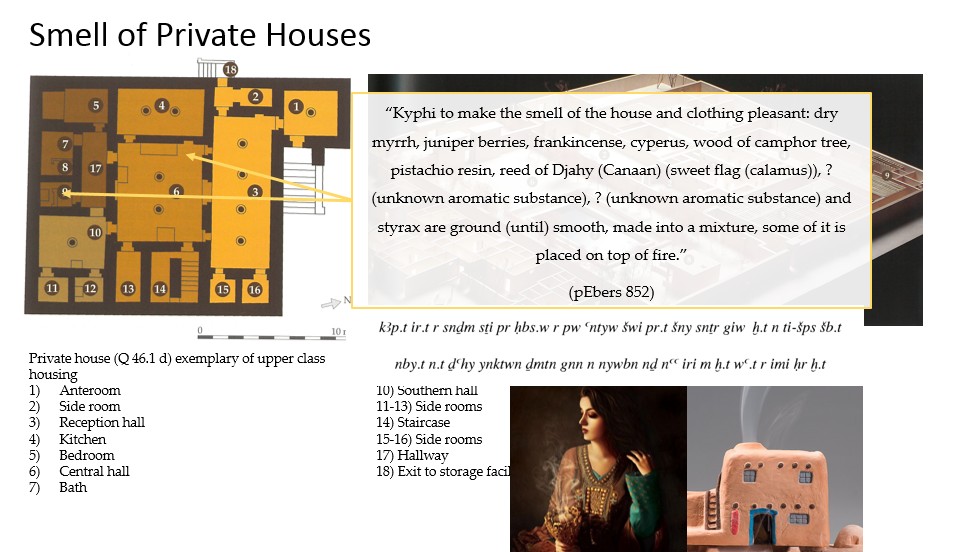
Smell of an upper-class house
A lady of a noble family is burning kyphi (a form of incense) in her living quarters to make the smell of her rooms and clothing pleasant.
Smell of high-class private house
“Kyphi to make the smell of the house and clothing pleasant: dry myrrh, juniper berries, frankincense, cyperus, wood of camphor tree, pistachio resin, reed of Djahy (Canaan) (sweet flag (calamus)), ? (unknown aromatic substance), ? (unknown aromatic substance) and styrax are ground (until)smooth, made into a mixture, some of it is placed on top of fire.”
(Papyrus Ebers 852)
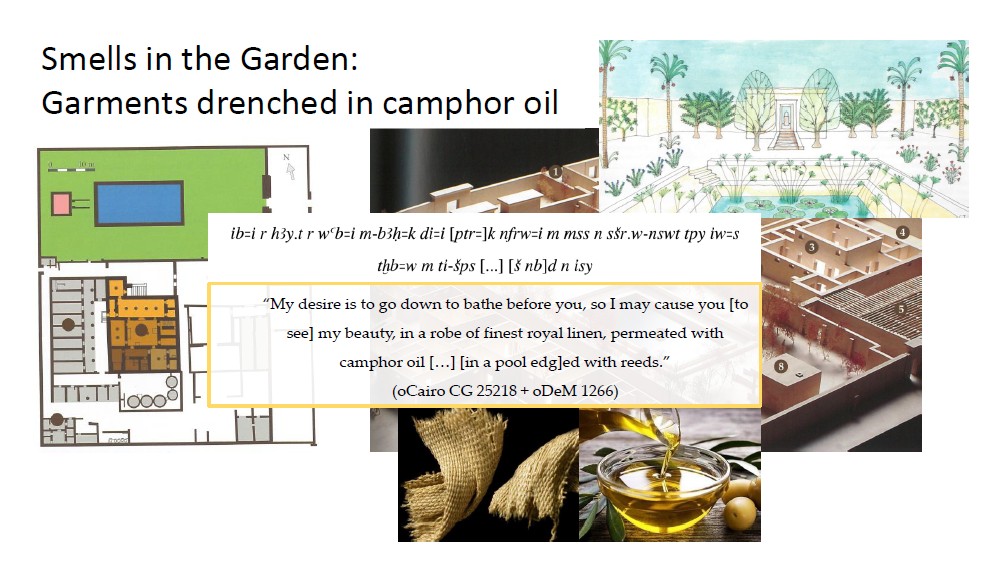
Later, she goes out to the garden to meet her lover. She takes a bath in the pool in front of him in robes permeated with scented oil.
Smell of high-class private house
“My desire is to go down to bathe before you, so I may cause you [to see]my beauty, in a robe of finest royal linen, permeated with camphor oil (ti-Sps) […] [in a pool edg]ed with reeds.”
(Ostracon Cairo CG 25218 + Ostracon DeM 1266)
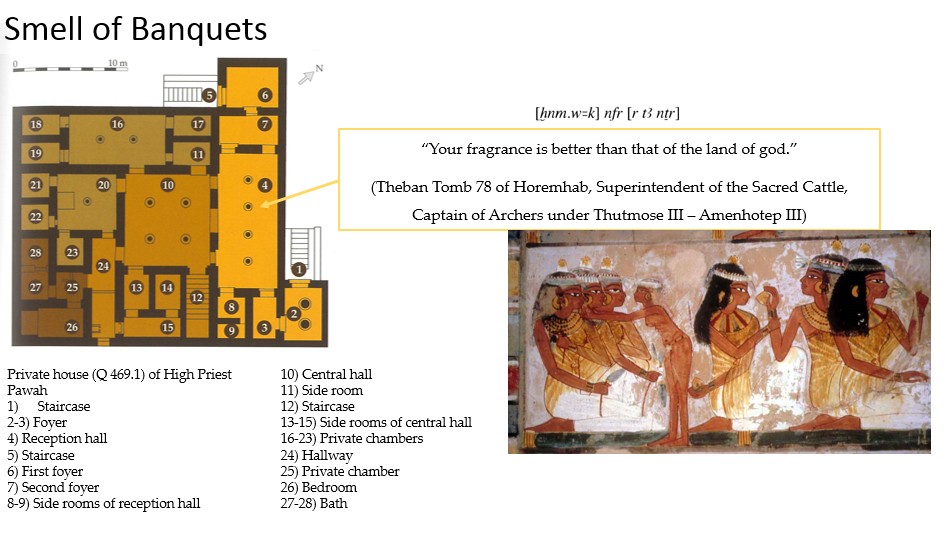
Smell of a high-class house during a banquet
A high official is hosting a banquet at his residence. Upon arrival, the guests are anointed with perfume oils, an unguent cone is placed on their head with a lotus flower in the front, and a floral garland is hung on their chest. The guests smell heavenly and are ready to celebrate.
Smell of banquets
“[Your fragrance] is better [than that of the land of god.]”
(Theban Tomb 78 of Horemhab)
Smell of the streets
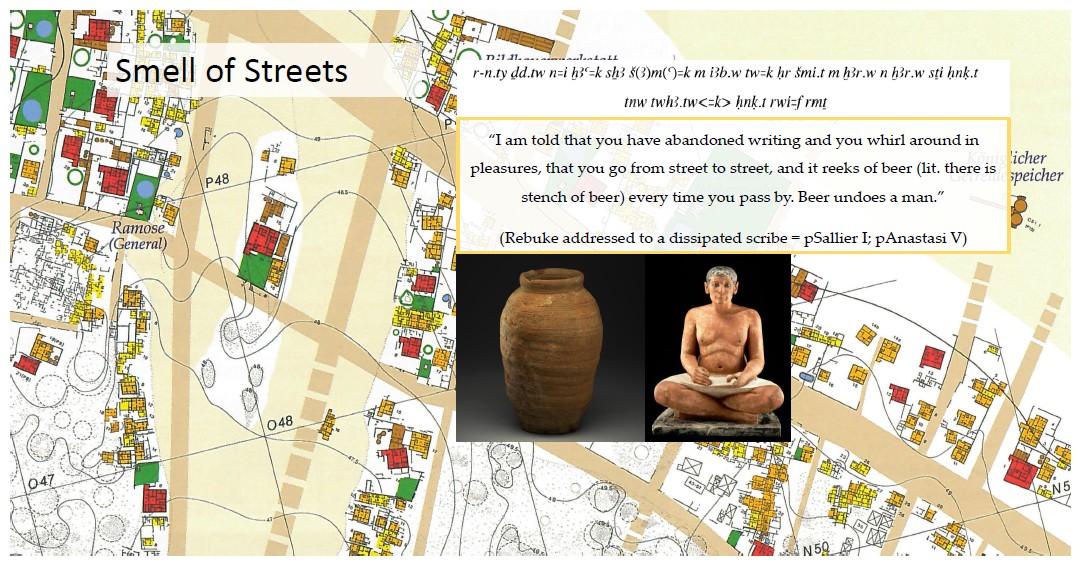
A scribe leaves the banquet drunk. He is wandering from street to street and he stinks of beer.
Smell of streets
“I am told that you have abandoned writing and you whirl around inpleasures, that you go from street to street, and it reeks of beer (lit. there isstench of beer) every time you pass by. Beer undoes a man.”
(Rebuke addressed to a dissipated scribe = Papyrus Sallier I; Papyrus Anastasi V)
Smell of a tanning workshop
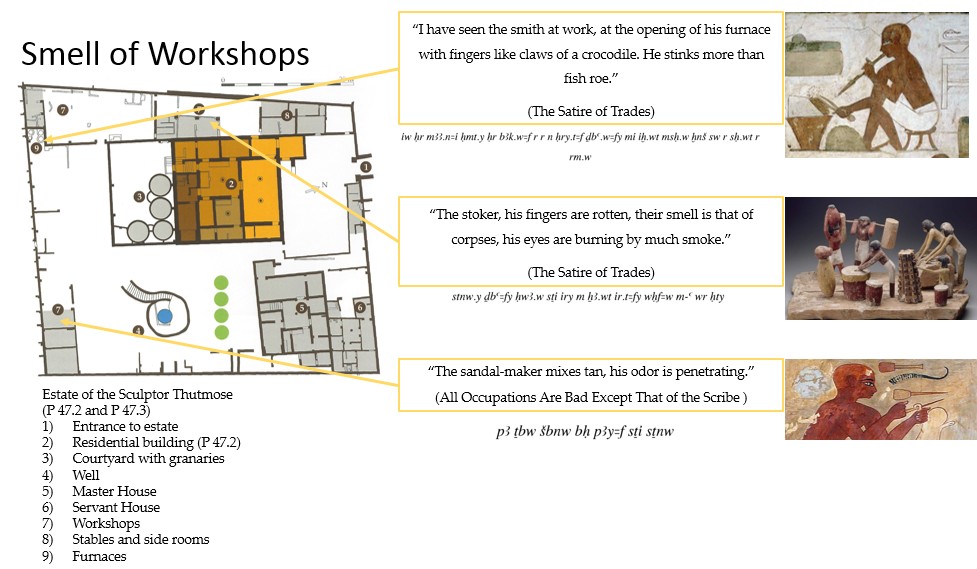
While the more fortunate are celebrating, on the outskirts of the city, a sandal-maker is hard at work mixing tan to soften hides, which he will use to make sandals.
“The sandal-maker mixes tan, his odor is penetrating.”
(All Occupations Are Bad Except That of the Scribe)
Smell of a smith’s workshop
A smith in close proximity to the sandal-maker is making weapons on royal demand for an impeding battle.
Smell of workshops
“I have seen the smith at work, at the opening of his furnace with fingers like claws of a crocodile. He stinks more than fish roe.”
(Satire of Trades)
The written sources demonstrate that the ancient Egyptians lived in a rich olfactoryworld. Olfaction, as all sensory perceptions, is not only a means of apprehending physical phenomena, but also an avenue for the transmission of cultural values. Through apprehending the smellscapes of ancient Egyptian cities, which has never been investigated before, we can reveal unknown aspects of their culture and contribute to better understanding of ancient Egyptian city life as a whole.
Dora Goldsmith is a PhD student of Egyptology at the Freie Universität Berlin. Her PhD project is “The Archaeology of Smell in Ancient Egypt. A Cultural Anthropological Study Based on Written Sources.”
All figures are courtesy Dora Goldsmith, who gratefully acknowledges source images from Christian Tietze (2010) (ed.), Amarna: Lebensräume – Lebensbilder – Weltbilder.
How to cite this article:
Goldsmith, D. 2019. “Smellscapes in Ancient Egypt”, The Ancient Near East Today 7.8. Accessed at: https://anetoday.org/smells-egypt-life/.

Post a comment