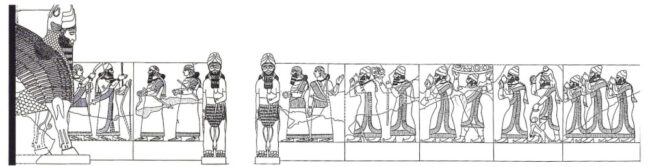
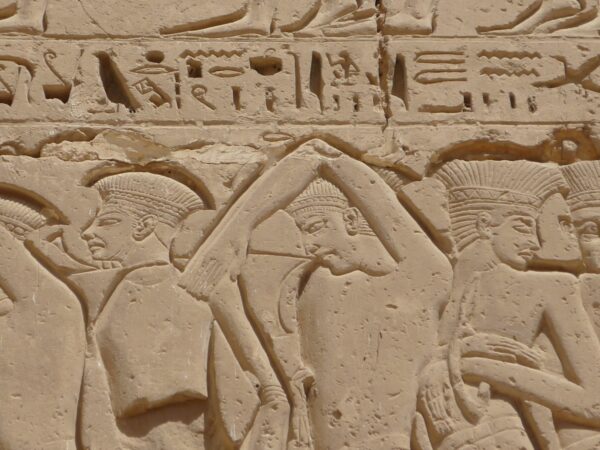
Two emissaries being presented to Assurnasirpal II, part of a procession depicted on either sides of the gate entering the throne room. Photo by Osama Shukir Muhammed Amin FRCP(Glasg) via Wikimedia CC By-SA 4.0

Israelite and Judahite Ambassadors to Assyria

december 2019 | Vol. 7.12

By Shawn Zelig Aster

Contacts between the mighty Assyrian empire and the ancient Israel and Judah were a critical part of the history of these kingdoms. Israelite reactions to Assyrian influence are explicit in hundreds of Biblical passages and implicit reactions shape many others. But who were the actual historical actors shaping these contacts? How did Assyrian ideology and modes of thinking reach Biblical Israel and Judah?  

Written contacts in Aramaic may be responsible for some of this cultural transmission. Many have noted that there is no evidence of scribal schools in Iron II Israel or Judah that taught cuneiform writing. Written contact therefore took place primarily in Aramaic, the primary spoken international language of the period. 

But human contact was the most important vector for transmitting Assyrian political culture to Israel, Judah, and the other kingdoms of Syria and the Levant. Each spring, the ambassadors of these kingdoms travelled to Assyria and then brought home Assyrian ideas.

Map of the Neo-Assyrian Empire, by Simeon Netchev, CC By-NC-ND.

These annual visits were demanded by Assyria as a basic element for creating alliances with weaker kingdoms. On the one hand, annual visits were needed for the purpose of remitting tribute. But such tribute could have been remitted to Assyrian officials posted closer to these kingdoms. The main purpose of the annual visit was to “convert” these ambassadors from representatives of their kingdoms to missionaries for Assyrian ideology.  

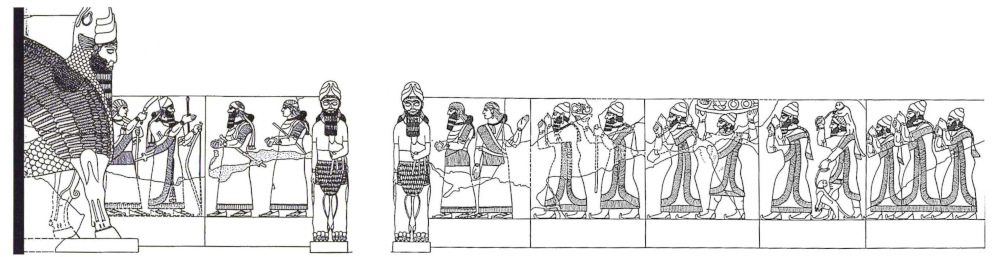
On their arrival in the grand Assyrian capital after their long journeys, they were shown reliefs of the annual gathering of ambassadors, in order to convince them that the Assyrian empire was truly universal and that its king was destined to rule the world. A relief from the palace of Assurnasirpal II at Nimrud, a palace built in the ninth century but in use until the reign of Sargon II (720-705 BCE), shows ambassadors carrying exotic goods such as monkeys, demonstrating that they come from far-flung regions.

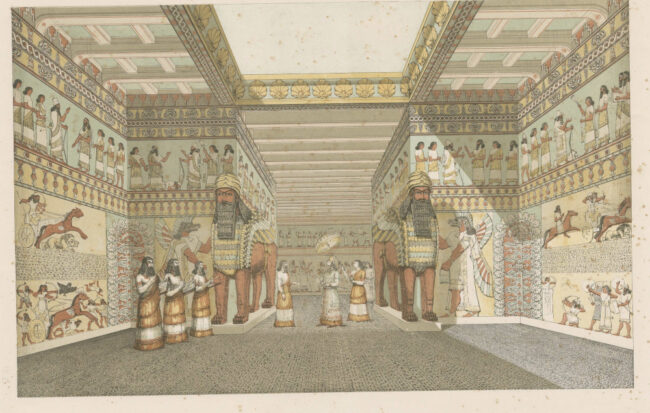
Rendition of the interior of an Assyrian palace at Nimud. A.H. Layard, Monuments of Nineveh, 1849, plate 1.
Two emissaries being presented to Assurnasirpal II, part of a procession depicted on either sides of the gate entering the throne room. Photo by Osama Shukir Muhammed Amin FRCP(Glasg) via Wikimedia CC By-SA 4.0

Another relief shows ambassadors being ushered into the presence of the king who received their tribute. 

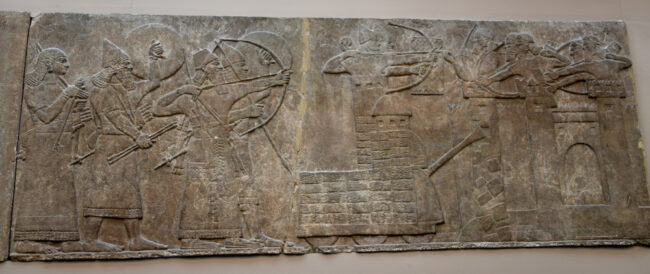
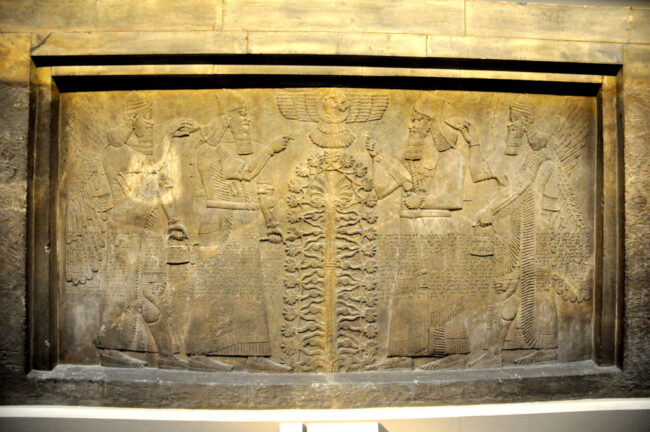
Ambassadors were exposed to many artistic reliefs in the royal palace. Some reliefs portrayed the king’s many bloody victories on the battlefield. These hardly required explanation, but others, such as that of the king, his guardian apkallu (ancient holders of knowledge) and the cosmic tree, were more subtle in conveying the idea of the Assyrian king’s universal rule and personal invincibility. Official translators explained the reliefs and their ideological statements to the ambassadors.

Assurnasirpal attacks a city. British Museum 124555. © The Trustees of the British Museum, CC By-SA 4.0.
Relief of Assurnasirpal standing before the sacred tree and the apkallu from the throne room. British Museum 124531. © The Trustees of the British Museum, CC By-SA 4.0.

Ambassadors were entertained at royal banquets, and were given large rations of wine and other luxuries. The Nimrud Wine lists, for example, mention Samaritans, early ambassadors of the Israelite kingdom, among the recipients.

Besides being wined and dined at Assyria’s expense, the ambassadors were given presents of clothing and shoes for their journeys, as well as valuable jewelry. The gifts were not part of the usual traditions of hospitality, but were rather intended as incentives to the ambassadors to undertake the journey again, and to be punctual in the bringing of tribute. These incentives made the ambassadors into eager tribute-bearers, who had a personal stake in promoting Assyrian royal ideology.  

Essentially, these ambassadors were co-opted by the Assyrian empire, part of its larger strategy of trying to co-opt local elites. Another part of this strategy was granting benefits to kings of small states in order to convince them to extract tribute from their subjects and remit it to Assyria. Local kings who cooperated with Assyria became tax-farmers, and ambassadors who cooperated with Assyria became emissaries for Assyrian ideology, responsible for propagating this ideology to their kingdoms.

Not surprisingly, the use of these ambassadors as Assyrian tools provoked strong reactions in Biblical Judah. As I have argued in my book Reflections of Empire in Isaiah 1-39: Reactions to Assyrian Ideology, the famous throne-room vision of Isaiah 6 contains the prophet’s critique of these ambassadors. He satirizes their descriptions of the powerful Assyrian king. In portraying God asking “Who will I send and who will go for us?” and the prophet saying “Here I am, send me!” (Isa. 6:8), the prophet mocks the ambassadors, who volunteer to become emissaries, not of their home kingdoms, but of the Assyrian empire and its ideology. In his response to these preachers of Assyrian ideology, Isaiah argues that their mission will result only in destruction for Judah (Isa. 6:11-13).  

The drama of the ambassadors of small states to Assyria is therefore one part of an ongoing historical drama of how small states relate to empires, of how smaller and weaker states’ elites are co-opted by empires, and of how critics in those smaller states lash out against what they see as the betrayal of their local culture by elites who become not ambassadors of their own states but of the empire.  
Shawn Aster is Associate Professor in the Martin (Szusz) Department of Land of Israel Studies and Archaeology at Bar-Ilan University, 

How to cite this article:

Aster, S. 2019. “Israelite and Judahite Ambassadors to Assyria“, The Ancient Near East Today 7.12. Accessed at: https://anetoday.org/israelite-judahite-ambassadors-assyria/.

Want to learn more?

Post a comment

Your email address will not be published. Required fields are marked *