
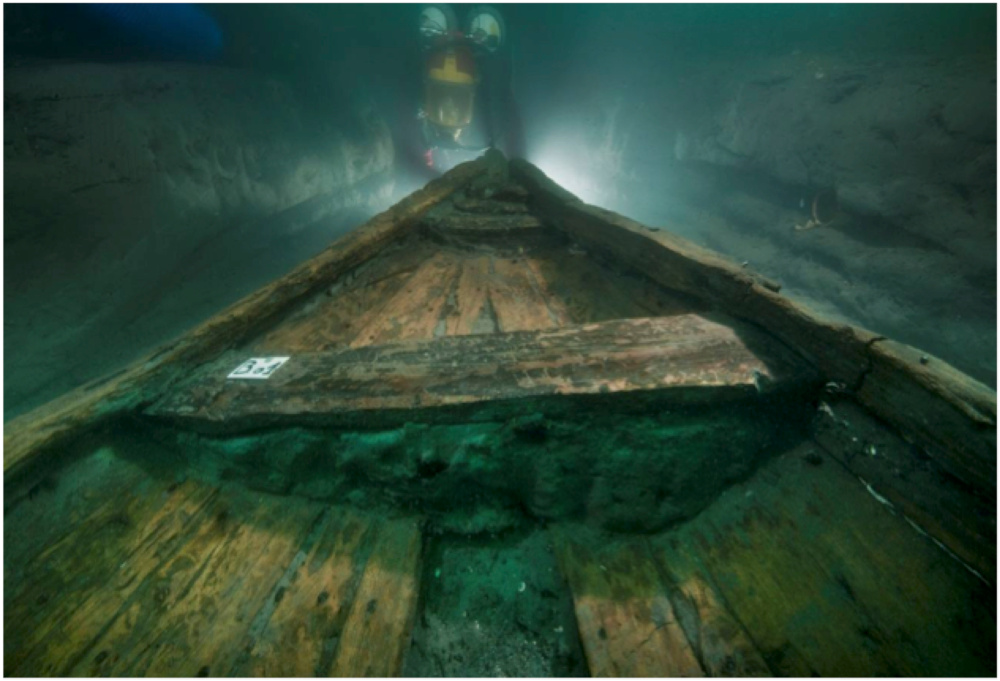
The Afterlife of Ships in Thonis-Heracleion: Recycling, Abandonment, and Ritual Sacrifice at an Egyptian Port
What do you do with a ship at the end of its life? Today, many of the ships that are at the heart of our interconnected maritime world end theirs driven onto a beach and cut up by hand to be recycled. In a few short weeks a giant vessel can be reduced to nothing as its owners gain one last pay day and rid themselves of something that was unwanted, no longer economically viable, or perhaps not even safe.
Ancient seafarers would have had exactly the same choice about what to do with their old ships, recycling timbers for use in new vessels, in buildings, or just for firewood. Some ancient ships, however, survived this ‘cull’ and entered the archaeological record through a variety of different formation processes. In the Egyptian port of Thonis-Heracleion, for example, old ships and boats have been found abandoned, reused in infrastructure, and even sacrificed to the gods.
Thonis-Heracleion was located at the end of the western most navigable branch of the river Nile, where its waters met the Mediterranean.
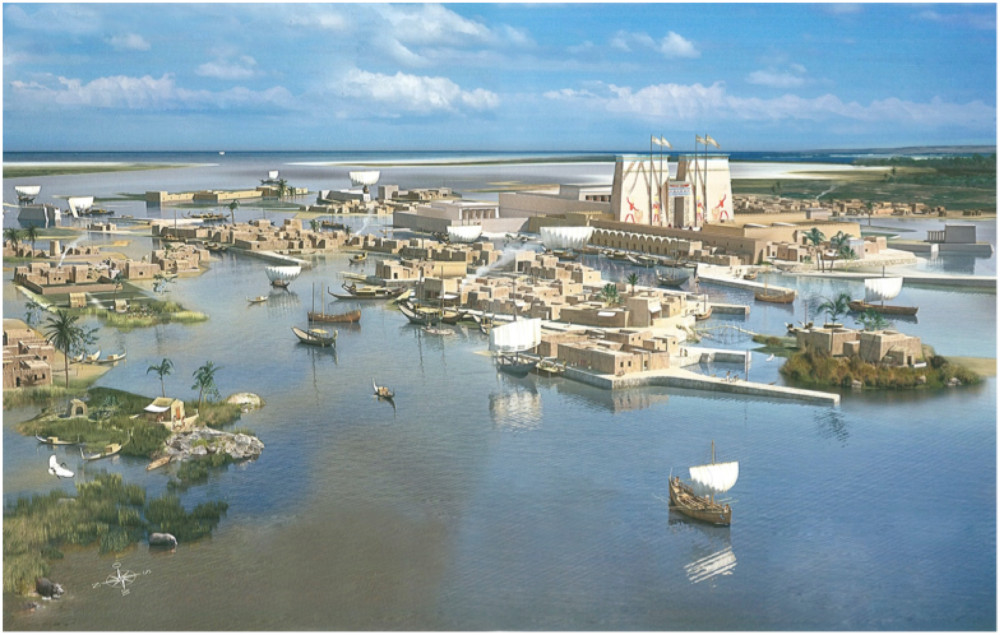
Reconstruction of the city of Thonis-Heracleion based upon the evidence from the archaeological excavations (Image © Franck Goddio/Hilti Foundation)
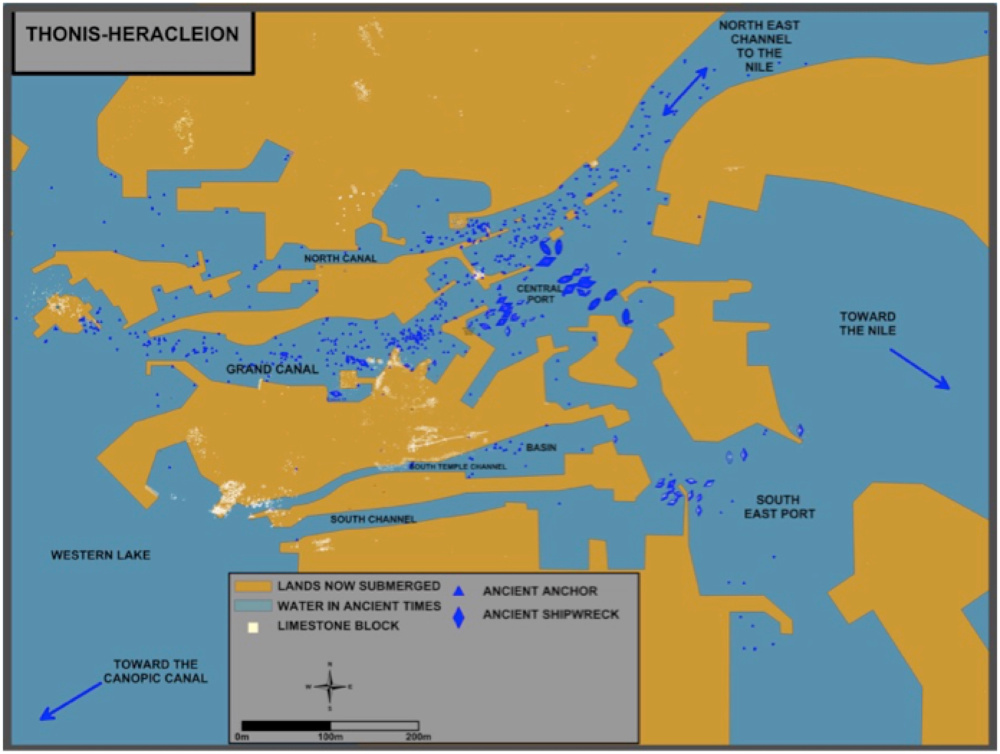
The location of ships of Thonis-Heralceion mentioned in this article. A Ship 61; B Ship 11; C Ship 17; D Ship 43 (Map Franck Goddio © Franck Goddio/Hilti Foundation)
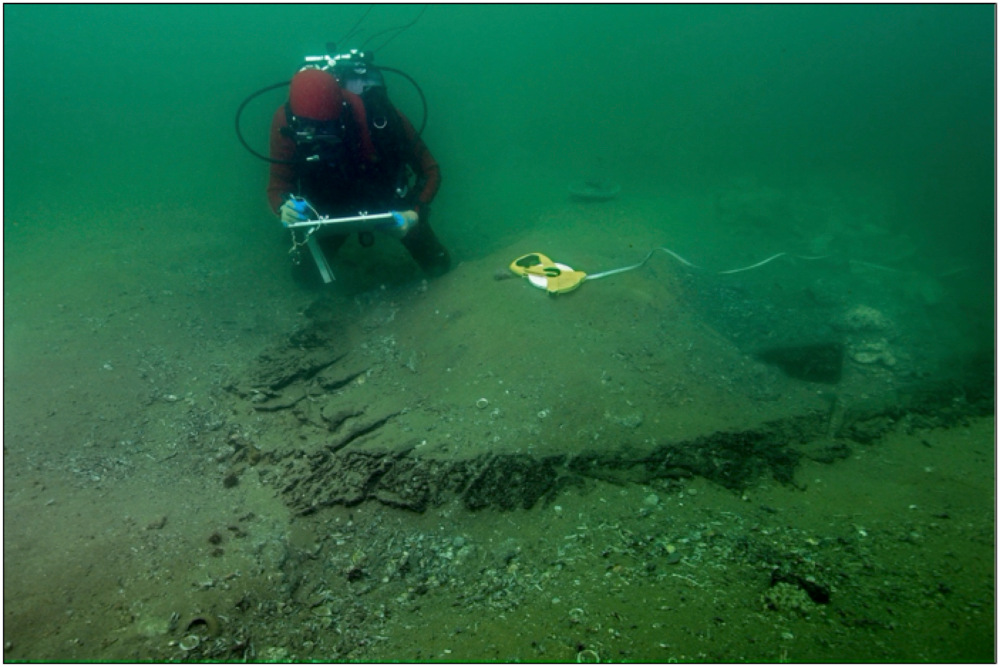
Recording the outline of an unexcavated ship as it appears from the Nile clays of the seabed (Photograph Christoph Gerigk © Franck Goddio/Hilti Foundation)
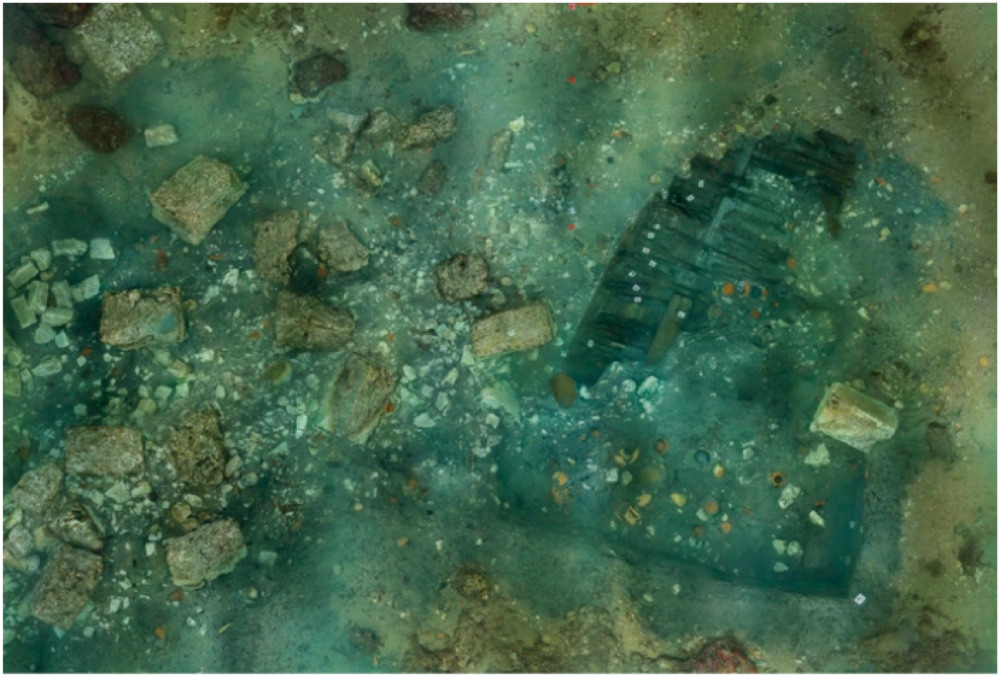
3D photomodel showing the excavation of the wider area of Ship 61 amongst the debris of the collapsed temple (Model Christoph Gerigk © Franck Goddio/Hilti Foundation)
From the detailed excavation of other vessels, however, it became clear that the majority of them entered into the archaeological record through a variety of different processes.
Simply, when a ship is wrecked it sinks along with its contents, or at least those elements of it that don’t float away. The things that go down with the ship usually entail both the objects that the crew would have used onboard, as well as any cargo it might have been carrying. Ships that are abandoned or reused, however, present very different archaeological signatures from a wreck. Their last cargoes would have been removed and their crew would have taken with them their personal belongings or anything else that would be useful (or saleable).
This process can clearly be seen in the excavated remains of ships 17 and 43, which when excavated were found to be without any in situ material culture that could be directly associated with them. Indeed, all that we found was the sort of general trash that washes around on the bottom of this busy harbour. As excavations continued, it became apparent that ship 17 was also surrounded by 14 long wooden piles that were driven up to 3 m into the harbour bottom. Clearly someone did not want this ship to move.
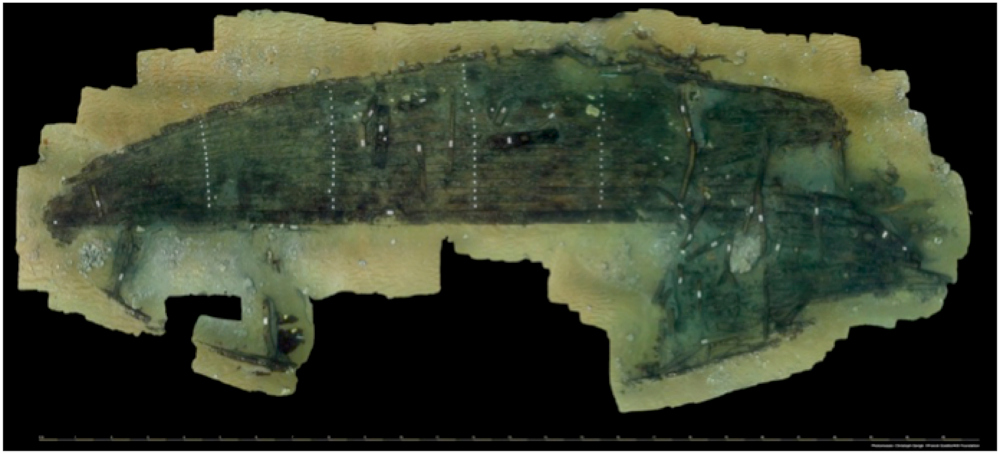
Photomosaic of Ship 17 from the 2010 mission with the position of the stakes marked (Photomosaic Christoph Gerigk © Franck Goddio/Hilti Foundation)
The reason was that the vessel was tethered into place at the end of a jetty in order to extend its length, perhaps out into deeper water. It would seem that the structural integrity of the hull was not breached and that it would still have floated, allowing the new jetty to rise and fall with the Nile flood and so to be used throughout the year.
A similar reuse of an old hull can be seen in the case of ship 43. Again, the hull appears to have been left watertight and it was then ballasted with local stone and tethered into place alongside another identically sized hull. Other pairs of ships, of the same size, type and dating to the same period, were found close by ship 43 leading to the suggestion that it formed part of a pontoon bridge that would have been used to link up some of the different islands that formed the settlement of Thonis-Heracleion. Again, the beauty of building a pontoon bridge is that it too could rise and fall with the yearly cycle of the river.
A very different process of deposition can be seen with ship 11. This small vessel was found lying across the western end of a waterway where it was deliberately scuttled through the removal of a piece of the keel.
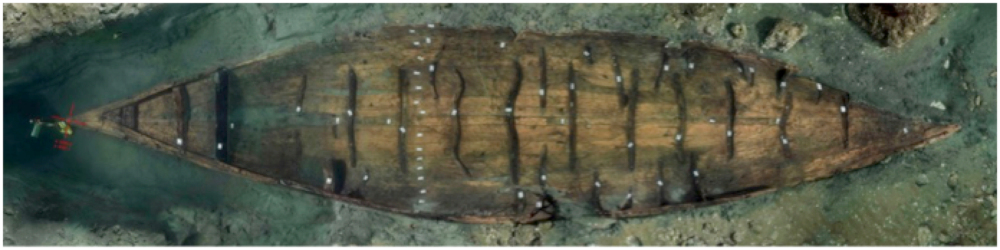
Photomosaic of Ship 11 (Photomosaic Christoph Gerigk © Franck Goddio/Hilti Foundation)
The bow end of ship 11 showing the hole where a piece of the keel has been carefully removed (Photograph Christoph Gerigk © Franck Goddio/Hilti Foundation)
While boats can be deliberately sunk to get rid of them – as certainly happened in Thonis-Heralceion’s nearby ship graveyard – this most commonly occurs in a quiet part of the port rather than directly across a busy waterway. Furthermore, excavations surrounding ship 11 revealed a range of objects with a clear ritual character. Stone offering plates complete with pieces of crushed lead and animal bones seem to have been placed into the waters close to the boat from small offering chapels on the banks, along with numerous simpula, long-handled ladles that were probably used in the rituals linked to the celebrations of the resurrection of Osiris during the Egyptian month of Khoiak.
Clearly very different in character from the everyday trash thrown into the waters, these artefacts suggest a more sacred character for this small boat, an interpretation strengthened by its graceful crescentic hull, carefully constructed from the wood of the sycamore fig tree sacred to Osiris. It could be a neshmet barque used in waterborne temple processions and also perhaps in ferrying the dead to their eternal rest. When the time came to replace this vessel, it was likely thought to be too sacred to be recycled or discarded and instead it was reused in a ceremony to mark an important location within the city’s ritual landscape.
The discovery of ships and boats from ancient Egypt is rare and to find them away from burial contexts in the desert is doubly so. Consequently, the ships and boats from Thonis-Heracleion have much to say about how Egyptian shipwrights of the Late and early Ptolemaic periods built their vessels, as well as the range of decisions that were made when they reached the end of their working lives on the waters of the Nile.
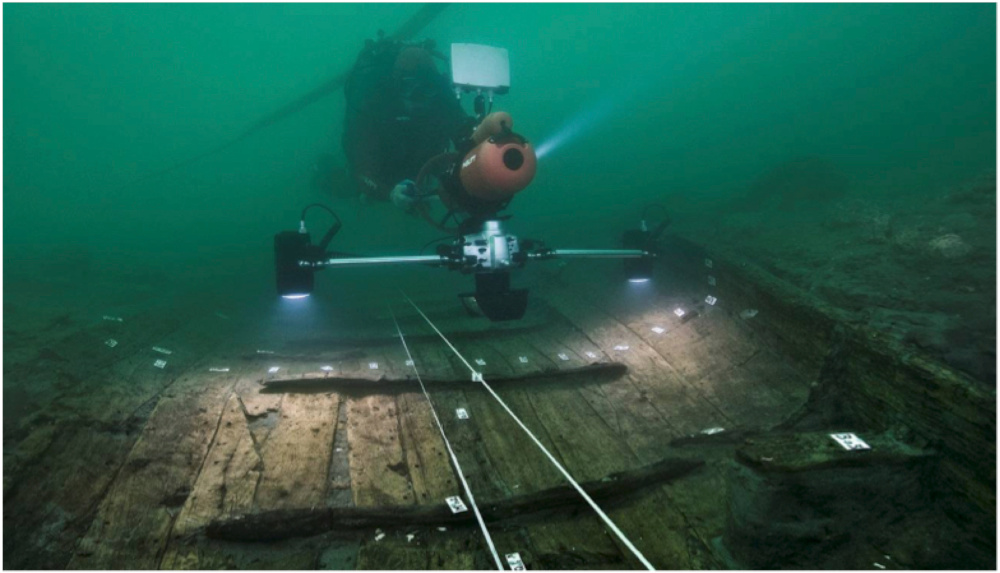
Photorecording the hull of ship 11 (Photograph Christoph Gerigk © Franck Goddio/Hilti Foundation)

Post a comment