

The Myth of the Servant: A New Tale of Kingship from the Ancient Near East
Kingship is one of the best-documented aspects of the ancient Near East, simply because so many of our sources are connected to royal figures in one way or another. Monarchical rule was also a feature shared by most of the various cultures that together make up the ancient world, and we know that ancient kings were aware of each other, across space and time: they maintained diplomatic relations, read their predecessors’ inscriptions, and compared their own achievements to those of others. In my recent book, Three Myths of Kingship in Early Greece and the Ancient Near East: The Servant, the Lover, and the Fool, I have drawn on the abundance of primary sources in order to identify several recurring story-patterns that were used, again and again, to explain and legitimise certain important features of ancient kingship.
One of these story-patterns I have called the “Myth of the Servant.” At various times in ancient history, a new man arrived on the scene and founded a new ruling dynasty that profoundly shaped the history of their people. This new ruler had no connection to the existing royal family, and so the beginnings of the new dynasty disrupted the established order. In the ancient way of thinking, it was not enough simply to say that some newcomer suddenly turned up and seized power: there had to be a plausible backstory, an account of who this person was, and how he came to rule. Significant people needed significant stories.
This is where the mythical element becomes relevant: the central claim of the “Myth of the Servant,” I argue, is that the newcomer originally served as a servant of the existing king. This claim is embedded in a longer story-pattern, which in its fullest version extends all the way back to birth. To summarise in abstract terms: the future ruler is born in a situation of tension, and is separated from his natural parents; he is then rescued and adopted by a palace servant, and begins a career at court that eventually introduces him to the immediate entourage of the existing king; in the end, the new man takes the throne himself, typically with divine support. One notable feature is that the incumbent king (the future ruler’s master) is usually an invented figure, in the sense that we rarely possess independent historical evidence for his existence.
This mythical story-pattern probably originated in connection with Sargon of Akkad, the founder of the Old Akkadian empire (2316–2277 BC). While Sargon’s true origins are unknown to us, his birth and early life quickly became the subject of a myth that presented Sargon as an outsider of non-royal birth who, thanks to the support of the goddess Inana/Ištar, founded a new and powerful dynasty of his own. The main sources for this story are the Sumerian King List, a rather lacunose Old Babylonian Sumerian literary text known as Sargon and Ur-Zababa, and the highly condensed prologue to a later Akkadian text that scholars have called the Sargon Birth Legend. While some have argued that these various sources present fundamentally different narratives, a careful review of the evidence suggests otherwise: it is in fact far simpler, and certainly more economical, to read the various texts as partial reflections of a single underlying story-pattern. This alternative (and in my view superior) reading had been suggested by several scholars, but had not yet been worked out in detail.
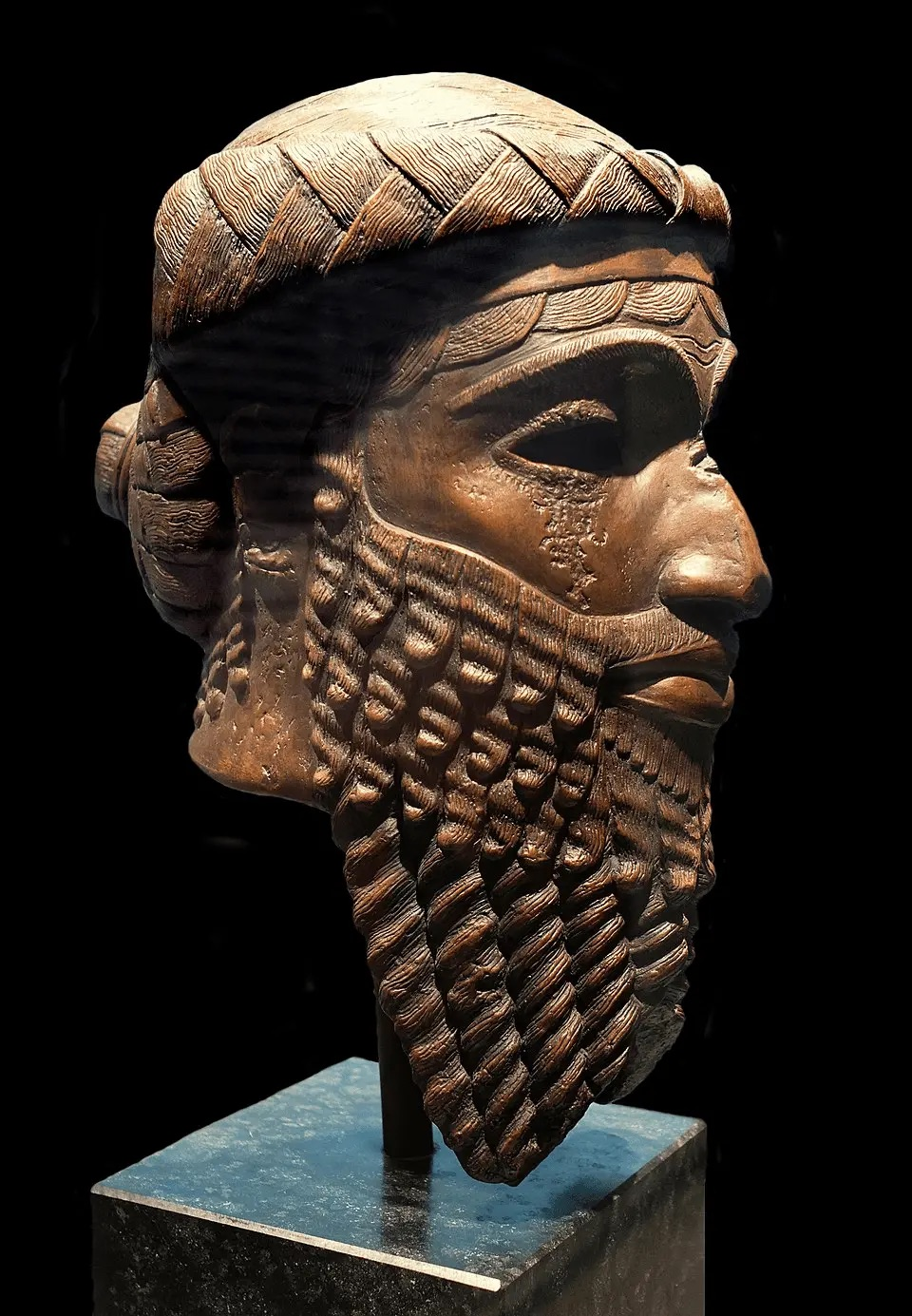
Replica of a bronze head of an Akkadian ruler found at Nineveh in 1931, perhaps depicting Sargon or his son Naram-Sin. British Museum C.281. Original is in the Iraq Museum, Baghdad. Photo by Eric de Redelijkheid, CC by-SA 2.0 via Wikimedia.
Sargon’s early life, on my reconstruction, displayed the mythical story-pattern that was eventually to become classic. His birth was marked by an inherent tension: Sargon’s father was himself an outsider, and his mother was a high-priestess, which implies both royal associations and illicit intercourse with a mortal man. This tension was resolved by Sargon’s separation from his parents: his mother exposed him in a basket on the river, an element that is best-known from the Sargon Birth Legend but that probably goes back to much older sources. Sargon is then rescued and adopted by a gardener, who happens to work at the royal palace and trains the boy to become a gardener himself. The young Sargon then progresses from the outside to the inside of the palace, and eventually ends up as cup-bearer (a highly prestigious position) to the incumbent king, Ur-Zababa of Kish. At this point the gods decide to end Ur-Zababa’s rule and to transfer kingship to Sargon, who succeeds in escaping his master’s wicked plots and ultimately takes the throne.
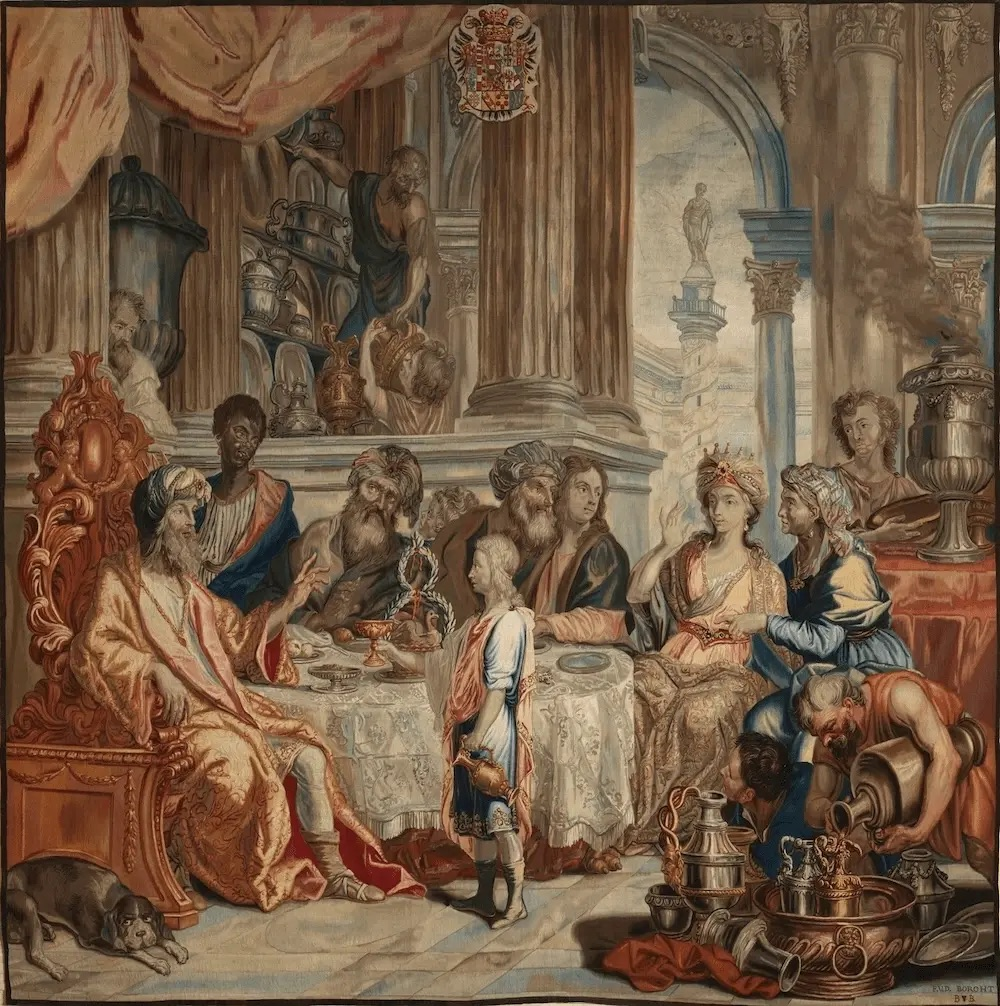
This story-pattern provided the template, so I argue, for other royal newcomers in need of mythical legitimation. A clear example is Cyrus the Great (ruled ca. 559–530 BC), the founder of the Persian Empire. Several Greek historians recorded tales of Cyrus’ early life, at least one of which (that of Ctesias) has long been seen to echo Sargon’s mythical biography. Yet my fuller reconstruction of the Sargonic story-pattern allows us to see that the same myth was used, and varied, by the much better-known account given by Herodotus in the first book of his Histories. Indeed Herodotus used the “Myth of the Servant” very prominently in his great work, and distributed elements of the same myth across two foundational figures: first Gyges, the founder of the Lydian royal house, and then Cyrus of Persia. In the equivalent of a scholarly footnote, Herodotus uses a closing scene, at the point at which Cyrus has succeeded in deposing the incumbent king, to signal to his readers his awareness of the “Myth of the Servant” and its central notion that the new man used to be a servant.
A young Cyrus offers a cup of wine to Astyages, King of the Median Empire. Tapestry in wool and silk from the van der Borcht workshop, after a drawing by Maximiliaann De Hase, 1772-76. Digital Image via The Clothworkers’ Company (CLC/TN/002), Public Domain.
Another good example is king David in the Hebrew Bible. Again, scholars have had a general sense that David’s story is probably connected in some way to other ancient Near Eastern kingship-narratives. My suggested analysis now permits a much more detailed appreciation of these links. David’s story exhibits all the key features of the myth, from non-royal birth to a period of servitude at the court of an existing king (in this case, Saul) to the accession of the new man, with divine support and against the resistance of the incumbent. There are intra-biblical links to be explored to the preceding stories of Joseph and Moses, in Genesis and Exodus: I suggest that certain elements of the ‘Myth of the Servant’ were applied to those figures, too.
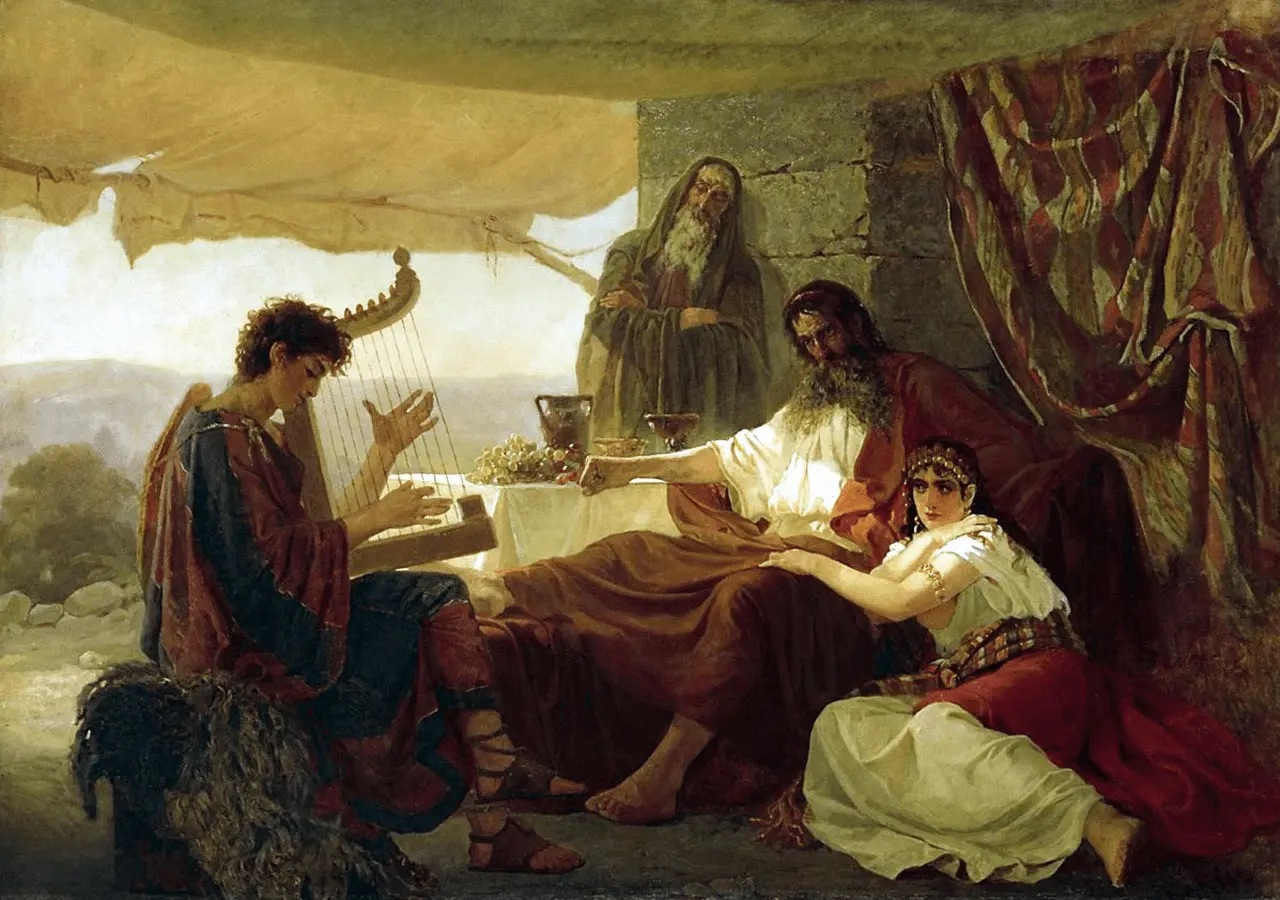
David and Saul (1873), by Nikolay Zagorskiy. David plays the harp to soothe King Saul, who was tormented by a spirit sent by God, as told in 1 Samuel 16:23. Public Domain via Wikimedia.
Nor does the story stop there. The Christ was seen as the “son of David”, and the heir to his throne, by early Christians. Thus it is not surprising to hear Jesus ask his apostles, at the Last Supper: “Who is greater, the one who is at the table or the one who serves? Is it not the one who is at the table? But I am among you as one who serves” (Luke 22:27). In light of the “Myth of the Servant,” this seemingly enigmatic remark reads like a recollection of David’s rise and, simultaneously, an implicit announcement of the coming kingdom.
There is much more to be said. But I hope that this summary has offered at least a glimpse of the fascinating ancient sources, and of the explanatory power of what I have called the “Myth of the Servant.” We should also note, once again, the many connections that existed between the ancient texts, despite superficial differences of genre and language. Ancient cultures took an keen interest in each other, including in each others’ stories. So, I argue, should we.


Post a comment