

A Bestiary of Ancient Nubia
The inhabitants of ancient Nubia, a region located along the Nile in what is today southern Egypt and northern Sudan, lived in symbiosis with animals. The Kushites were renowned throughout West Asia and North Africa as suppliers of animals and animal by-products such as skins and ivory. They were also represented as such, whether in the context of bearing tribute or in scenes of presenting diplomatic gifts. Wild or domesticated, fantastic or realistic, hunted or feared, animals were depicted in temples and tombs, on the walls of palaces, on ceramics, and in the niches of houses. Companions of daily life, sources of artistic and religious inspiration, subjects of trade, familiar even in the afterlife, animals in the ancient world had their place at the top of society and power.
The Institute for the Study of Ancient Cultures (ISAC) Museum proposes a special exhibition and accompanying catalog that offers a fascinating synthesis on animals in ancient Nubia, from the A-Group to the medieval period (3800 bce–900 ce). The exhibition is structured in four sections exploring different categories of animals and the larger ecosystem:
- Animals as an exploited resource (swine, bovids, birds, fish)
- Wild and dangerous animals (savanna and river animals, insects and invertebrates, reptiles, felines)
- Humans’ best companions (canids, equids, monkeys)
- The Nubian landscape and ecosystem (climate evolution and faunal change; the pressure of farmers, pastoralists, and hunters; cryptic creatures)
The catalog that accompanies the exhibition is an original take on the history of the Nubian civilization — from the lion to the hippopotamus and crocodile, from the ibis to the griffin, from cattle to insects — with unparalleled information and a keen sense of storytelling. The illustrations selected for the catalog essays were not limited to the objects displayed in the exhibition, so as to offer a comprehensive anthology of Nubian animal art. A world first, A Bestiary of Ancient Nubia is a particularly timely exploration of Nubian civilization.
An Exploited Resource
The long-standing relationship between humans and domesticated animals—swine, cattle, bovids, fish, and others—played a crucial role in ancient Nubia’s economy, culture, and symbolism. However, this relationship is still poorly understood because of a scarcity of excavations and modern studies devoted to fauna. From an archaeozoological standpoint, only a few species of African fauna are present in Nubia, and in most cases the low ratio of wild animals to domesticated animals is remarkable. From the Late Neolithic period (ca. 4500 bce) forward, hunting wild animals was no longer a priority for humans, even if predation still played a minor role in the economy. A clear break occurred at the end of this period: extensive crops testify to the almost absolute importance of domestic animals, of which livestock species formed the majority. The presence of domestic animals, mainly cattle and goats, in or near a given habitat freed its human inhabitants from the random and laborious search for wild proteins, such that hunting became a prestige activity or one with rare products as its prize.
One of the highlights of this section of the exhibition is a bowl on loan from the University of Pennsylvania Museum of Archaeology and Anthropology:
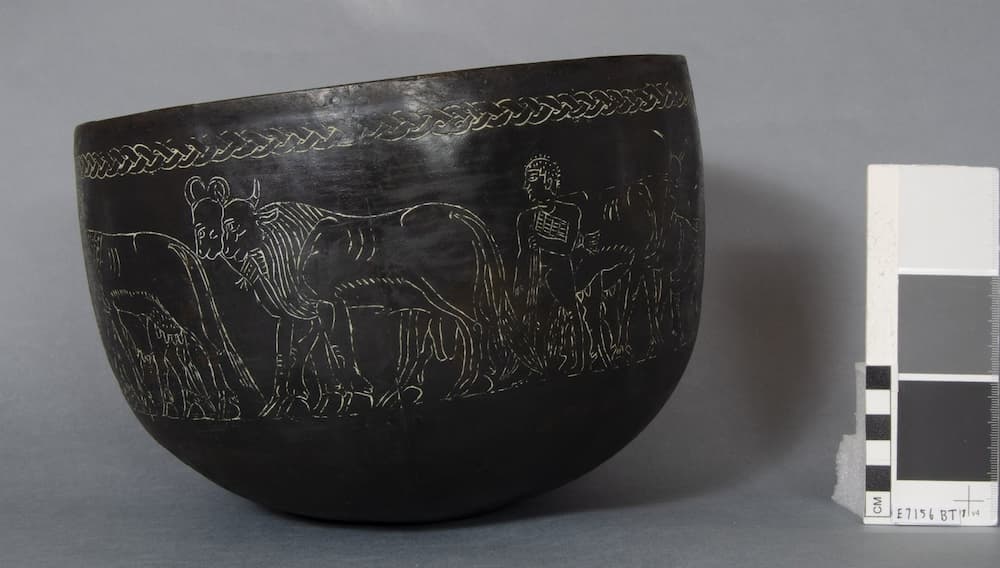
Bowl with cattle and herdsmen. Bronze electrotype reproduction of the original in Cairo (JE 41017). Nubia, Karanog, tomb G187. Meroitic period (270 BCE–350 CE). Original excavated in 1908. Penn Museum E7156.
The pastoral scene that adorns it illustrates the importance granted to cattle herds in semi-nomadic contexts. In front of a thatched hut appears a family, composed of a couple and their daughter. They receive a vessel of milk from a herdsman. The sun disk surmounting the hut identifies the shelter as a shrine. The variations in the shape of the cattle’s horns reflect the East African shepherds’ common practice of purposely deforming them to mark ownership and signal the herdsmen’s prestige. This practice is also illustrated on the ISAC Adindan bowl (E23452), which is decorated with three registers of cattle, some of them with their calves. Each animal is set apart by the shape of its horns, the pattern of its hide, and the position of its tail. We created a separate exhibition area for the ISAC sandstone stelae of the C–Group period depicting cows and their calves, since the very shallow depth of the stelae’s incisions requires reinforced lighting.
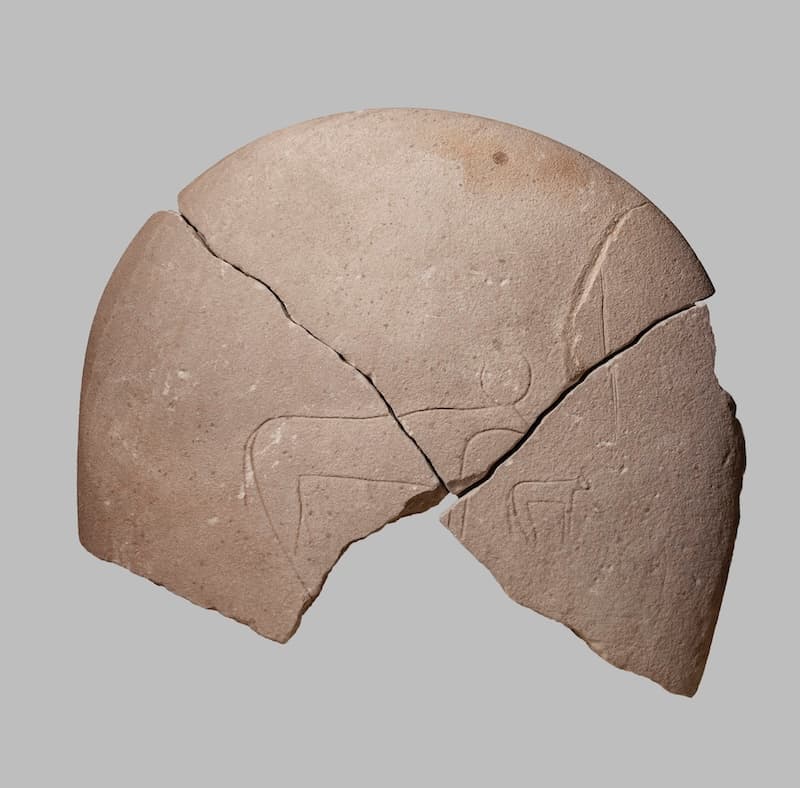
Stela with incised cow and calf. Sandstone. Nubia, Adindan, tomb 39. C-Group (1900–1750 BCE). Excavated in 1964. ISAC Museum E23303 A–C.
Birds are notable for their symbolic functions, as demonstrated by ba statues, guinea fowl stelae, and the magnificent Wizz vase:
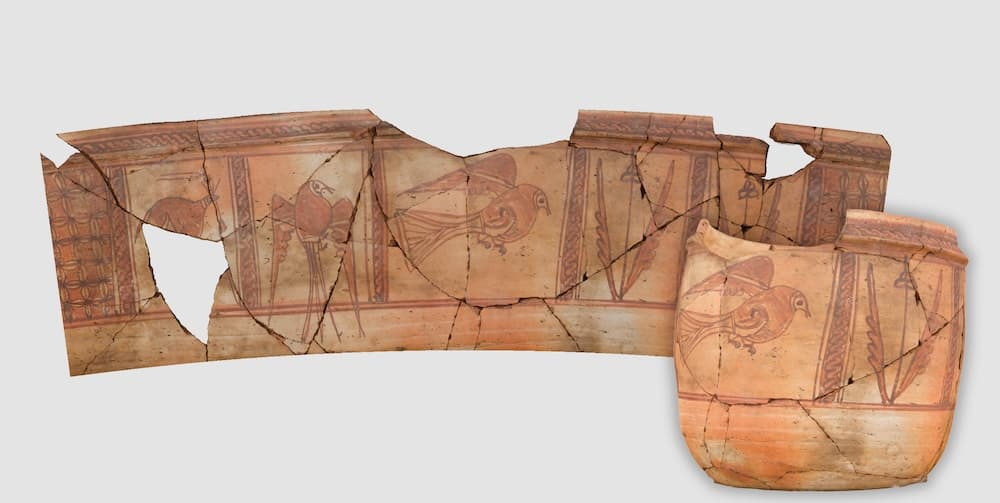
Jar with three birds and a guinea fowl(?). Baked clay, paint. Nubia, Qasr el-Wizz, Area II-UU. Medieval period (ca. 900 CE). Excavated in 1965. ISAC Museum 42001.
Named after the site of Qasr el-Wizz (“Castle of the Flying Geese”), where it was excavated, the Wizz vase presents a frieze of six panels separated by bands of vertical guilloche. The frieze includes an antelope with large ears and twisted horns, a bird with feathers painted frontally but with head, body, and claws oriented to the right, and a central panel with a bird in profile, wings deployed. This masterfully executed frieze exemplifies the artistic skill of the medieval painters at the monastery of el-Wizz. Certainly associated with the diocese of Faras, the master painter was probably part of a workshop that executed several works of art for the clergy, as demonstrated by similar jars and manuscripts discovered in religious complexes in the vicinity.
Fish in Ancient Nubia were an important part of daily life as a key source of food. The Nile and its seasonal tributaries provided a wide variety of fish, including tilapia, catfish, Nile perch, and the Bagrid and Alestes species. Fish remains found in settlement sites and graves show that they were roasted, dried, and possibly salted and brined. Fishing tools such as hooks, nets, and harpoons have been uncovered in archaeological excavations (e.g., at Kerma and Meroe). Fish played notable roles in Nubian art and religion, particularly in connection with the Nile River, which was central to Nubian life both spiritually and economically. Fish are represented in the exhibition in the form of amulets and painted on Meroitic pottery, with designs ranging from stylized geometric fish to naturalistic profiles. Fish were both sacred and practical, crossing the line between ritual offering and subsistence.
Wild and Dangerous
A gold ram’s-head amulet from the Metropolitan Museum of Art (MMA 1989.281.98) opens the next section on wild and dangerous animals, alongside a caprine skull from Adindan (ISACM E23196) and a magnificent bronze antelope figurine from the Royal Ontario Museum (ROM 912.4.24). Savanna animals, such as hippopotami and giraffes, are also part of this section, which features an incised ostrich eggshell fragment depicting a giraffe dated to 3200 bce (ISACM E30288). Displaying this fragment in the show was challenging because a specific intensity of light was needed to illuminate the shallow incisions.
Insects are present, of course, and not only in the form of scarabs and scaraboid amulets. The insect-shaped leather ornament excavated at Qustul is particularly interesting:
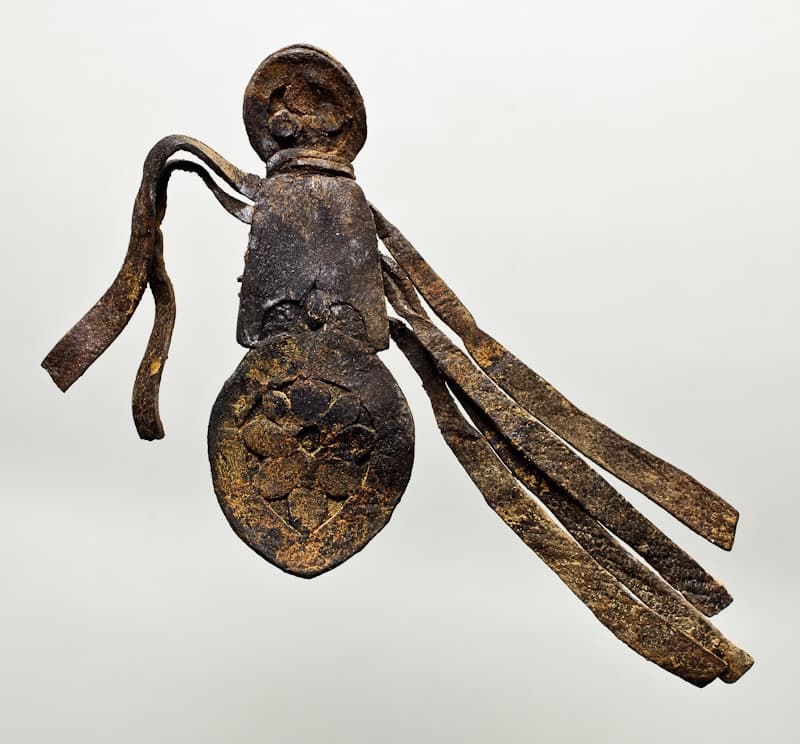
Ornament. Leather. Nubia, Qustul, tomb Q74. Unknown date. Excavated in 1962–1963. ISAC Museum E20186.
It presents a tooled rosette pattern on the “abdominal” part of the object and a tooled design on the “thorax.” The “legs” consist of strips of leather joined under the thorax and twisted to form the underbody. Flies, represented in the exhibition by pendants and faience amulets, were particularly widespread in collars and necklaces, where they were grouped in a row of three. In Egypt and Nubia, flies often made of precious materials, such as gold, have been discovered in tombs dedicated to high-ranking military officials. This association reinforces the interpretation of the fly as persistent and brave, relentlessly harassing the opponent.
Reptiles have a prominent place in the show, including depictions on the ISAC Meroitic fine ware collection from Ballana, such as the famous ankh-spitting cobra jar (ISACM E22563) and the jar with a human-headed frog and a winged goddess:
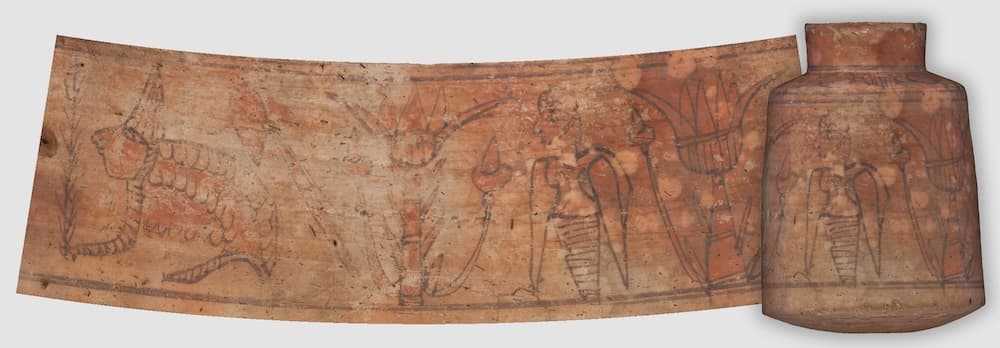
Jar with a winged goddess, a human-headed frog, and flowers. Baked clay, paint. Nubia, Ballana, tomb B66A. Meroitic period (270 BCE–350 CE). Excavated in 1963. ISAC Museum E22480.
The frieze on the latter example groups two hybrid (animal/human) representations. The frog’s human face has been interpreted as a reference to the god Bes, protector of the household, who is regularly associated with the lion and the uraeus in the Meroitic period. It could also refer to the frog goddess Heqat, associated with fertility and abundance. The winged goddess has a spike-shaped body, a capped head, and wings bent downward.
Felines are represented by artifacts from ISAC’s collection as well as two loaned objects: the menat of King Taharqo from the Metropolitan Museum of Art, previously exhibited at the Institut du Monde Arabe in 1997, and a very elegant furniture leg from the Brooklyn Museum:
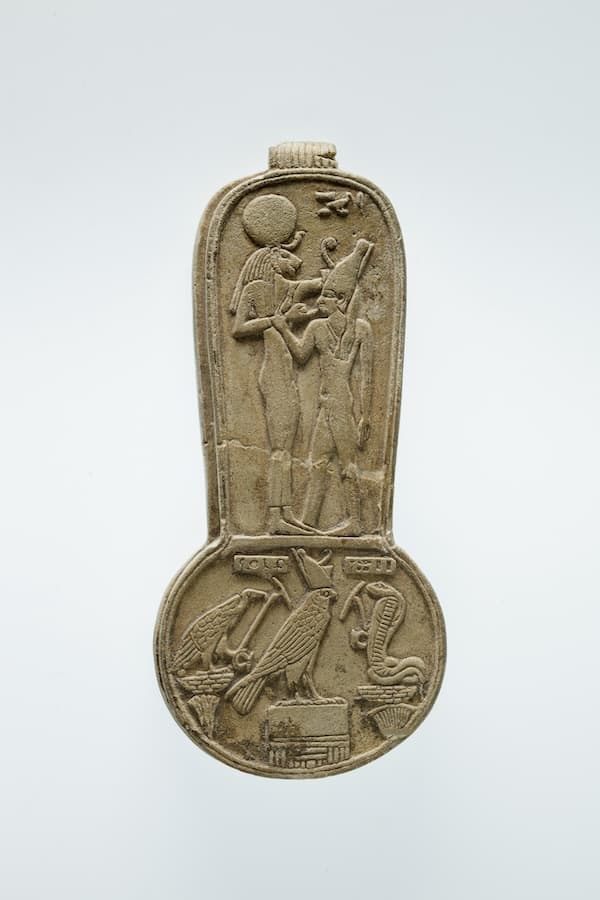
Menat of King Taharqo. Faience. Egypt/Sudan. Third Intermediate Period, Dynasty 25 (747–656 BCE). Bequest of W. Gedney Beatty, 1941. Metropolitan Museum of Art 41.160.104.
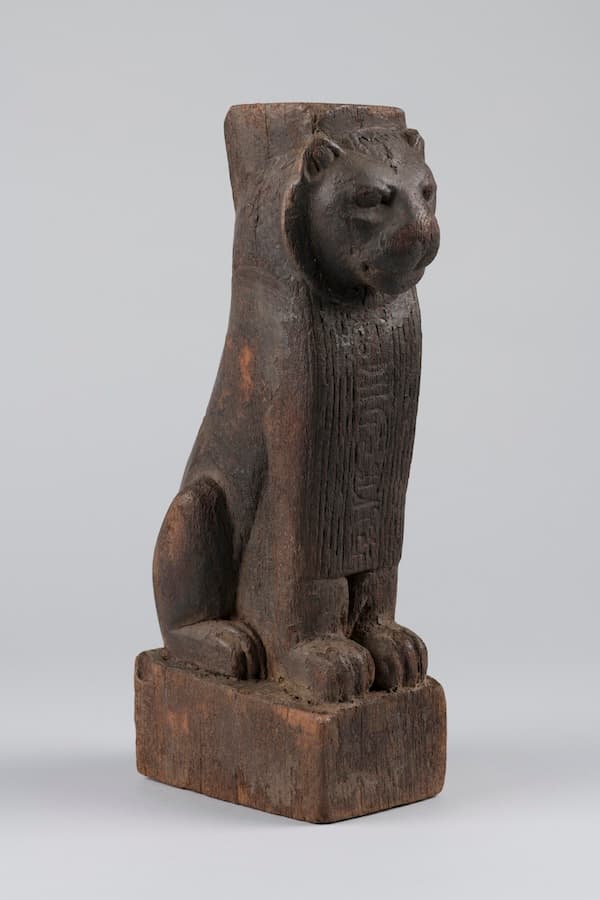
Lion-shaped furniture leg. Wood (sycamore fig, Ficus sycomorus). Egypt/Sudan. Third Intermediate Period, Dynasty 25 (747–656 BCE). Charles Edwin Wilbour Fund, 1948. Brooklyn Museum 37.42E.
This leg is carved in the form of a lion seated on a base. An inscription running down the front of the mane contains the titles and name of Aspelta, one of the most renowned Napatan kings. The piece seems to have been coated with plaster and then possibly painted. As for the menat, it is a necklace counterpoise decorated with a relief scene showing Taharqo as a child nursed by the feline goddess Bastet. The Double Crown worn by the king and the inscription on the reverse identify Taharqo as the King of Upper and Lower Egypt, the son of Re, and “beloved of Bastet,” the latter two epithets reflecting his divine status. The scene in the lower part of the menat represents the king in the shape of a falcon wearing the same crown and flanked by two guardian figures—the vulture goddess Nekhbet and the snake goddess Uto.
Humans’ Best Companions
A limited number of species were welcomed by the ancient Nubians as part of their household. Dogs and cats were particularly favored, and monkeys were a source of entertainment. Through careful observation of their behavior, artists often represented these companions as mimicking human poses and attitudes, demonstrating that the iconography of such animals should be understood as reflecting human traits. The monkey is the most subject to that treatment, to the point where it can substitute for humans in certain activities, such as brushing the hair of its master, setting the course of a boat, or pressing grapes for making wine.
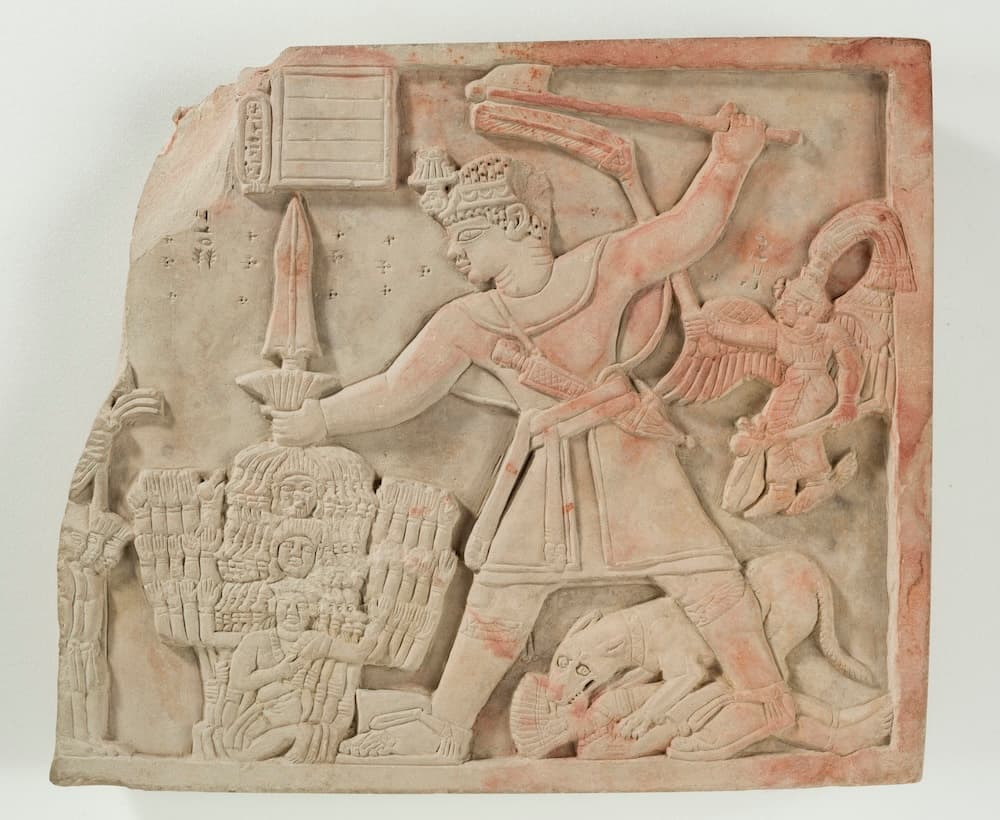
The dog was domesticated as early as the sixth millennium BCE. Several species of dog exist in the Nile Valley. The oldest ones, with erect, pointed ears and a curled tail, are similar to the basenji. One of the most popular was the saluki, with floppy ears and a thin muzzle, slender body, and long tail. It is renowned for its speed in hunting, which explains the numerous representations of canids in Nubian rock art. Dogs are often represented wearing a collar and on a leash, signs of domestication since prehistoric times. Dogs were also used for security, barking to warn of intruders when guarding a house. They were ideal companions, sitting next to their master or under a chair. They also guarded prisoners, as demonstrated on a British Museum jar from Faras (EA51562), or replaced the lion as an embodiment of the king’s strength, a specific Nubian feature. We therefore opened the third section of the show, Humans’ Best Companions, with a resin replica of a sandstone plaque in the Worcester Museum of Art:
Prince Arikankharor slaying his enemies. Sandstone (exhibition replica in resin). Unknown location (Meroe?). Meroitic period (270–350 CE). Purchased in 1922. Worcester Art Museum 1922.145.
The plaque has an unusual feature: it replaces the expected lion at the foot of Arikankharor, shown in the traditional posture of “smiting the enemies,” with a dog. Arikankharor was a crown prince of Kush. The raised–relief plaque shows him as a conqueror holding his enemies by the hair. Behind him floats a female winged victory, the goddess Taleya, who brushes flies away. Between Arikankharor’s legs, a dog mutilates a fallen enemy. Ritual scenes showing the smiting of enemies are a traditional theme of Egyptian military iconography. One of the most famous examples of this theme is carved on the facade of the Lion Temple in Naga, Sudan, featuring the brother of Arikankharor, King Natakamani, and their mother, Queen Amanitore. Taleya occurs only twice in Sudanese mythology, the other example being an inscription at the necropolis of Sedeinga.
Horses and monkeys complete the animals in the Humans’ Best Companions section of the exhibition, with a bowl fragment displaying a horse rider and ISAC’s famous leather quiver and saddle from Qustul Cemetery Q. These objects allow us to reflect on the introduction of horses into Nubia through Egypt around 1650 BCE. Saddles were usually made of a wood frame covered with leather. The legs of the frame were inserted into the pockets at each corner of the leather cover. The ISAC saddle (E20374A) was discovered in a pit with the remains of horses, donkeys, and camels.
Two pieces in the exhibition exemplify the popular motif of a Nubian figure wearing a cheetah skin and accompanied by an antelope and a monkey. A bronze plaque from the Brooklyn Museum (below) and a print of the Metropolitan Museum of Art’s similar ivory figurine from Assyria (MMA 60.145.11) underline the permanence of the ancient topos of Nubians as providers of exotic animals and animal products.
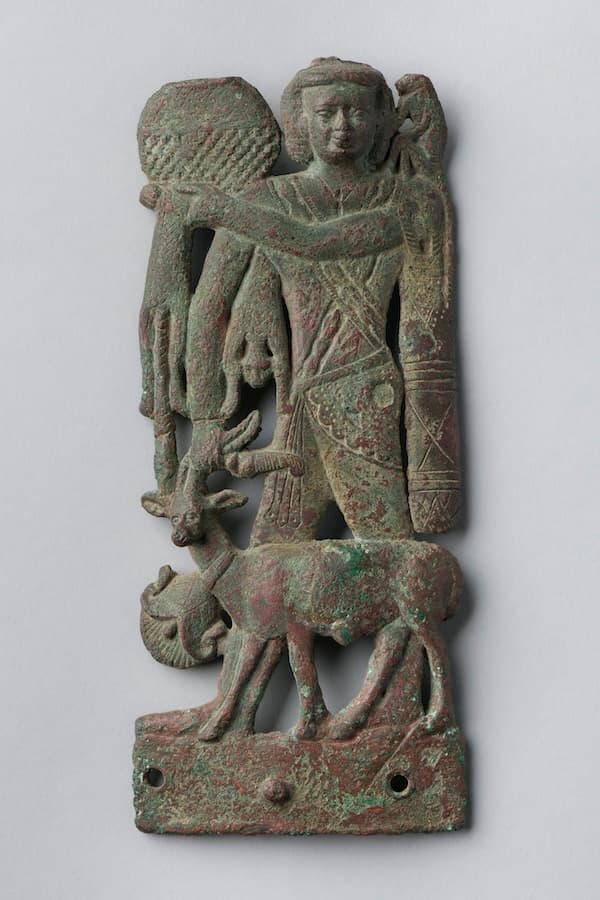
Plaque for attachment. Bronze. Egypt/Sudan. Ptolemaic period (300–250 BCE). Charles Edwin Wilbour Fund, 1955. Brooklyn Museum 56.101.
Originally, the Met statuette was attached to long, ivory plinths and perhaps arranged within a procession of foreigners bringing animal skins as tribute to the Assyrian king. This interpretation would seem to be confirmed by another parallel in the Louvre Museum (E8879), a copper-alloy plaque depicting a Syrian foreigner as a tribute bearer, also part of a furniture plinth. A gazelle represented at the feet of the Syrian tribute bearer symbolizes the submission of the desert to the pharaoh’s power.
This section concludes with a tempera-on-paper copy by Nina de Garis Davies of a scene from the Theban tomb of Rekhmire:
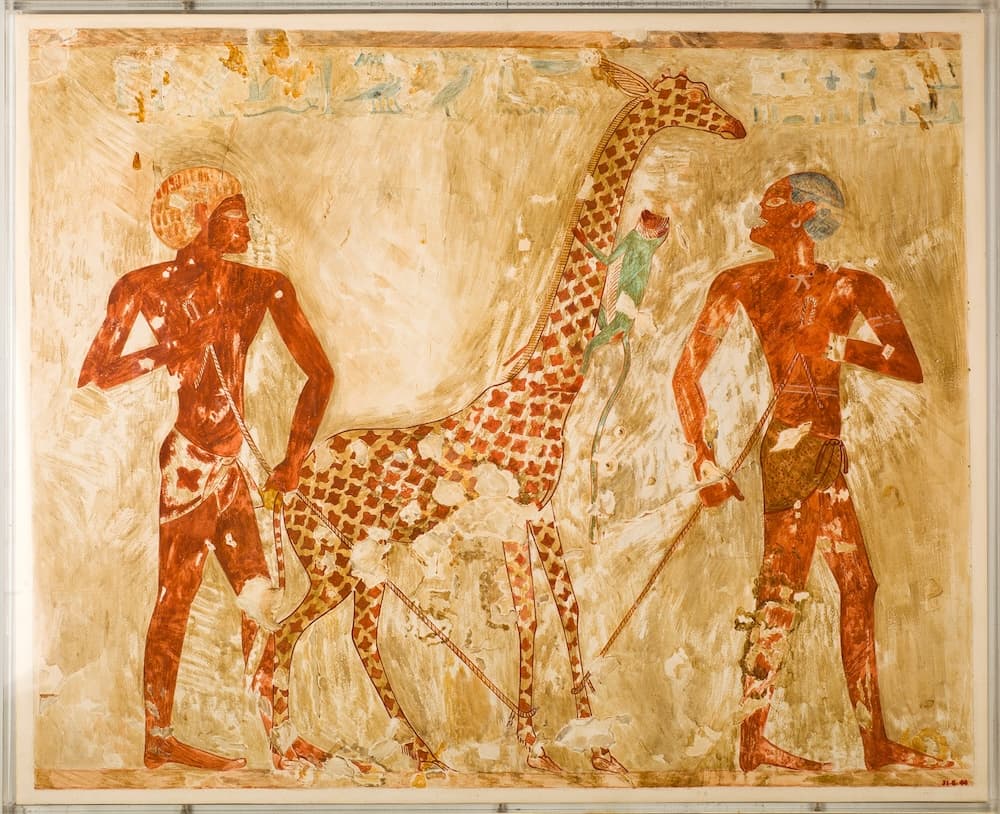
Facsimile of Nubians with a giraffe and a monkey. Nina de Garis Davies (1881–1965). Tempera on paper. Original from Egypt, Thebes, Sheikh Abd el-Qurna, tomb of Rekhmire (TT 100). Original New Kingdom, Dynasty 18 (ca. 1504–1425 BCE). Rogers Fund, 1931. Metropolitan Museum of Art 31.6.40.
In addition to acknowledging Davies’s exquisite work in recording the Theban tombs from 1907 to 1940, the facsimile is a good way to shine a spotlight on two topics: (1) the African green monkey, native to sub-Saharan Africa, and (2) the question of scale, since the giraffe’s size has been reduced to favor compositional harmony over realism. The painting is representative of the identification of Nubians as providers of exotic animals in tribute processions. The giraffe’s legs are tied, and the monkey, whose facetious character is emphasized here, is represented as climbing the giraffe’s neck. This motif is a variation of a more regular scene, where the monkey climbs the trunk of a doum palm. As noted earlier, monkeys were particularly popular among the Egyptian and Nubian elite; like dogs and antelope, they were often depicted alongside their owner or substituting for humans in certain chores, such as grooming their master’s hair. In this painting, the species chosen is the vervet monkey (Chlorocebus sabaeus), native to sub-Saharan Africa and renowned for its green fur.
The Nubian Landscape and Ecosystem
The exhibition closes with a fourth section dedicated to the Nubian landscape and ecosystem. Here, we reflect on the gradual shift toward aridity at the end of the Neolithic period and its impact on fauna. Human pressure on the distribution of fauna is also addressed, as widespread pastoralism led to conflict with wild animals and farmers, a particularly acute phenomenon in today’s troubled times in Sudan. Indeed, the expansion of pastoralism in the Butana region of eastern Sudan intensified competition with wild species traditionally living in this area, which progressively became inaccessible to antelope because of excessive loads of domestic stock and thinning vegetation. Hunting on a massive scale, as demonstrated by elephant tusks discovered at Wad Ben Naga or the founding of Ptolemais Theron (“Ptolemais of the Hunt”) on the Red Sea shore for the capture and export of elephants, also explains the migration of savanna animals toward the south:
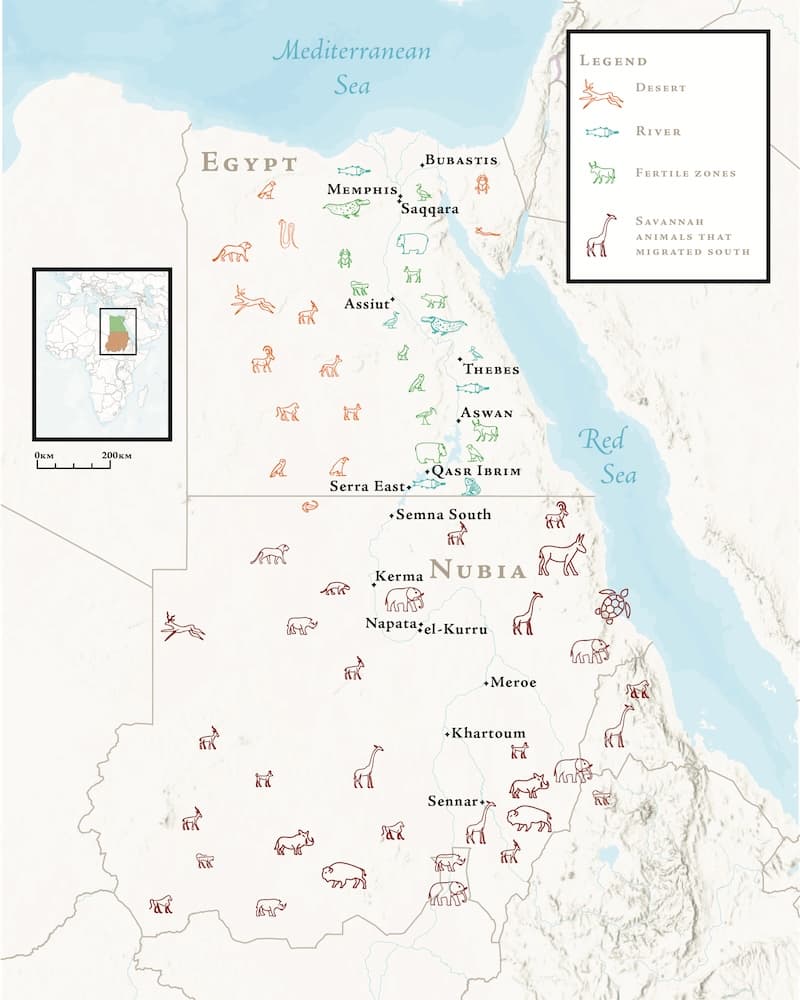
Distribution map showing the distribution of fauna in the Nile Valley.
Three objects illustrate how the Nubian animal world was represented by human contemporaries as symbolic embodiments of the landscape and prevailing political structure. The Qustul incense burner (ISACM E24069), whose representation of a palace facade is among the first evidence of a centralized power in the Nile Valley, displays a complete menagerie impersonating the power of the king. The fact that the same animals are mobilized until the medieval period demonstrates the exceptional permanence of these motifs in royal pageantry. They are all aboard boats in a procession floating on the Nile toward the house of the pharaoh, thereby underlining his control over the land.
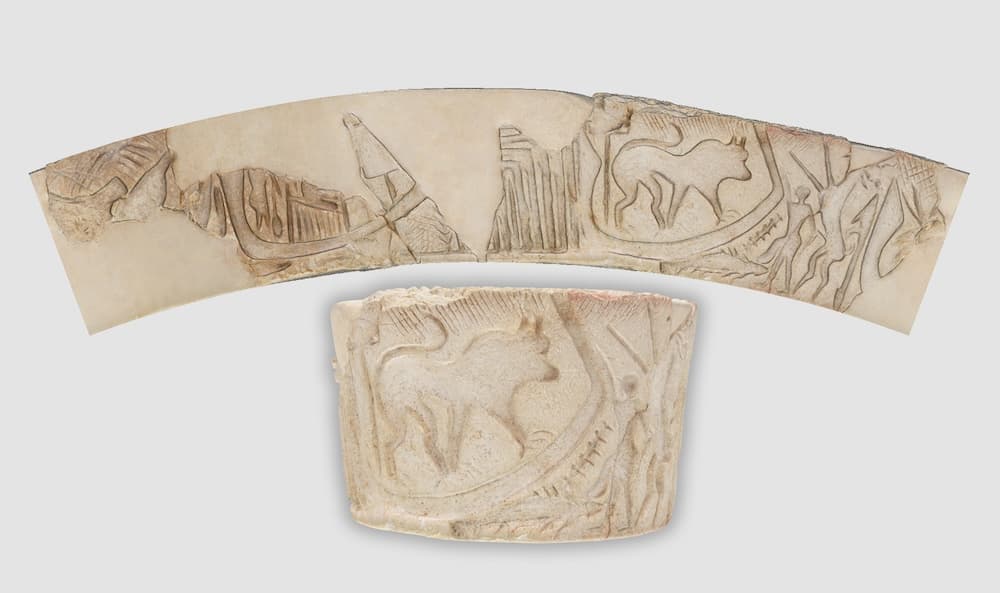
Incense burner. Limestone (with modern restoration). Nubia, Qustul, tomb L24. A-Group (3200–3100 BCE). Excavated in 1964. ISAC Museum E24069.
The bowl with a tree and another animal procession, also discovered in a funerary context, is particularly rich in symbolic significance:
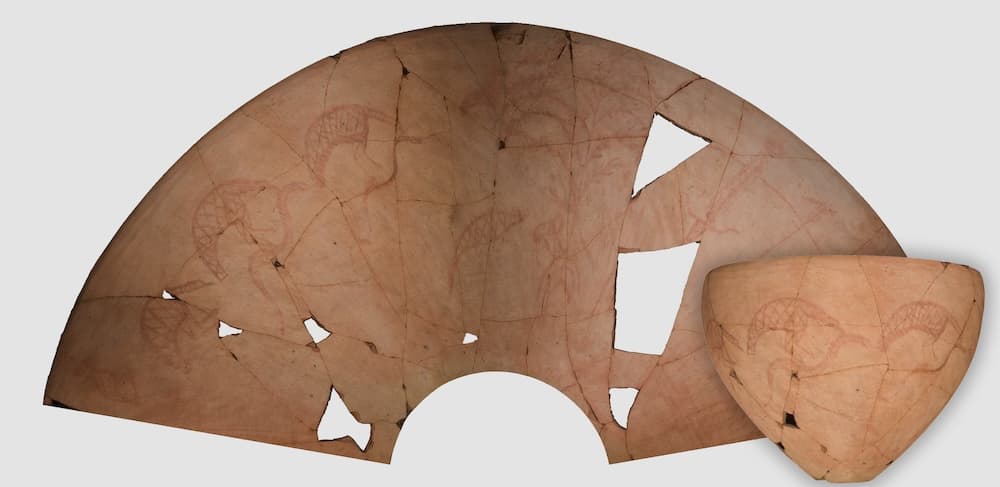
Bowl with animal procession and tree. Baked clay, paint. Nubia, Qustul, tomb L23. A-group (3200–3100 BCE). Excavated in 1964. ISAC Museum E24119.
The animals represented are literal metaphors of the landscape within which victory against the enemies of the state and the evil forces of nature is ensured by the unifying power of the king over the land. The focal point of the bowl’s decoration is the shrine, represented by vertical poles surmounted by emblems, which places the restoration of order under the patronage of the divine. The bowl was meant to be displayed in public before its transfer to the deceased’s viaticum, thereby reinforcing the eloquent messaging evoked by the animal world in ancient Nubia.
To conclude, allow me to focus on a fable. The jar with the animal procession, or “Hyena jar”, is also illustrative of the evocative power of fauna in Nubia, but through a different lens:
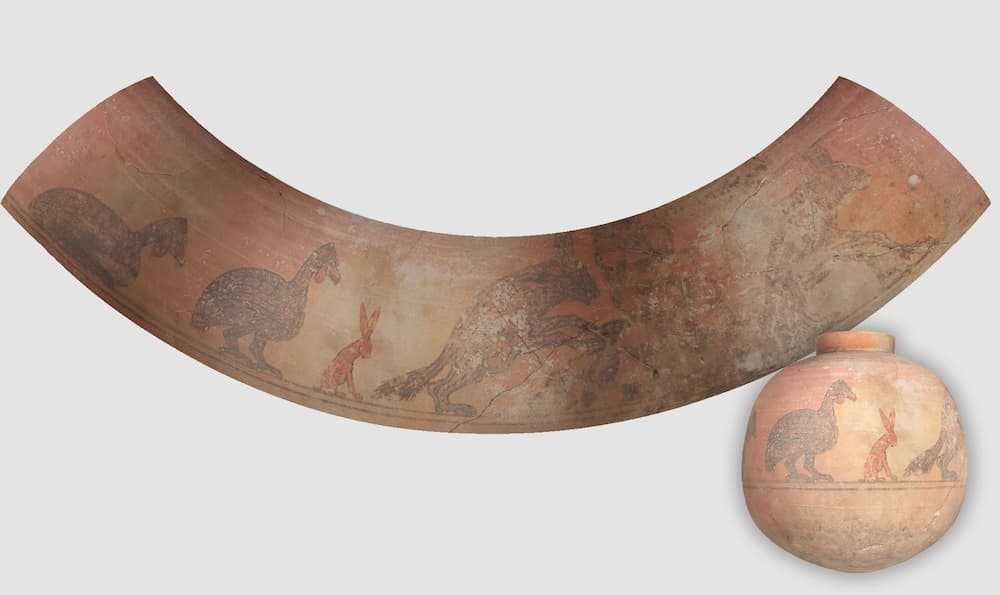
Jar with animal procession. Baked clay, paint. Sudan, Semna South Cemetery, tomb N224. Meroitic period (270 BCE–350 CE). Excavated in 1966–68. ISAC Museum E35579.
The juxtaposition of these animals within a frieze whose central design is a rocky cataract, a most salient marker of the Nubian landscape, conveys a taste and keen eye for the observation of nature. The discovery of the jar in an elite funerary context reinforces its importance to the owner. This jar was excavated at the site of Semna South. Originally built as a Middle Kingdom fortress, Semna was used as a cemetery in the Meroitic period. The jar was discovered in one of its graves. The animals painted on it—a hare, two hyenas, and two guinea fowl—are indigenous to East Africa. This composition was possibly meant as a bucolic scene, as the stones depicted may represent a rocky cataract of the Nile River, or possibly a cave. The significance of the animals themselves is unclear, possibly referring to a lost tale or a fable. It is therefore possible that the two guinea fowls, like the two hyenas, in fact represent the same animal depicted at two different moments in the narrative.
Although the guinea fowl is more rarely involved, numerous African folktales feature the hare and the hyena — the former often outwitting the latter thanks to its legendary cunning. This is the case among the Shilluk (South Sudan), the Tiv (Cameroon, Nigeria), the Mande peoples of West Africa, and the Wasukuma of Lake Victoria. Among the Maasai and the Wakamba of Kenya, numerous tales depict a hare and a hyena in a cave — perhaps corresponding to the rocky formation on the Semna jar — which most often contains meat. Given how much literary motifs must have evolved since the Meroitic period, great caution is required regarding the supposed survival of ancient narratives in modern forms within oral literature. Nevertheless, representations depicting animals that seem to be natural opposites are quite common in Kushite art, celebrating wit over strength.
Post a comment