Piles of dung cakes drying. Nihal Singh Wala, District Moga, Punjab, India 2014. Photo by Satdeep Gill, CC By-SA 3.0.

Animal Dung and Energy — A View from Mesopotamia

November 2025 | Vol. 13.11

By Alex Joffe

Baby, It’s Cold Outside

Humans need heat to keep warm and to cook. This is true whether you’re a Windmill Person or on Team Drill Baby Drill. The same was true in the ancient Near East. But in the era before fossil fuels, options were limited. You could burn trees and shrubs or you could burn animal dung.

So where in the ancient Near East did you get animal dung, how did they use it, and what were the rules? This is to say, what were the cultural, political and legal rules which governed its acquisition and use, as fuel or anything else, and how do we discern them? The short answer to this last question is from Mesopotamian texts, where there is a surprisingly small amount of information about animal dung as fuel. This absence, however, suggests quite a bit.

Where Does Animal Dung Come From?

As any pet owner knows, animals create dung. Animal domestication, specifically of sheep/goat, cattle and pigs, occurred between 8,500 and 8,000 BCE as humans manipulated animal reproduction and genetics to create bigger, meatier, and more docile animals. Another result were secondary animal products, meaning milk, hair and wool, the ability to carry and pull loads, and animal dung.

Animal proteins in meat, milk and blood were critical for human nutrition, which allowed for population growth. Products like skins were the original basis of clothing, but manipulating hair and wool permitted creation of cords, ropes, nets, baskets and bags for storage, transport, fishing and finally woven textiles. Keeping animals also changed the relationship of humans to the landscape; the larger the population, the greater the need for animals and products, meaning larger herds and more grazing lands, and, of course, more dung.


How Do You Use Animal Dung?

The most obvious use of animal dung is fertilizer for crops—ever since the advent of agriculture ca. 10,000 BCE—but it is also used for fuel and as temper for pottery and mortar for construction. So how much dung do animals produce anyway?

Estimates of manure production vary widely and are contingent on factors like breed, size, age, and environmental conditions; data from dry Australia suggest perhaps 500 kg annually per head of cattle, while optimal North American feedlot cattle produce around 2007 kg. Either way, that’s a lot of dung. Sheep produce 150 kg and goats about 100 kg.

But transferring these figures to the ancient Near East is difficult. Since livestock production is partially dependent on water, let’s arbitrarily adopt a low figure of 50 kg of dung per sheep annually. This suggests the estimated 320,000 animals associated with the city of Ur during the Ur III period (ca. 2111-2003 BCE) produced approximately 16,000,000 kg of manure annually. Thousands of cattle would also have produced large amounts. Again, that’s a lot. Such rough estimates suggest the amount of animal dung available in Mesopotamia was large, but it would have been distributed very unevenly between irrigated and dry farming regions, rural and urban areas, and the spaces in between, and across the agricultural year.


Iraq map showing land utilization zones. Central Intelligence Agency. Cartography Center, 2003.

What about dung as fuel? The energy potential of dung is considerable, which is why it is still used in many parts of the world today.

Dried cattle dung produces between 11-18 MJ/kg which compares well to other biomass fuels. Put another way, one kilogram (2.2 pounds) of dry cattle manure equates to about 1300 BTU (British Thermal Units). Dry dung burns evenly and quickly and produces little smoke but lots of volatile organic compounds (be sure to open a window).  

Dung cooking fire. Pushkar India. Photo by שיע.ק, CC By-SA 3.0.

But how much do you need? Andean data indicates 15 kg of dry dung is needed for a three hour fire kindled twice a day. This requires a penned herd of 19 cattle or 75 llamas and allows for 40% collection. In contrast, Bedouins in semi-arid areas of Syria and Iraq use an estimated 25-30 kg of wood and shrubs per family per day, resulting in large-scale denudation and soil erosion. Not an especially sustainable practice.

A donkey carrying collected brush and roots for fuel, Ottoman Palestine between 1900 and 1910. Library of Congress, Matson Collection, LOT 13756, no. 18.

Archaeology shows that animal dung was nearly everywhere in the ancient Near East, which is not surprising considering the close proximity of humans and animals. All sorts of data from archaeobotany, soil geochemistry, micromorphology, biomolecular archaeology, and microarchaeology demonstrate that dung was used on and off-sites in all periods, including as fuel. The proportion of dung to wood as fuel, however, appears to have varied considerably from site to site with access woody vegetation, especially in northern Mesopotamia. Agricultural use of dung has also been documented indirectly, for example by worn sherds in off-site surveys, indicating collection of manure from habitation sites placed in fields. 

Dung and Energy

Ethnographic and historical evidence shows how dung is collected and processed into fuel. Manure is collected during the summer, usually by women and/or children, formed into cakes, often with the addition of straw, and allowed to dry. Sheep/goat and gazelle dung presents particular problems given the small size of the pellets. Typically, pellets are collected and compressed into patties or sheets, which is simplified by penning animals. Dung cakes are dried outside in open spaces such as courtyards and then stored inside for later use.

Piles of dung cakes drying. Nihal Singh Wala, District Moga, Punjab, India 2014. Photo by Satdeep Gill, CC By-SA 3.0.

In the Iraqi marshes dung was regarded as property; herders made agreements with farmers to pasture cattle on fields during the winter while claiming certain quantities of dung and milk. Taking dung from another family’s cattle could result in feuds. And in a southwestern Iranian village a gifted dung cake might be seen as an act of generosity.

So modern individuals and communities regard dung as a valuable commodity. What about in Mesopotamia? On the one hand there is ample archaeological evidence for use of dung as fuel. But on the other, written evidence minimal; institutions apparently did not regard dung as a primary resource.


Dung in Mesopotamian texts

Mesopotamian texts were produced by administrators for institutions like palaces, temples, and family corporations. Texts reflect the economic, political, and legal concerns of those institutions, and while they infrequently discuss dung, it is never in terms of energy. That is a telling omission.

The earliest Mesopotamian text references to dung are difficult to understand and terms for dung appear infrequently in the later cuneiform record. The most common terms appear to be kabūtu (animal dung, Sumerian šurim/šurum/n), ṣabītu (gazelle excrement), putrum (animal droppings, dung, dung cake), and tabāštānu (excrement).

The term kabūtu or animal dung, for example, is used in Neo-Assyrian (ca. 912-612 BCE) divination, magic, and medical texts, such as in this text from the Library of Ashurbanipal:

If a man suffers from sores on the ankle and his heels are swollen, the muscles in his legs are thick, so that he is not able to walk: in order to heal him, you pound gaṣṣu (‘gypsum’), saḫlû (‘cress’), uḫūlu qarnānû (‘horned alkali’) (and) dung cake, you stir them into a paste in milk using a small copper pot, you smear (the mixture) on a piece of fabric while it is steaming hot, you bandage him with it and you should not remove it for three days.

Kabūtu also appears in a Neo-Assyrian treaty between Ashur-nirari V and Mati-‘el of Arrad (BM.134596) as part of a curse formula:

May Sin, the great lord who dwells in Harran, clothe Mati'-ilu, [his so]ns, his magnates, and the people of his land in leprosy as in a cloak; may they have to roam the open country, and may there be no mercy for them. May there be no more dung of oxen, asses, sheep, and horses in his land.

This text implies that lack of dung was a serious agricultural problem for the kingdom but not an energy resource. Conversely, the term kabūtu is absent in the many texts praising rulers who bring prosperity to their lands, for example the Ur III king Gudea, who makes “certain that faultless cattle and goats, grain-fed sheep, fresh bread and hind’s milk are available day and night”. 

As for other terms, tabāštānu is found in a bilingual liturgy and an astrological divination. Another uncommon term, piqannu (Sumerian A.GAR.GAR), refers to gazelle droppings and is used in medical texts, especially related to eye diseases. The words ṣabītu and putrum are used in medical, magical, and divination texts in a ritual to counter bad omens.

Several texts, however, suggest that putrum had an economic role as manure. An Old Babylonian (ca. 1894–1595 BCE) letter requests: 

When you see my letter, load 4 shiploads of dung into baskets made of cane and bring (these) away to me… You will have 20 tons of dung patties, 1 shock [bundle of reeds] and 20 talents of wood chips brought to me for the offering of the god Marduk on the 10th of Simanu. It further follows that this will be paid to Marduk.

This sounds like fertilizer. A Neo-Babylonian (626–539 BCE) text from Uruk also discusses a shipment of manure saying “give them dung cakes and plants there for nothing, but sell them here for a profit.”

There are also laconic references to dung in literary texts. The Lament for Sumer and Ur, composed in the late third millennium and known from Old Babylonian period copies, (lines 38-47) cites dung in the context of rural agricultural activities:

That the hoe not attack the fertile fields, that seed not be planted in the ground, That the sound of the song of the one tending the oxen not resound on the plain, That butter and cheese not be made in the cattle pen, that dung not be laid on the ground, That the shepherd not enclose the sacred sheep fold with a fence, That the song of churning not resound in the cattle pen, To decimate the animals of the steppe, to finish off (all) living things, That the four-legged creatures of Sakan not lay dung on the ground

A handful of Sumerian proverbs, which also originate in the third millennium and are primarily known from Old Babylonian period copies, also mention dung, for example “From 3600 oxen is there no dung?” and “You are multiplying oxen (and) you are collecting their dung!” These didactic, conservative, and often playful sayings imply scribes understood the uses of dung were for agriculture rather than for energy.

Finally, dung is mentioned in a negative context in the “Poem of the Righteous Sufferer,” composed in the late second millennium and known from Neo-Assyrian and Neo-Babylonian copies:

From writhing, my joints were dislocated, My limbs were splayed, they were lying awry. I spent the night in my dung like an ox, I wallowed in my excrement like a sheep.

Then as now, being abandoned by the gods and being forced to lie in dung like an animal was a metaphor for human degradation and pollution.


Why aren’t there more references? And what about energy?

Understanding a pattern of absence is problematic. But surveying lexicons, electronic databases, and text corpuses nonetheless suggests that terms for dung are conspicuously absent from Mesopotamian economic texts such as ration lists, inventories, contracts, as well as from school texts and legal cases. Nor are references found in Mesopotamian agricultural manuals such as The Farmer’s Instructions which discuss fields, irrigation canals, animals, and implements. In contrast, much later Roman agricultural manuals such as Cato’s De Agricultura have extensive discussions of manuring.

Other texts discuss land tenure and land sales, crops, productivity, payments, and irrigation, but not manuring practices or dung as an agricultural or energy resource. And yet texts also make it clear institutional herds were routinely managed alongside private herds, and hundreds and thousands of animals were annually delivered to cities for sacrificial purposes alone. 

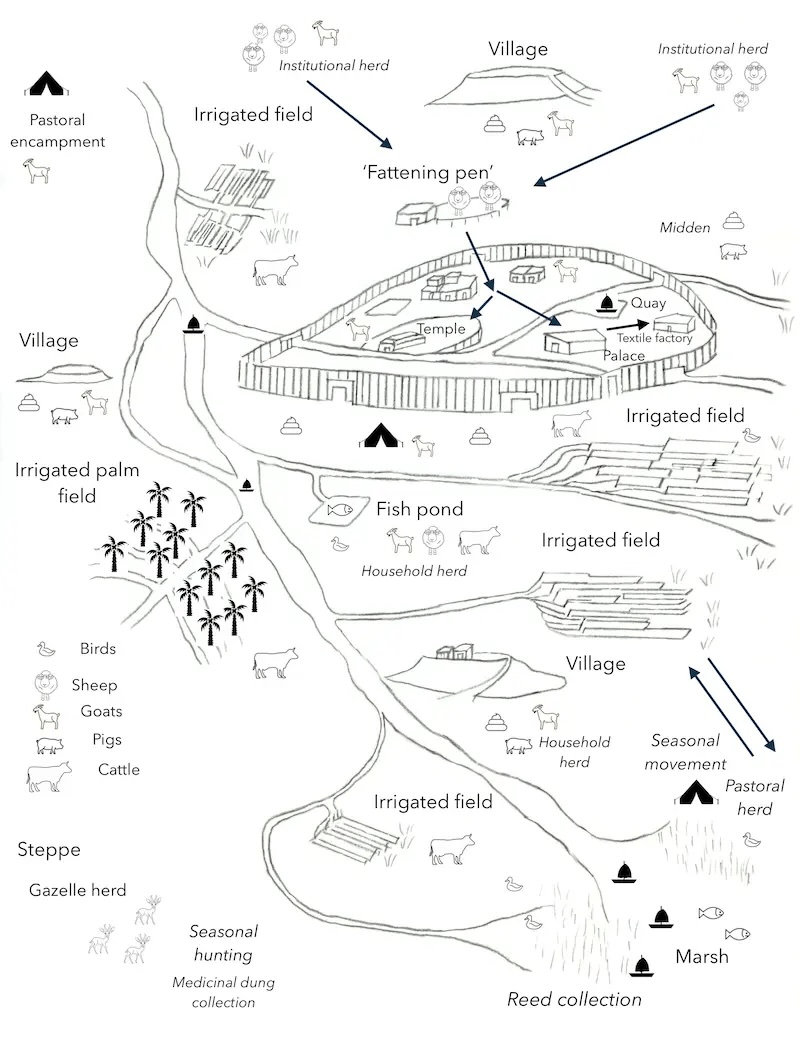
Reconstruction of a Mesopotamian landscape showing areas of agricultural production, animal utilization and potential dung collection. Drawing by Alex Joffe.

Even during the time of the Third Dynasty of Ur (ca. 2112–2004 BCE), when bureaucrats went to extreme length to record everything they could, dung was not a recorded commodity. For example, a central “livestock agency” at Puzriš-Dagan (Tell Drehem) with branch offices recorded many aspects of animal administration; the collection of living, dead, and exotic animals for wool production, meat consumption for gods (meaning cult personnel), the royal household, dependents, workers, the military, and dogs, and for extispacy (divination via animal entrails). But no dung.

The Mesopotamian tradition did not appear to have had a term for dung collector or even street sweeper, but it did have a term for forester, lu-tir. In some periods groups of foresters would collect tens and hundreds of tons of trees, reeds, and grasses for shipment to southern Mesopotamian cities and allocation to state workers. These energy resources were exploited by institutions using recognized categories of worker. Dung was not.

Iraq, a barge carrying fuel on the Tigris at Baghdad, 1932. Library of Congress, Matson Collection, LC-M33- 4606 [P&P].

Finally, animals appear frequently in both Mesopotamian art and non-economic texts as symbols of power, motherhood, and beauty, but dung as fuel or fertilizer is absent. Whatever utility dung and potential economic value had for agriculture or for energy, the commodity was not symbolic of power or wealth. Which was probably for the best.

The place of dung

The collection, storage and use of dung, including whatever energy was produced, was apparently conducted almost completely out of the view of literate institutions. Public institutions were aware of dung as an agricultural resource since it was a component of state prosperity but they do not claim to have controlled the commodity, even through taxation. Private institutions discussed dung as a common, apparently readily available medical material. But dung as an energy resource goes unmentioned.

Dung was apparently part of an informal economy; households could obtain the commodity by following patterns and rules that were of little interest to institutions. This economy functioned well enough to have not even been the subject of court cases. How dung was collected, stored, and used by private institutions like families remains unclear. I’ll trade you this pot for a dung cake? Kids, go out and scour the streets? We don’t know.

As we prepare for another long and lustrous winter, we might ask how the early complex societies like Mesopotamia, Egypt, the Indus Valley, China, and in the Americas addressed thermal energy. They may not have many answers for us, but animals and dung are a common thread in their evolution which deserves closer examination.

Alex Joffe is an archaeologist and historian. He is Director of Strategic Affairs for the Association for the Study of the Middle East and Africa and one third of the podcast This Week in the Ancient Near East. He also founded The Ancient Near East Today 

Further reading:

Joffe, Alex. 2025. Notes on the Mesopotamian Energy Economy. Oxford Journal of Archaeology 44 (2), pp 120-138. https://doi.org/10.1111/ojoa.12320

How to cite this article:

Joffe, A. 2025. “Animal Dung and Energy — A View from Mesopotamia”, The Ancient Near East Today 13.11. Accessed at: https://anetoday.org/animal-dung-energy/.

Want to learn more?

Post a comment

Your email address will not be published. Required fields are marked *