
Russian Archaeology of the Holy Land
Politics have long been the context for scholarly activity and Russia’s are no exception. The past 150 years of Russian research into Holy Land antiquities were a by-product of Russia’s Eastern policy from the second half of the 19th century onward. The same may be said for other European powers that attempted to reinforce their positions in the lands of the weakened Ottoman Empire.
Various Russian organizations and individuals were active in Ottoman Palestine, but most prominent were the Russian Foreign Ministry, the Russian Ecclesiastic Mission, and the Imperial Palestinian Orthodox Society—a benevolent organization under the patronage of the Royal Russian family. All were united in a common effort to reinforce the positions of the Russian Empire and the Russian Church in the Orient and to facilitate the pilgrimage of thousands of Russians willing to visit the holy sites of Palestine.
One of the most effective agents of the Russian Oriental project was Fr. Antonin Kapustin (1817–1894), a priest who led the Russian Church mission in Jerusalem for over 30 years. To establish a strong position for the Russian Church in the Holy Land, he purchased lands where he built churches, hospices for pilgrims, and schools for local children. Being a passionate antiquities collector, Kapustin often purchased land plots ‘with ancient ruins.’ The presence of archaeological remains, either at the site of the land plot or nearby, or both, was an important element in the decision to purchase the lands intended for construction in Jerusalem. Examples included plots where the St. Alexander’s Compound, near the Holy Sepulchre Church, St. Mary Magdalene Church in Gethsemane, and the Ascension Monastery on the summit of the Mount of Olives were built. Outside the Holy City, these included lands for a pilgrim guesthouse in Jericho, for a large compound in Jaffa, and many others.
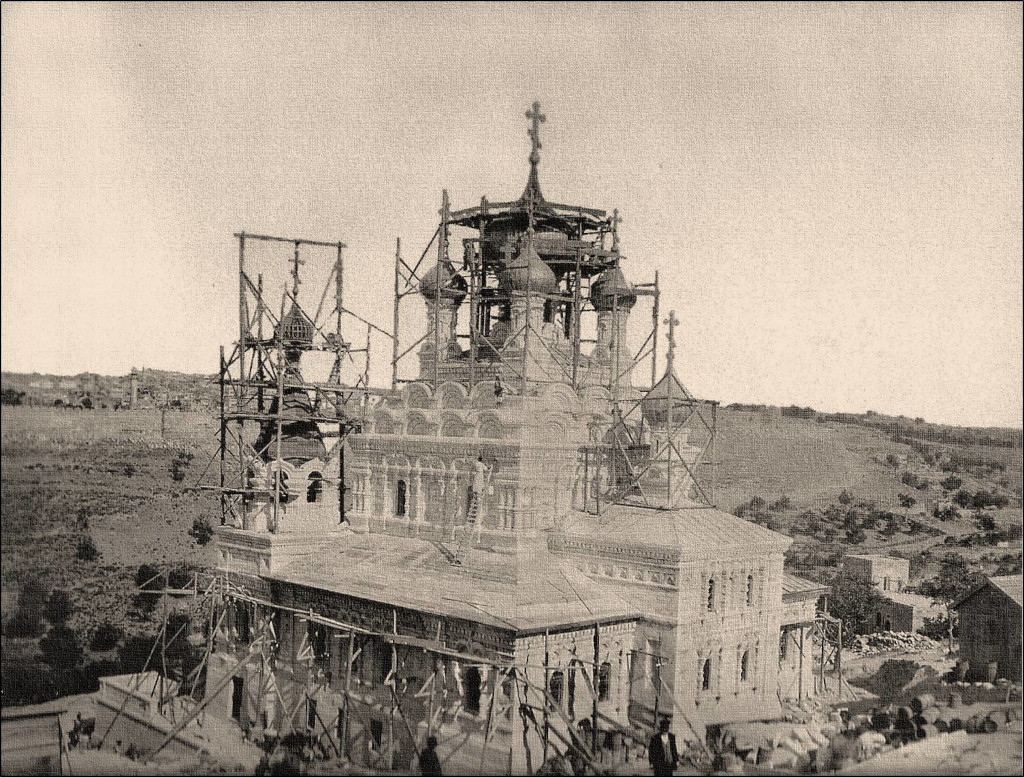
Construction of St. Mary Magdalene church in Jerusalem, 1887. Courtesy of GMIR, St. Petersburg.
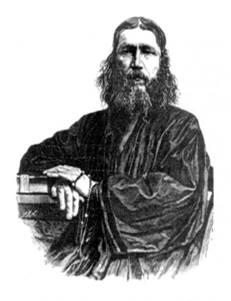
Fr. Antonin (Kapustin), head of Russian Church mission in Jerusalem.
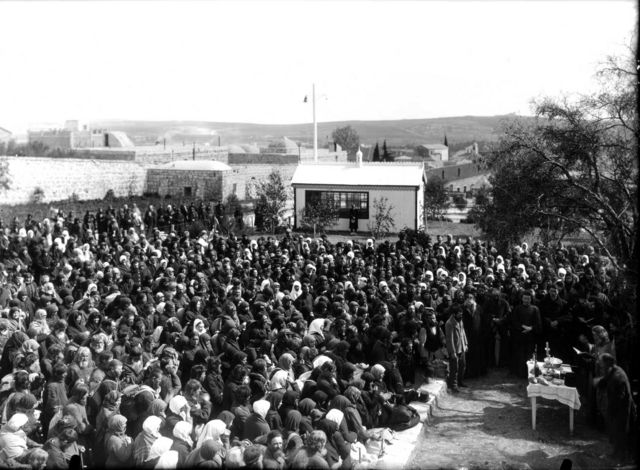
Fr. Antonin is preaching to pilgrims. Jerusalem, Russian compound. 1880-s. Courtesy of GMIR, St. Petersburg.
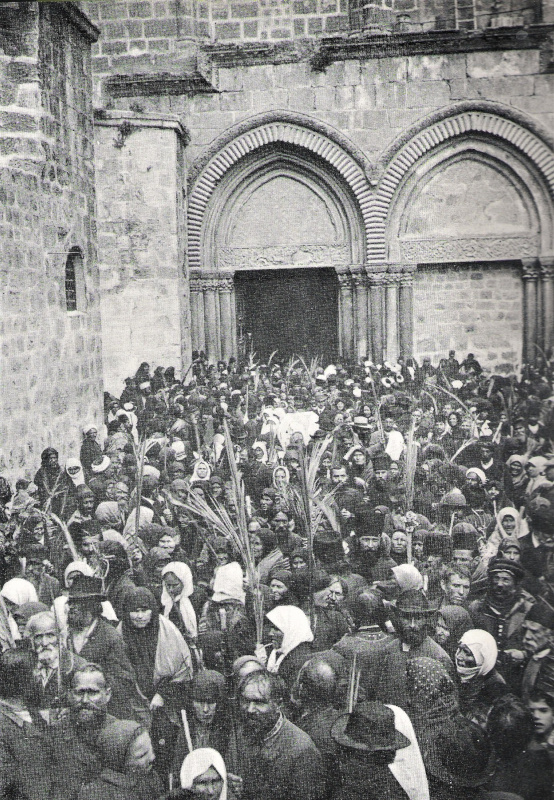
Russian pilgrims in the courtyard of the Holy Sepulchre at Palm Sunday. 19th c. photo
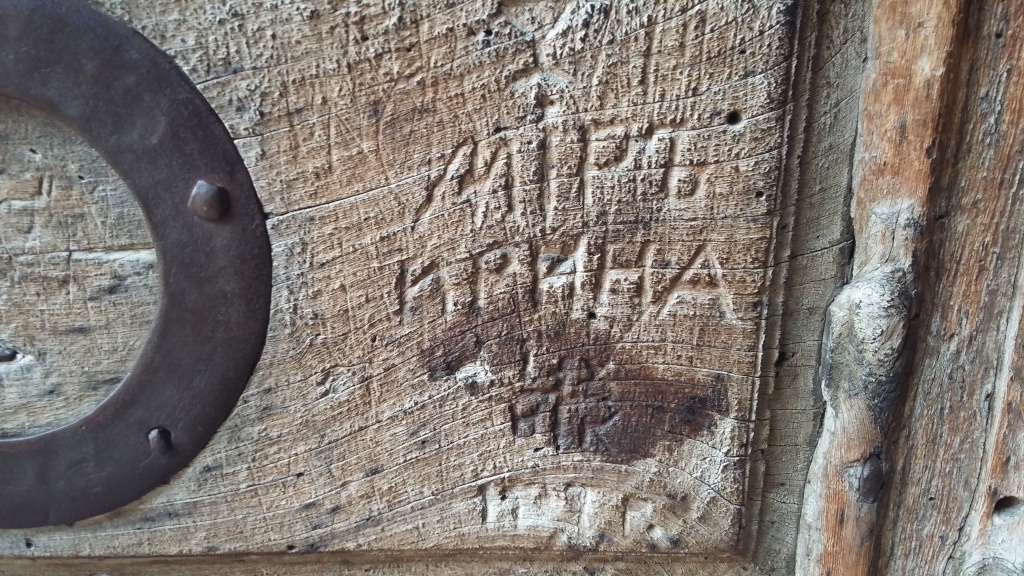
Russian pilgrim’s graffito on the doors of the Holy Sepulchre church.
A survey of the remains and excavations preceded almost every building activity in the newly obtained sites. Like many of his enlightened contemporaries, Fr. Antonin was an amateur scholar and an antiquarian. He often excavated in the purchased sites and showed the most vivid interest in research on ancient monuments. He was acquainted with the work of the leading scientists working in the Holy Land in the last third of the 19th century and knew many of them personally—among his close friends were Charles Clermont-Ganneau and Conrad Schick.
The mostly unpublished diary of Fr. Antonin is an interesting and detailed source for the history of Jerusalem in the last third of the 19th century, detailing the most important events and personalities of the Holy City. Together with other Russian sources, such as diplomatic reports, pilgrimage accounts, photographs and so forth, they represent extremely important sources for the archaeological study of certain key sites and particular finds in Jerusalem, Jaffa, and Jericho.
Russian scholars were also active elsewhere in the region.
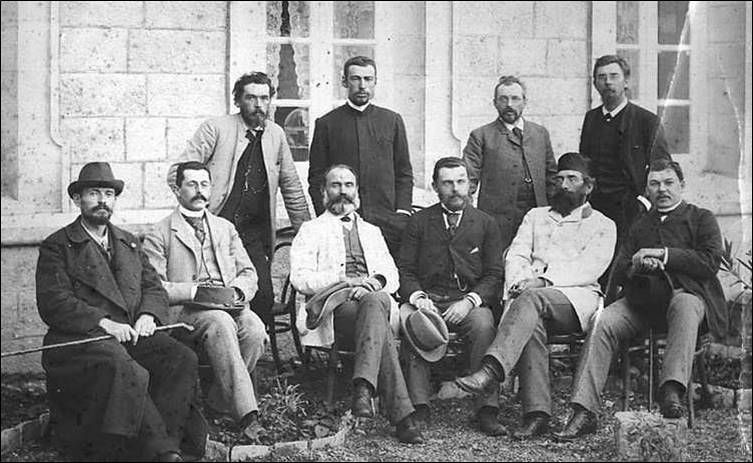
Members of Russian expedition to Syria and Palestine in Jerusalem,1891. Seating in the center: Akim Olesnitskii; second from the right: Nicodim Kondakov. Courtesy of the State Tretyakov Gallery, Moscow.
Two expeditions worked in Palestine, Syria, and Transjordan, led by the art historians Akim Olesnitskii (1873–74) and Nicodim Kondakov (1891). These Russian expeditions can be described as archaeological only in terms of the 19th century; their survey focus was on the architectural and historical-geographic features of the country. But the solid reports published by Olesnitskii and Kondakov effectively present the results of these large surveys, supplying also drawings and photographs of the monuments. However, the most important achievements by Russian scholars were studies of ancient manuscript collections of the Holy Land and Sinai, and the many publications of ancient pilgrimage texts written by Russian visitors, beginning with abbot Daniel who visited Palestine in the 12th century.
The outbreak of World War I in 1914 and the following Russian Revolution of 1917 stopped Russian pilgrimage and research in the Holy Land for almost a century. Today, the vestiges of the Russian presence in the Holy Land can be studied like any other archaeological material dated to later periods of occupation of the Holy Land’s historical cities.
For example, remains of demolished Russian buildings of the late 19th century and their infrastructure—water cisterns, drain channels—and various sign of preparations for building—quarries, limekilns, and other installations—were discovered in salvage excavations in Jerusalem in the large area around the ‘Russian Compound,’ the main administrative and religious center of Russian pilgrimage in Ottoman Palestine. Together with the relevant archival materials, these finds provide interesting information regarding the city’s development in the last third of the 19th century, with its curious combination of European and local architectural elements. Since the ‘Russian layers’ cover, and sometimes cut through earlier archaeological remains, the detailed study of these upper layers is also important for understanding the site’s formation process, since they may often change the interpretation of the ancient finds.
Large waves of Russian pilgrims to Palestine also left numerous material remains that can be archaeologically studied, such as graffiti inscriptions scratched by pious visitors in the holy sites. The most ancient Russian inscription of the sort, dated to the 12th century, was discovered in the Church of the Nativity in Bethlehem, but most date from the 19th century. Today, Israeli and Russian archaeological teams are carrying out a joint systematic study of Russian-pilgrims graffiti at the Church of the Holy Sepulchre and in minor monasteries in the Old City of Jerusalem.
Other archaeological remnants of pilgrimage are the small souvenirs from the Holy Land, mainly bottles with Russian inscriptions containing blessed oil and holy water collected from the Jordan River and other sites. Such bottles were recently discovered in archaeological excavations at the Church of the Holy Sepulchre and the City of David. A few examples are also preserved in Russian museums. Amazingly similar souvenirs, the so-called eulogia (“blessings”) bottles, decorated with Evangelical scenes, are known from Byzantine Palestine, showing the strong continuous tradition of these pilgrimage practices.
After more than a century-long break, Russian archaeologists are also coming back to study the Russian antiquities of the country.
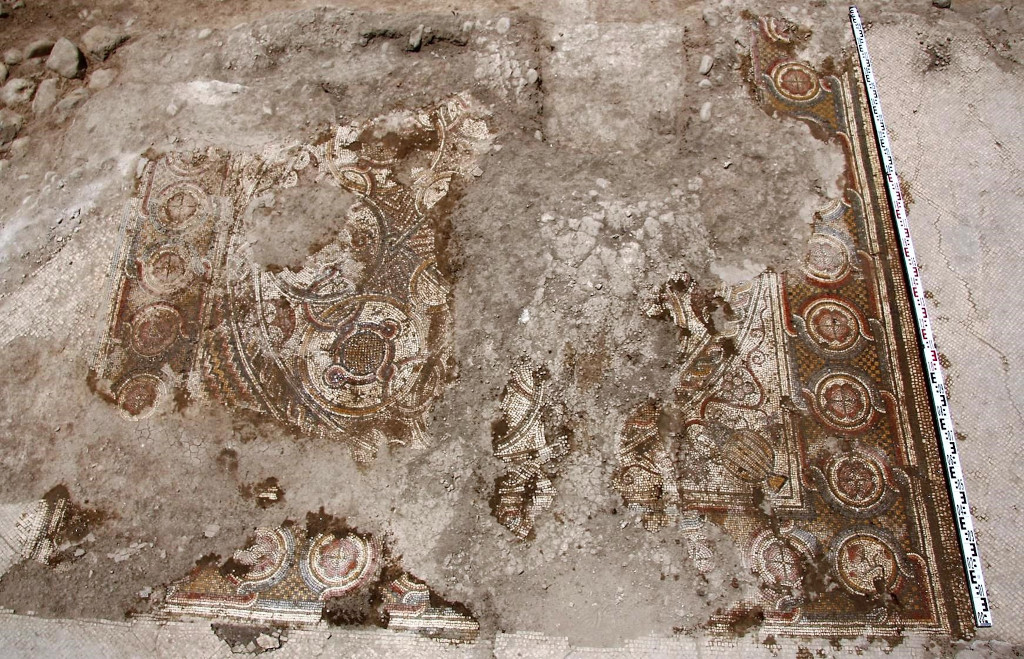
Byzantine mosaic discovered at Jericho. Courtesy of the Institute of Archaeology RAS, Moscow.
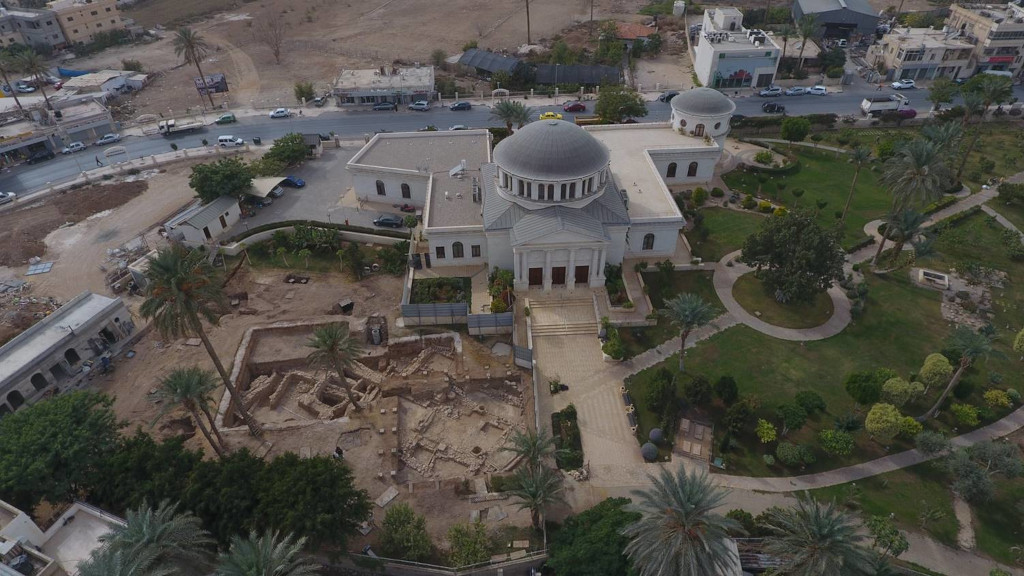
Russian museum and park complex at Jericho. Courtesy of the Institute of Archaeology RAS, Moscow.
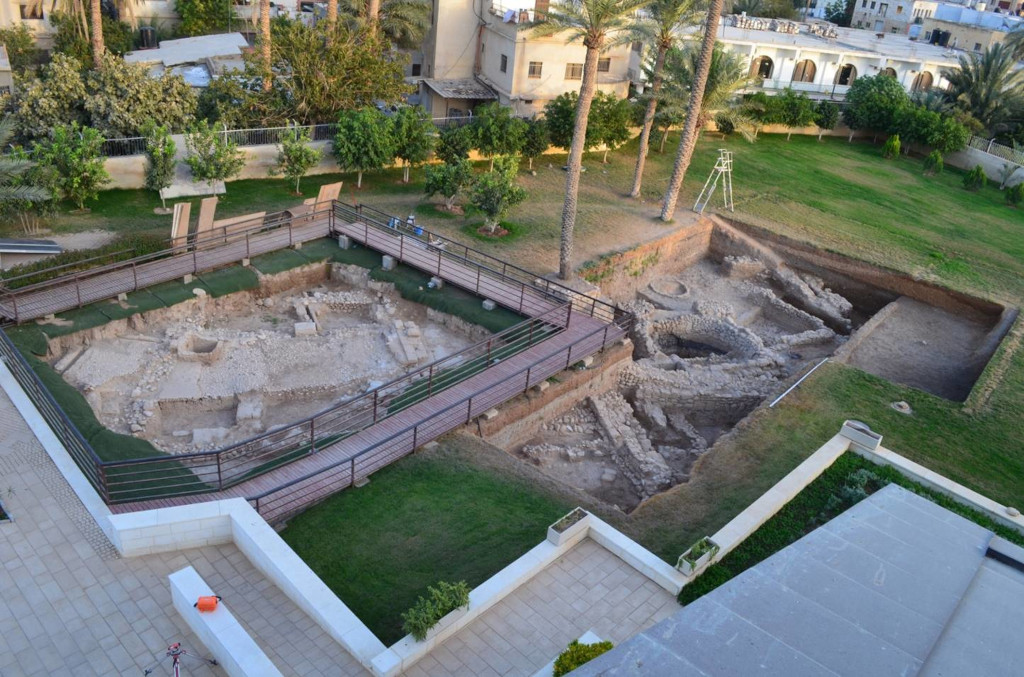
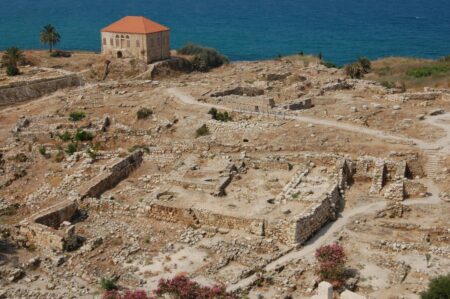
Byzantine and Early Islamic structures discovered at Jericho. Courtesy of the Institute of Archaeology RAS, Moscow.
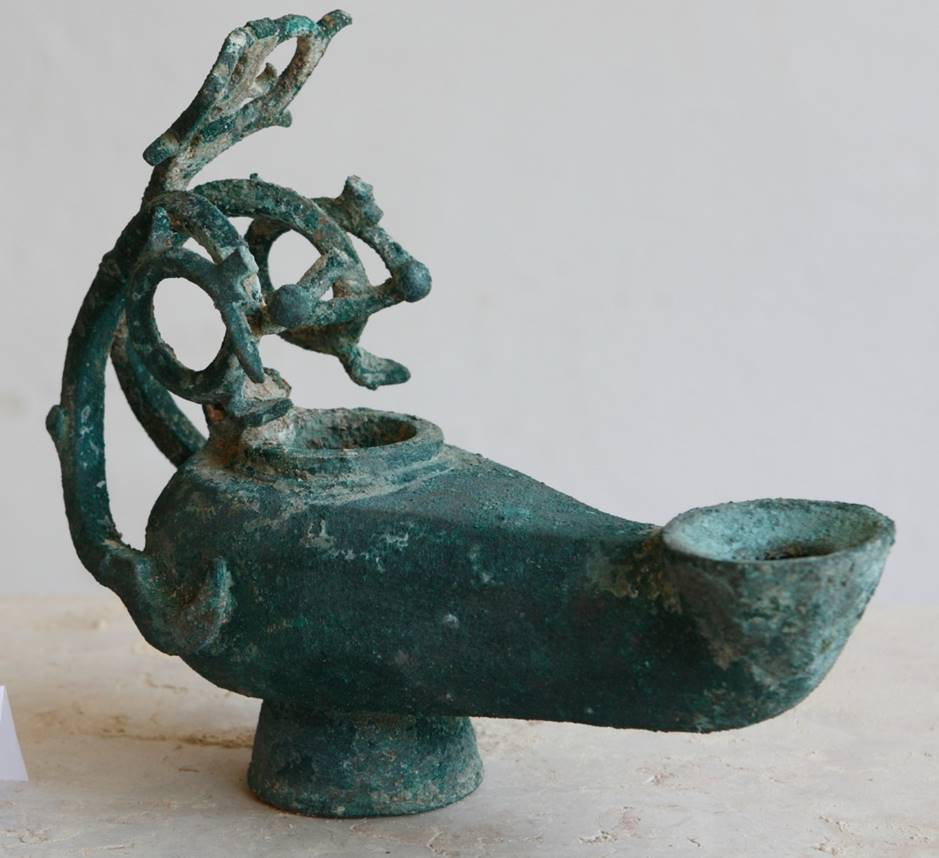
Byzantine bronze lamp from Jericho excavations. Courtesy of the Institute of Archaeology RAS, Moscow.
The first excavated site, a Russian plot in Jericho’s city center where interesting Byzantine finds had been discovered a hundred years ago, is being studied by the Institute of Archaeology of Moscow, in collaboration with Palestinian Department of Antiquities. At the center of the plot a large complex dated to the fifth–seventh centuries CE was exposed, probably built by some ecclesiastic institution. The structure was decorated with white and polychrome mosaics, and many fragments of an architectural décor, mainly column fragments made of local stone, were also discovered. South of this elaborate structure, an industrial complex was discovered dated to the Early Islamic period with various installations and a series of pottery kilns, active for at least a hundred years, as well as layers of waste and large refuse pits. The excavation at Jericho continues, hoping to reveal the complete plan of the complex and to determine its place within the urban plan of Byzantine and Early Islamic Jericho.
Post a comment