

Severed Spaces: Documenting Cultural Heritage at Risk in Iran
For scholars residing far from the Middle East — in North America, where ASOR is based, and elsewhere — whose work centers on Middle Eastern cultural heritage, the war being waged across the region feels both a world away and overwhelmingly close to home. As civilians endure death, injury, displacement, and the prospect of long-term trauma, the destruction of historic landmarks, museums, markets, schools, and neighborhoods also reveals how war tears apart the physical fabric of communal life. Some of these sites are the direct target of strikes; a greater share of the damage is collateral — the result of shockwaves and shrapnel. Watching the continuous dismantling of the beating hearts of so many urban communities — places where many of us have walked, studied, lived, and built lasting relationships—is devastating beyond words. And with all of this comes the added feeling of futility — of calling for the protection of cultural heritage, of invoking international agreements that exist precisely for moments like this one, and watching them go unheeded. To speak of cultural heritage in wartime is not to look away from human suffering, but to recognize its loss as another form of that same suffering.
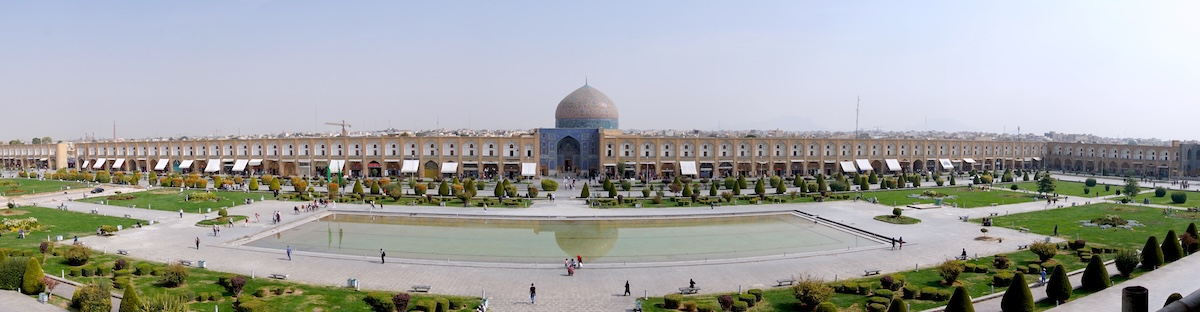
View from the Ali Qapu Palace across Naqsh-e Jahan Square toward the Sheikh Lotfollah Mosque, Isfahan, 2016. © Kiersten Neumann.
Such grief is felt differently, and more acutely, by diasporic communities for whom these landmarks, cities, and landscapes are their ancestral identity, and for whom the people moving through these brutally disrupted spaces are family and friends. Even greater still is what those presently living in the region experience — today and also the day after, when the conflict is over, the war is said to have been won, when the buildings lie in ruin and the fabric that bound those spaces together remains severed and frayed. In those instances where, after untold years and unquantifiable energy, these places are restored and rebuilt, they nevertheless stand as surrogates of what once was.
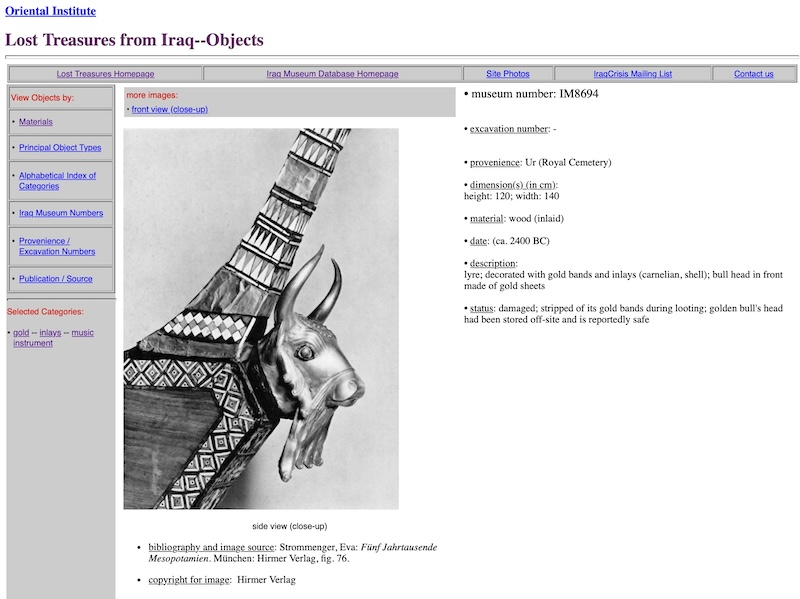
Object record from ISAC’s Lost Treasures from Iraq Database (accessed April 22, 2026).
ISAC’s engagement with Iranian cultural heritage has a history of its own — one that also stretches back nearly a century. In the late 1920s, Ernst Herzfeld—the first director of ISAC’s Persepolis Expedition (1931–1939) — worked alongside Iranian officials and the newly founded Society for National Heritage (Anjoman-e Āsār-e-Melli) to help draft Iran’s Antiquities Law of 1930, which established the legal framework for archaeological research in the country and reflected Iran’s own longstanding commitment to the preservation of its heritage — a commitment that has since withstood decades of revolution and political upheaval. In the years that followed, ISAC’s presence in Iran continued through fieldwork, research, and partnerships with Iranian colleagues and institutions. The present moment calls for that collaboration once again.
Today, ISAC’s Center for Ancient Middle Eastern Landscapes (CAMEL), in close partnership with the Society of Iranian Archaeology (SIA), is responding to the destruction of cultural heritage in Iran through a similar mode of public outreach and crowdsourcing as the Lost Treasures from Iraq webpage. The Middle East Cultural Heritage at Risk in Armed Conflict project — Cultural Heritage Watch, for short — was initiated in March 2026 to serve as a geographically grounded, publicly accessible interactive database of heritage sites and historic landmarks damaged during U.S. and Israeli airstrikes on Iran, and which remain at risk of further destruction and looting. While the project’s immediate focus is Iran, Cultural Heritage Watch is open to contributions from professional volunteer organizations and official cultural heritage bodies documenting damage in other affected countries.
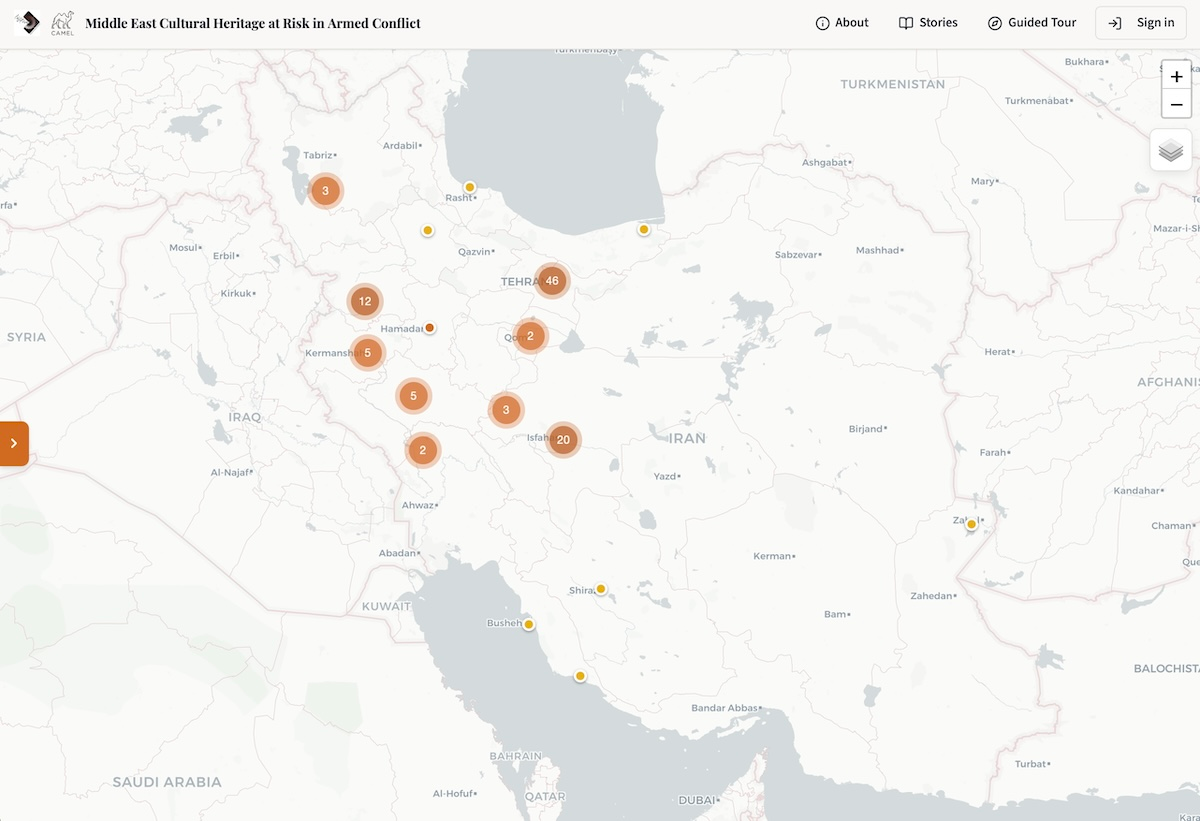
The Middle East Cultural Heritage at Risk in Armed Conflict platform, (accessed April 22, 2026).
As photographic evidence of damage to historic buildings started to trickle out, so too did statements from international heritage organizations — including UNESCO and the U.S. Committee of the Blue Shield, among others — calling on all parties to protect cultural heritage in compliance with international law. Cited with greatest frequency is the 1954 Hague Convention for the Protection of Cultural Property in the Event of Armed Conflict. Established after World War II, it was the first international treaty dedicated exclusively to safeguarding cultural heritage during war, requiring nations to prepare protections in peacetime and respect cultural property in conflict. The Convention has been recently invoked in the context of the Israel-Hezbollah war, where UNESCO — working with Lebanon’s Ministry of Culture and Directorate General of Antiquities — granted provisional enhanced protection to 39 cultural properties (in addition to the 34 already protected in 2024), along with more than $100,000 in emergency funding for urgent operations on the ground. Among the damaged sites is the ancient city of Tyre, a UNESCO World Heritage Site, where an Israeli strike in March reportedly landed within the buffer zone of its archaeological site.
It was in early March, as news of the damage in Iran began circulating, that I reached out to Mehrnoush Soroush — assistant professor of landscape archaeology and director of CAMEL — with a simple question: what could we do? Within days she had contacted Sepideh Maziar, senior researcher at Goethe University Frankfurt’s Institute of Archaeological Sciences, and together they built what became the Cultural Heritage Watch platform. I joined them, along with additional colleagues, and the work of populating it began immediately. The speed of that response, under the circumstances, and the dedication of our team to expanding it, still strikes me.
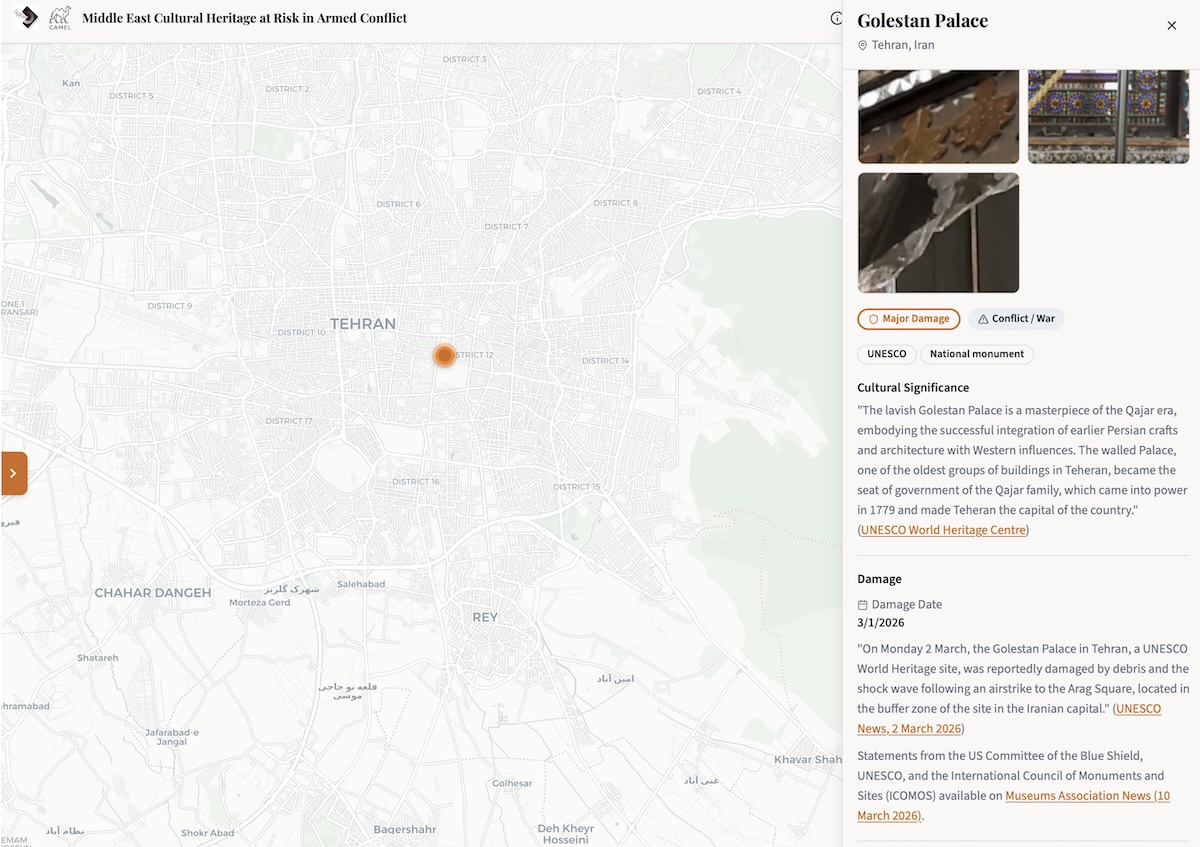
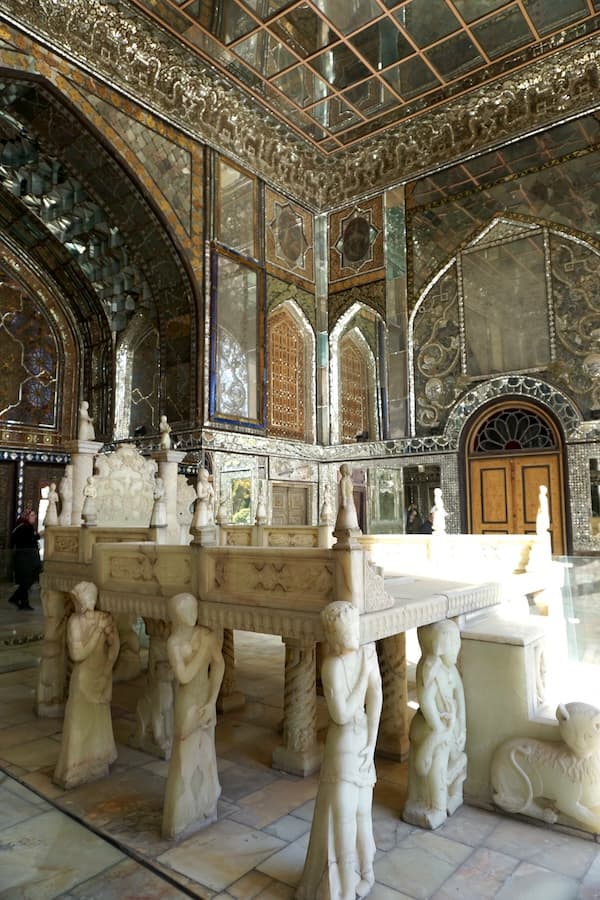
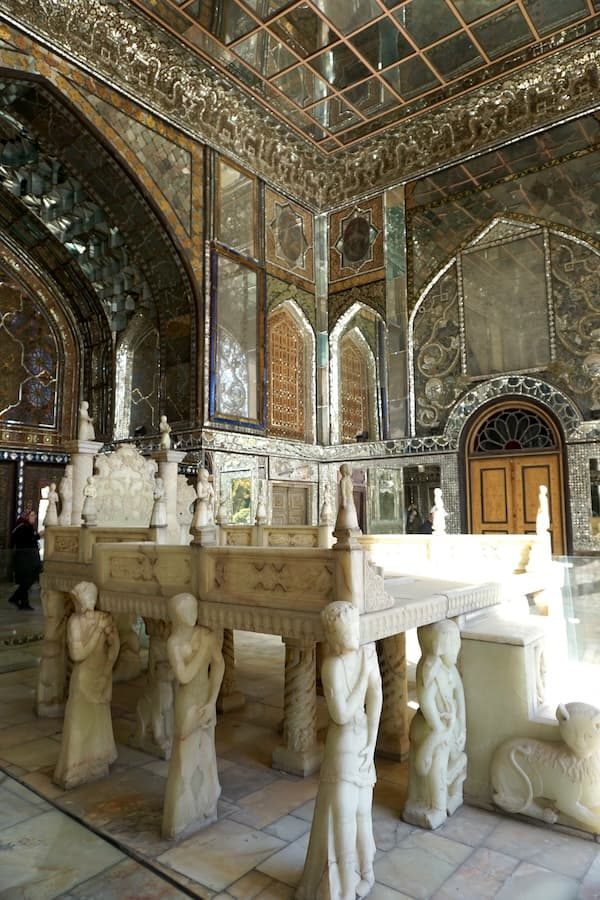
The site record for the Golestan Palace on the Cultural Heritage Watch platform (accessed April 22, 2026).
We published 70 sites within the first few days, drawing on emerging news coverage and the work of cultural heritage professionals in Iran — who continue to secure and safeguard sites and collections even as bombardment continues around them. Each site record includes location, status, threat category, cultural significance, a date and description of damage, and sourced images when available. In the weeks that followed, dozens more sites were added, and the database continues to grow, with over 100 sites recorded as this piece goes live. All major damage and destruction listings are confirmed; minor damage assessments reflect a mix of verified news reports and the best available preliminary information.
The goal is to be comprehensive, draw on multiple sources, and create a long-term record, with a provisional plan to add all recorded sites to the Endangered Archaeology in the Middle East and North Africa (EAMENA) database. Limitations are unavoidable: we include only sites that are specifically named, identifiable as national monuments or architectural landmarks, and can be accurately or approximately geolocated. Internet disruptions and the security situation continue to limit communication between organizations, and the true scale of damage is likely greater than official figures currently reflect — figures that account only for urban sites, excluding archaeological sites such as tepés and many historic places in remote areas and border regions.
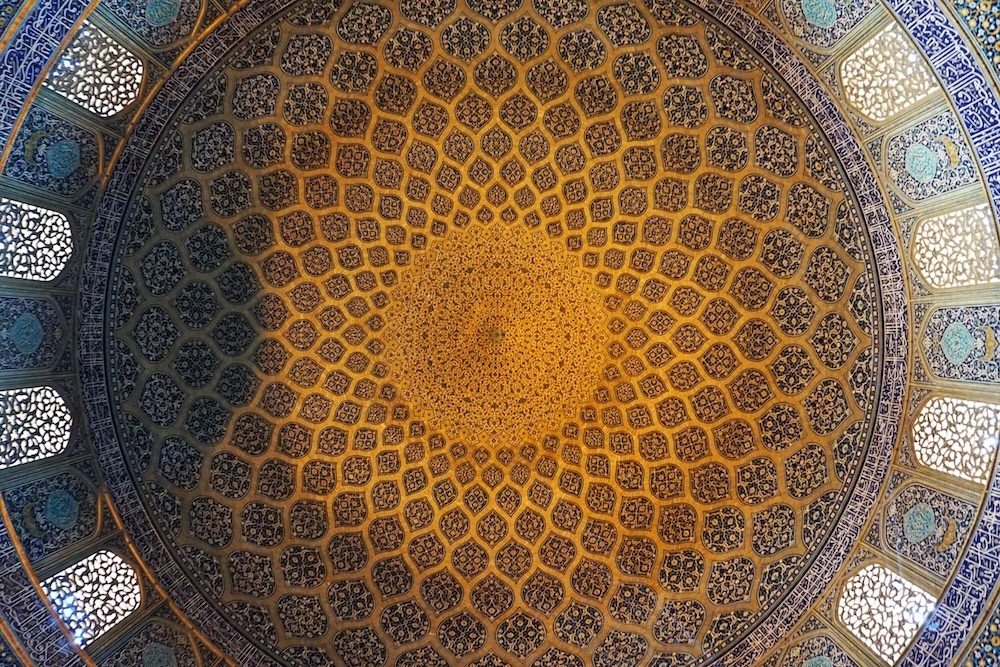
Safavid-era tile work at the Sheikh Lotfollah Mosque, Isfahan, 2016. © Kiersten Neumann.
Documentation has not been the only response. In early April, Mehrnoush led the drafting of a joint statement — since signed by more than 380 scholars worldwide — calling on the United States to honor its legal obligations as a signatory of the 1954 Convention, and pressing UNESCO and the United Nations to break what the statement describes as a troubling institutional silence and speak openly against the damage being done to Iran’s cultural heritage. In the weeks following, the World Monuments Fund also weighed in. In a news article citing damage in Iran, Lebanon, and Israel, WMF urged governments and other actors to protect civilians and cultural heritage alike, and announced its readiness to “support heritage professionals in affected countries to the fullest extent possible through our Crisis Response Program,” having “allocated $100,000 toward emergency protection and stabilization measures.”
CAMEL’s Cultural Heritage Watch is about more than sites — it’s about a nation’s memory and identity, and about the people whose daily lives and histories are inseparable from these places. A recently launched feature, called Stories, invites users from around the globe to submit their own memories of recorded sites — a childhood visit to a palace garden, a photograph taken in a mosque courtyard, a scholar’s note on why a monument mattered to their field, a reflection on a building’s place in Iran’s long history. These contributions, written and visual, build something the damage assessments alone cannot: the meaning beyond four walls. Readers with their own memories of these sites are warmly invited to contribute. At its heart, the project is also a record of cultural heritage professionals inside Iran who continue to document and protect that meaning under extraordinary conditions.
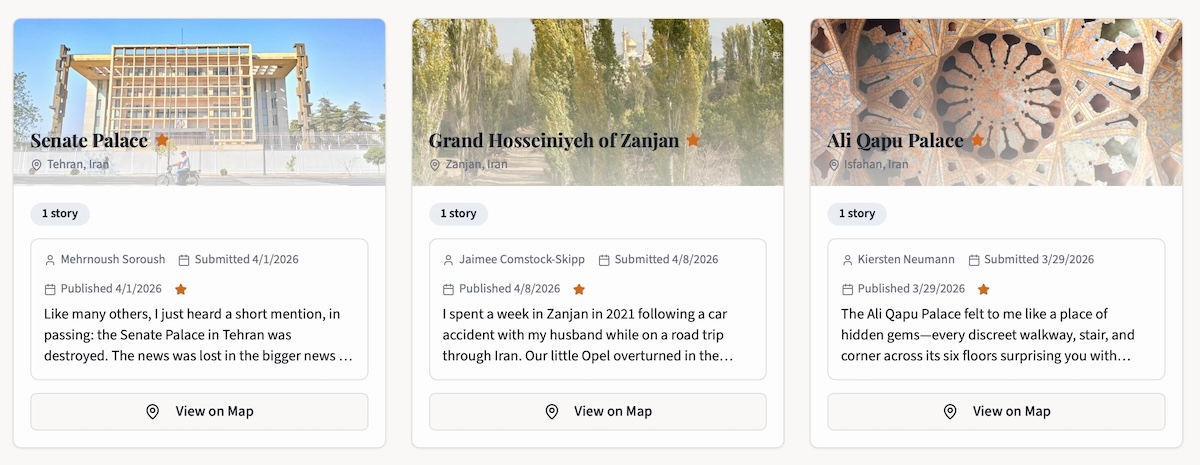
Screenshot of Stories on the Cultural Heritage Watch platform, (accessed April 22, 2026).
Documenting heritage inside Iran is paramount, but threats to cultural heritage do not stop at its borders. Conflict creates conditions in which portable antiquities move quickly and quietly to market — plundered from archaeological sites or taken from museum galleries and storerooms in times of instability. Writing in The Hill on March 21, Rick St. Hilaire, an attorney practicing cultural-heritage law and ASOR trustee, called on Washington to strengthen Iran sanctions on antiquities trafficking proactively. In sanctions environments, he argues, portable assets like antiquities “can move through markets and be converted into cash outside regulated financial channels,” which is why he urges the president to amend the Iran sanctions program under the International Emergency Economic Powers Act (IEEPA) “to declare that the illicit antiquities trade presents an ‘unusual and extraordinary threat … to the national security, foreign policy, or economy of the United States.’” This approach has precedent: the U.S. adopted comparable measures under IEEPA in 2003 to protect Iraqi cultural property.
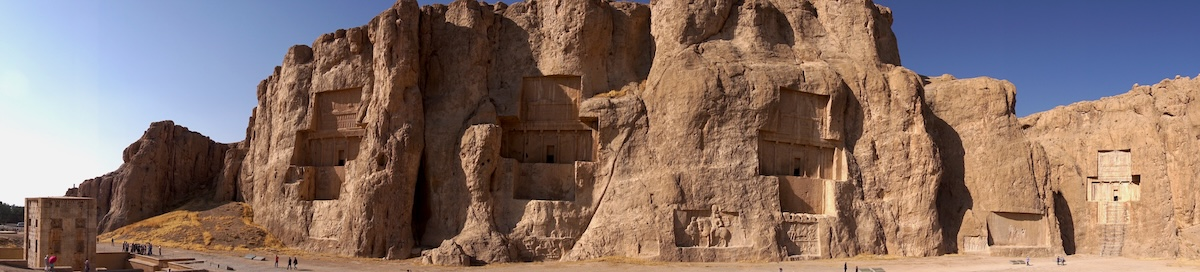
Achaemenid royal tombs and Sasanian rock reliefs at Naqsh-e Rustam, near Persepolis, Fars Province, 2016. © Kiersten Neumann.
The immediate impetus for CAMEL’s Cultural Heritage Watch platform is the current conflict in Iran, but its deeper purpose is one this community knows well: to insist that the material record through which people know themselves — and situate themselves within the world — is worth protecting, documenting, and grieving when it is lost. To look away from this, or to allow its destruction to become ordinary, is to lose something that cannot be rebuilt — only ever an echo of what once was.
Post a comment